Review
. 2022 Jun 20;15(1):216.
doi: 10.1186/s13071-022-05333-4.

Robust network stability of mosquitoes and human pathogens of medical importance

Affiliations
Review

Robust network stability of mosquitoes and human pathogens of medical importance

Donald A Yee et al. Parasit Vectors. .

Abstract

Background: The exact number of mosquito species relevant to human health is unknown, posing challenges in understanding the scope and breadth of vector-pathogen relationships, and how resilient mosquito vector-pathogen networks are to targeted eradication of vectors.

Methods: We performed an extensive literature survey to determine the associations between mosquito species and their associated pathogens of human medical importance. For each vector-pathogen association, we then determined the strength of the associations (i.e., natural infection, lab infection, lab dissemination, lab transmission, known vector). A network analysis was used to identify relationships among all pathogens and vectors. Finally, we examined how elimination of either random or targeted species affected the extinction of pathogens.

Results: We found that 88 of 3578 mosquito species (2.5%) are known vectors for 78 human disease-causing pathogens; however, an additional 243 species (6.8%) were identified as potential or likely vectors, bringing the total of all mosquitos implicated in human disease to 331 (9.3%). Network analysis revealed that known vectors and pathogens were compartmentalized, with the removal of six vectors being enough to break the network (i.e., cause a pathogen to have no vector). However, the presence of potential or likely vectors greatly increased redundancies in the network, requiring more than 41 vectors to be eliminated before breaking the network.

Conclusion: Although < 10% of mosquitoes are involved in transmitting pathogens that cause human disease, our findings point to inherent robustness in global mosquito vector-pathogen networks.

Keywords: Arbovirus; Culicidae; Extinction curves; Network analysis; Pathogen; Vector.


Conflict of interest statement

The authors declare no competing interests.

Figures
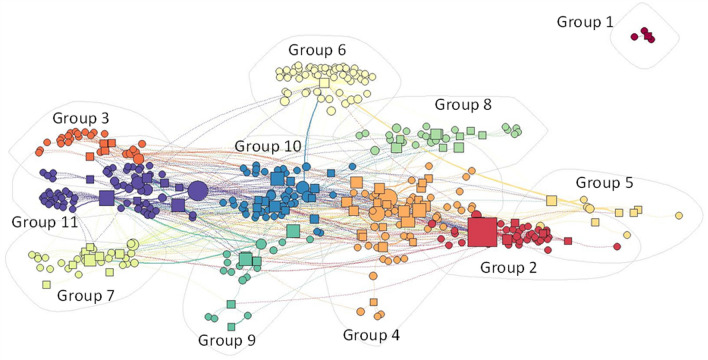
Fig. 1
Fig. 1
Full pathogen and vector network illustrating vectors and pathogens within each cluster (color-coded and outlined in light gray). The relative size of the shape indicates the betweenness centrality index (BCI) score in the full network, with circles indicating vectors and squares indicating pathogens. Larger symbols indicate higher BCI values. Lines connect vectors and pathogens, with known vectors/pathogen relationships connected by solid lines, and potential vector/pathogen relationships with dashed lines
Fig. 2
Fig. 2
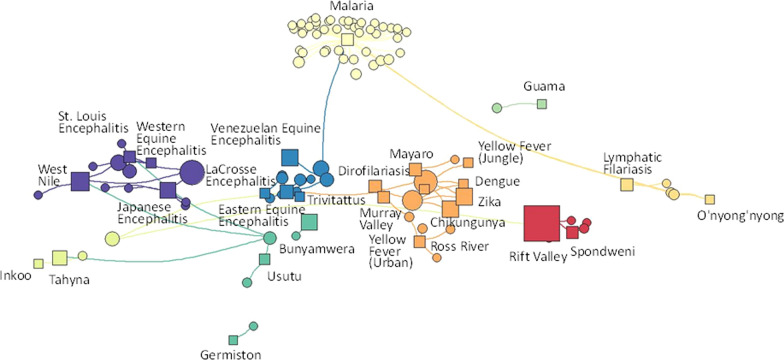
Subset of the full pathogen and vector network (as visualized in Fig. 1), showing the placement of known vectors and their pathogens. The relative size of the shape indicates the BCI score in the full network, with circles indicating vectors and squares indicating pathogens (labeled)
Fig. 3
Fig. 3
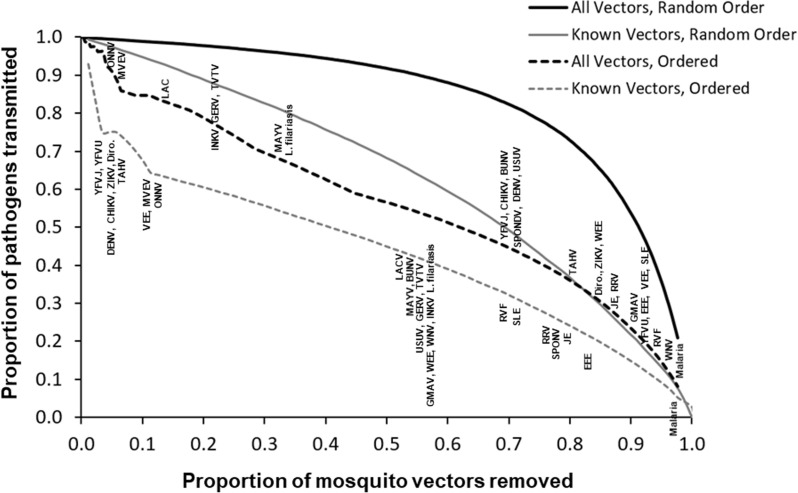
Extinction curves for the network with all vector and pathogen combinations (black lines), or only those of known vectors (gray lines) indicating the proportion of pathogens that remain transmitted as mosquito vectors are either randomly removed (solid lines) or removed in order from most to least connected (dashed lines). For the ordered removals, individual pathogens (abbreviations) are placed on the ordered lines for all vectors and known vectors where those pathogens would be removed (extinctions) from the network after removing vectors
Fig. 4
Fig. 4
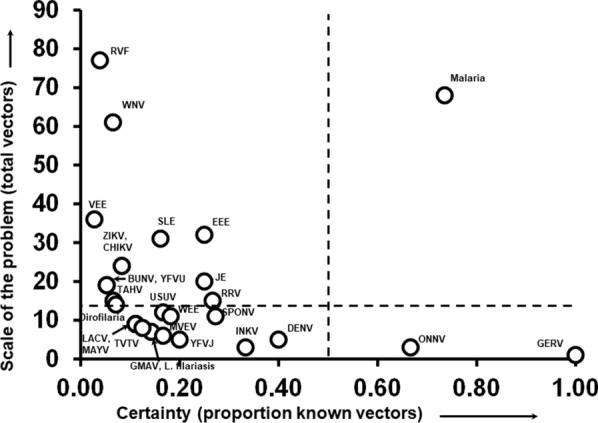
Relationship for individual pathogens of human medical importance between the total number of vectors with any association (scale of the problem) and the proportion of those that are known vectors (certainty). The dashed line for the y-axis was based on the median number of total vectors per pathogen (13), whereas the dashed line in the x-axis was placed at 0.5 to demarcate pathogens with either less than half or more than half of the vectors considered as known vectors

References

    1. Carter R, Mendis KN. Evolutionary and historical aspects of the burden of malaria. Clin Microbiol Rev. 2002;15:265–594. doi: 10.1128/CMR.15.4.564-594.2002. - DOI - PMC - PubMed
    1. Althi TS, Shocket MS, Couper LI, Nova N, Caldwell IR, Caldwell JM, et al. The influence of vector-borne disease on human history: socio-ecological mechanisms. Ecol Let. 2021;24:829–846. doi: 10.1111/ele.13675. - DOI - PMC - PubMed
    1. Löwy I. Leaking containers: success and failure in controlling the mosquito Aedes aegypti in Brazil. Am J Public Health. 2017;107:517–524. doi: 10.2105/AJPH.2017.303652. - DOI - PMC - PubMed
    1. Braak L, de Gouveia Almeida AP, Cornel AJ, Swanepoel R, de Jager C. Mosquito-borne arbovirus of African origin: review of key viruses and vectors. Parasit Vectors. 2018;11:29. doi: 10.1186/s13071-017-2559-9. - DOI - PMC - PubMed
    1. Evans MV, Dallas TA, Han BA, Murdock CC, Drake JM. Data-driven identification of potential Zika virus vectors. Elife. 2017;6:e22053. doi: 10.7554/eLife.22053. - DOI - PMC - PubMed