


Developmental trajectories of eating disorder symptoms: A longitudinal study from early adolescence to young adulthood
- PMID: 35725645
- PMCID: PMC9210773
- DOI: 10.1186/s40337-022-00603-z
Developmental trajectories of eating disorder symptoms: A longitudinal study from early adolescence to young adulthood
Abstract
Background: Adolescence is a critical period for the development of eating disorders, but data is lacking on the heterogeneity of their evolution during that time-period. Group-based trajectories can be used to understand how eating disorders emerge and evolve over time. The aim of this study was to identify groups of individuals with distinct levels of eating disorder symptoms between 12 and 20 years and the onset of different types of symptoms. We also studied sex differences in the evolution and course of eating disorder symptoms from early adolescence to adulthood.
Methods: Using archival data from the QLSCD cohort, trajectories of eating disorder symptomatology were estimated from ages 12 to 20 years using semiparametric models. These trajectories included overall eating disorder symptomatology as measured by the SCOFF (Sick, Control, One Stone, Fat, Food), sex, and symptom-specific trajectories.
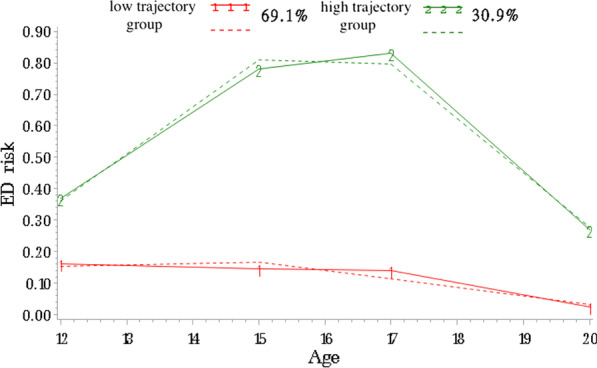
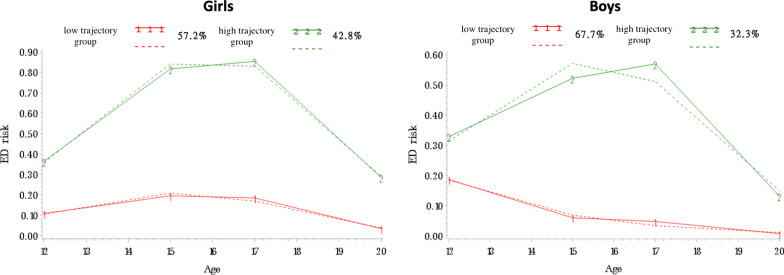
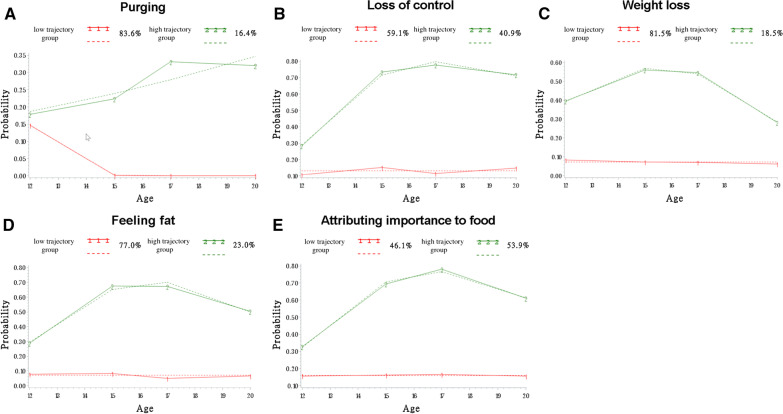
Results: Two groups of adolescents following distinct trajectories of eating disorder symptoms were identified. The first trajectory group included 30.9% of youth with sharply rising levels between 12 and 15 years, followed by high levels of symptoms between 15 and 20 years. The second trajectory group included 69.1% of youth with low and stable levels of symptoms between 12 and 20 years. Sex-specific models indicated that the proportion of girls in the high trajectory group was 1.3 times higher than the proportion of boys (42.8% girls vs. 32.3% boys). Trajectories of SCOFF items were similar for loss-of-control eating, feeling overweight, and attributing importance to food. The weight loss item had a different developmental pattern, increasing between 12 and 15 years and then decreasing between 17 and 20 years.
Conclusions: The largest increase in eating disorder symptoms in adolescence is between the ages of 12 and 15 . Yet, most prevention programs start after 15 years of age. Our findings suggest that, unlike common practices, eating disorder prevention programs should aim to start before puberty.
Keywords: Adolescence; Developmental trajectories; Eating disorder symptoms; Mental health; Sex-specificity.
Plain language summary
Eating disorders, typically involving preoccupation with eating, excessive exercise, and body image issues, are particularly common in adolescence. However, their evolution over time remains unclear as certain signs and symptoms may appear sooner than others. The current study studied the development of eating disorder symptoms in a community cohort followed from birth to adulthood. This study describes trajectories of eating disorder symptoms and risk from age 12 to 20 in both boys and girls. Results showed that the largest increase in eating disorder symptoms occurs between 12 and 15 years of age, both in overall symptomatology as well as in specific symptoms such as loss-of-control when eating, feeling overweight, and attributing importance to food. Additionally, more girls than boys appeared at risk for eating disorders, although the patterns represented by the trajectories were similar in both sexes. Our results highlight the importance of starting early prevention programs before the beginning of adolescence, when symptoms usually start to manifest.
© 2022. The Author(s).
Conflict of interest statement
The authors declare that they have no competing interests.
Figures
References
-
- Zeiler M, Waldherr K, Philipp J, Nitsch M, Dür W, Karwautz A, et al. Prevalence of eating disorder risk and associations with health-related quality of life: results from a large school-based population screening. Eur Eat Disord Rev J Eat Disord Assoc. 2016;24(1):9–18. doi: 10.1002/erv.2368. - DOI - PubMed
-
- American Psychiatric Association . Diagnostic and statistical manual of mental disorders. 5. Washington, DC: American Psychiatric Association; 2013.
-
- O’Dea J, Abraham S. Onset of disordered eating attitudes and behaviors in early adolescence: interplay of pubertal status, gender, weight, and age. Adolescence. 1999;34:671–679. - PubMed
LinkOut - more resources
Full Text Sources
