


Bone Quality in Relation to HIV and Antiretroviral Drugs
- PMID: 35726043
- PMCID: PMC10309294
- DOI: 10.1007/s11904-022-00613-1
Bone Quality in Relation to HIV and Antiretroviral Drugs
Abstract
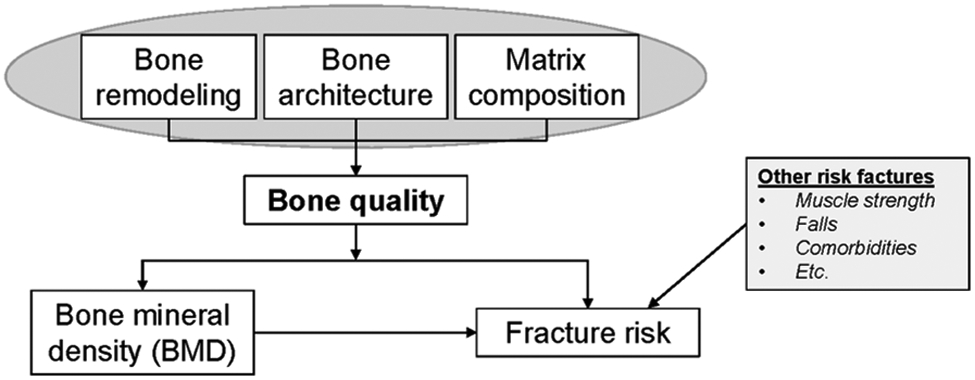
Purpose of review: People living with HIV (PLWH) are at an increased risk for osteoporosis, a disease defined by the loss of bone mineral density (BMD) and deterioration of bone quality, both of which independently contribute to an increased risk of skeletal fractures. While there is an emerging body of literature focusing on the factors that contribute to BMD loss in PLWH, the contribution of these factors to bone quality changes are less understood. The current review summarizes and critically reviews the data describing the effects of HIV, HIV disease-related factors, and antiretroviral drugs (ARVs) on bone quality.
Recent findings: The increased availability of high-resolution peripheral quantitative computed tomography has confirmed that both HIV infection and ARVs negatively affect bone architecture. There is considerably less data on their effects on bone remodeling or the composition of bone matrix. Whether changes in bone quality independently predict fracture risk, as seen in HIV-uninfected populations, is largely unknown. The available data suggests that bone quality deterioration occurs in PLWH. Future studies are needed to define which factors, viral or ARVs, contribute to loss of bone quality and which bone quality factors are most associated with increased fracture risk.
Keywords: Bone mineral density; Bone quality; Matrix composition; Microarchitecture; Remodeling.
© 2022. The Author(s), under exclusive licence to Springer Science+Business Media, LLC, part of Springer Nature.
Conflict of interest statement
Figures
Similar articles
-
Do people with HIV infection have a higher risk of fracture compared with those without HIV infection?Curr Opin HIV AIDS. 2016 May;11(3):301-5. doi: 10.1097/COH.0000000000000249. Curr Opin HIV AIDS. 2016. PMID: 26882459 Review.
-
People with HIV infection had lower bone mineral density and increased fracture risk: a meta-analysis.Arch Osteoporos. 2021 Feb 27;16(1):47. doi: 10.1007/s11657-021-00903-y. Arch Osteoporos. 2021. PMID: 33638754 Review.
-
Skeletal health in adults with HIV infection.Lancet Diabetes Endocrinol. 2015 Jan;3(1):63-74. doi: 10.1016/S2213-8587(13)70181-5. Epub 2014 Feb 26. Lancet Diabetes Endocrinol. 2015. PMID: 24731663 Review.
-
Utilization of DXA Bone Mineral Densitometry in Ontario: An Evidence-Based Analysis.Ont Health Technol Assess Ser. 2006;6(20):1-180. Epub 2006 Nov 1. Ont Health Technol Assess Ser. 2006. PMID: 23074491 Free PMC article.
-
Osteoporosis and HIV Infection.Calcif Tissue Int. 2022 May;110(5):624-640. doi: 10.1007/s00223-022-00946-4. Epub 2022 Jan 30. Calcif Tissue Int. 2022. PMID: 35098324 Free PMC article. Review.
Cited by
-
Bone Tissue Changes in Individuals Living with HIV/AIDS: The Importance of a Hierarchical Approach in Investigating Bone Fragility.J Pers Med. 2024 Jul 26;14(8):791. doi: 10.3390/jpm14080791. J Pers Med. 2024. PMID: 39201983 Free PMC article. Review.
-
Bone Loss and Fractures in Post-Menopausal Women Living with HIV: A Narrative Review.Pathogens. 2024 Sep 19;13(9):811. doi: 10.3390/pathogens13090811. Pathogens. 2024. PMID: 39339002 Free PMC article. Review.
-
Evaluation of bone mineral density and its influencing factors in patients infected with HIV under antiretroviral therapy.BMC Infect Dis. 2025 Jan 7;25(1):33. doi: 10.1186/s12879-024-10388-y. BMC Infect Dis. 2025. PMID: 39762767 Free PMC article.
-
Contribution of viral and bacterial infections to senescence and immunosenescence.Front Cell Infect Microbiol. 2023 Sep 11;13:1229098. doi: 10.3389/fcimb.2023.1229098. eCollection 2023. Front Cell Infect Microbiol. 2023. PMID: 37753486 Free PMC article. Review.
-
Bone Disease in HIV: Need for Early Diagnosis and Prevention.Life (Basel). 2024 Apr 17;14(4):522. doi: 10.3390/life14040522. Life (Basel). 2024. PMID: 38672792 Free PMC article. Review.
References
-
- Brown TT and Qaqish RB, Antiretroviral therapy and the prevalence of osteopenia and osteoporosis: a meta-analytic review. AIDS, 2006. 20(17): p. 2165–74. - PubMed
-
- Chang CJ, et al., People with HIV infection had lower bone mineral density and increased fracture risk: a meta-analysis. Arch Osteoporos, 2021. 16(1): p. 47. - PubMed
Publication types
MeSH terms
Substances
Grants and funding
LinkOut - more resources
Full Text Sources
Medical
Research Materials
