Review
. 2022 Sep 21;86(3):e0002922.
doi: 10.1128/mmbr.00029-22. Epub 2022 Jun 21.

FabT, a Bacterial Transcriptional Repressor That Limits Futile Fatty Acid Biosynthesis

Affiliations
Review

FabT, a Bacterial Transcriptional Repressor That Limits Futile Fatty Acid Biosynthesis

Clara Lambert et al. Microbiol Mol Biol Rev. .

Abstract

Phospholipids are vital membrane constituents that determine cell functions and interactions with the environment. For bacterial pathogens, rapid adjustment of phospholipid composition to changing conditions during infection can be crucial for growth and survival. Fatty acid synthesis (FASII) regulators are central to this process. This review puts the spotlight on FabT, a MarR-family regulator of FASII characterized in streptococci, enterococci, and lactococci. Roles of FabT in virulence, as reported in mouse and nonhuman primate infection models, will be discussed. We present FabT structure, the FabT regulon, and changes in FabT regulation according to growth conditions. A unique feature of FabT concerns its modulation by an unconventional corepressor, acyl-acyl-carrier protein (ACP). Some bacteria express two ACP proteins, which are distinguished by their interactions with endogenous or exogenous fatty acid sources, one of which causes strong FabT repression. This system seems to allow preferred use of environmental fatty acids, thereby saving energy by limiting futile FASII activity. Control of fabT expression and FabT activity link various metabolic pathways to FASII. The various physiological consequences of FabT loss summarized here suggest that FabT has potential as a narrow range therapeutic target.

Keywords: FabT; acyl-ACP; binding sites; fatty acid synthesis; feedback regulation; repressor.


Conflict of interest statement

The authors declare no conflict of interest.

Figures
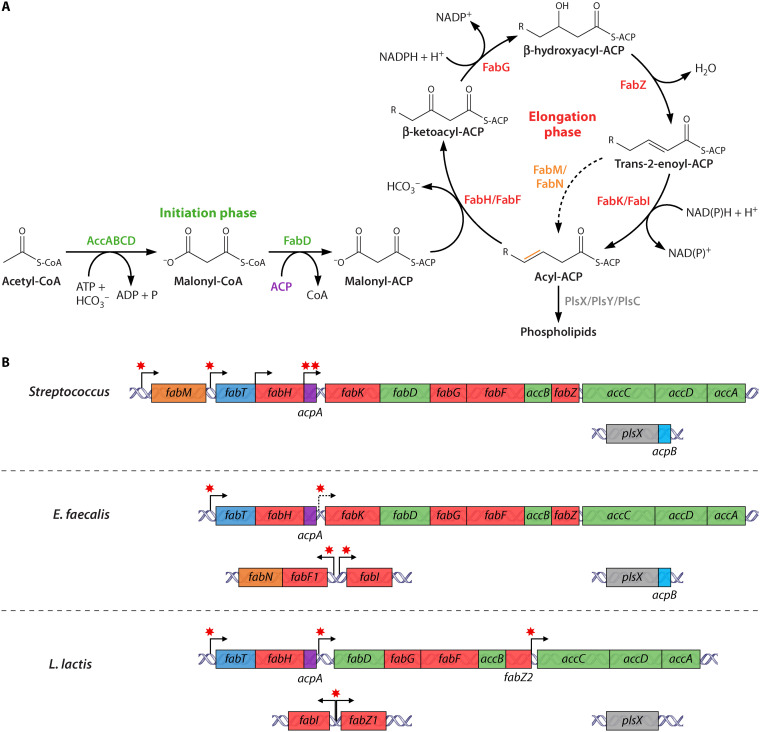
FIG 1
FIG 1
Fatty acid synthesis pathway (FASII) in food and pathogenic Lactobacillales. (A) FASII comprises a first initiation phase for precursor synthesis, followed by the recursive elongation cycle. The mature acyl-ACP products supply fatty acids for phospholipid synthesis. Products of FabM/FabN are unsaturated (in gold), while those of FabI/FabK are saturated. Proteins performing the same functions may vary according to species. (B) FASII genes are clustered in streptococci (S. pneumoniae, S. agalactiae, S. pyogenes), E. faecalis, and L. lactis, and share a similar genetic organization. Proteins (in panel A) or coding genes (in panel B) are in green for initiation functions, red for elongation functions, brown for FA-modifying functions, and gray for phospholipid synthesis functions. fabF1 is also named fabO. In panel A, the dashed arrow represents the shunt leading to unsaturated FA synthesis; in (B) dark blue, fabT; purple and light blue, acpA and acpB, respectively. Bent arrows, transcription start sites (12, 15); dashed bent arrow, suggested transcription reinitiation site (11); *FabT binding sites; a single star represents one or two closely localized consensus sequences.
FIG 2
FIG 2
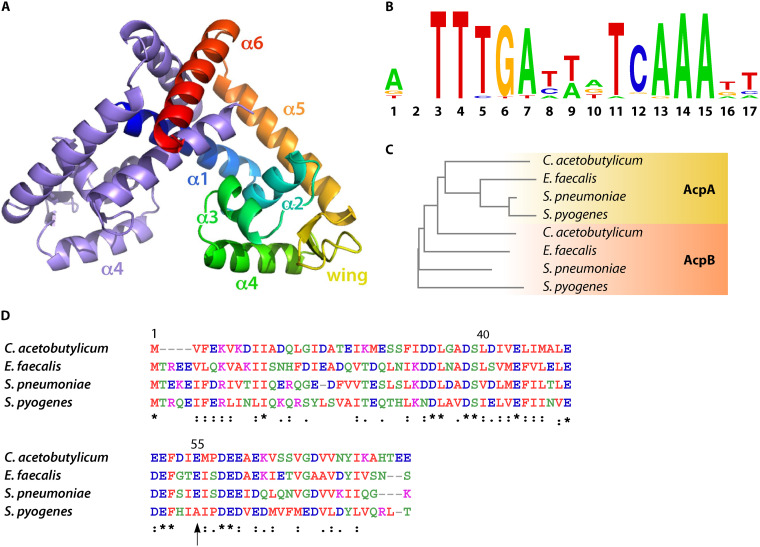
Structural features of FabT, the ACP corepressor, and the FabT-DNA binding motif. (A) Overall structure of MarR family member dimer; one monomer is represented multicolored and the other in blue. Reprinted from reference with permission. (B) FabT DNA binding motif; top, calculated from 56 FabT DNA binding sequences (https://regprecise.lbl.gov/regulog.jsp?regulog_id=3571). The relative size of letters corresponds to the relative frequency at which each nucleotide is present. (C) Phylogenetic neighbor-joining tree obtained from a multiple sequence alignment carried out using Clustal W (1.83). Branch lengths correspond to: C. acetobutylicum AcpA, 0.28257; E. faecalis AcpA, 0.19187; S. pneumoniae, AcpA 0.0325; S. pyogenes, AcpA 0.04858; C. acetobutylicum AcpB, 0.25594; E. faecalis AcpB, 0.29157; S. pneumonia, AcpB, 0.25143; S. pyogenes, AcpA, 0.35383. (D) AcpB alignment; multiple sequence alignment was carried out using Clustal W (1.83) (unpublished results), color code follows functional classification; *, identical in all four species: the same structural class; vertical arrow highlights amino acid residue 55, which is adjacent to the FabT-AcpB binding (32) but is not conserved in S. pyogenes.
FIG 3
FIG 3
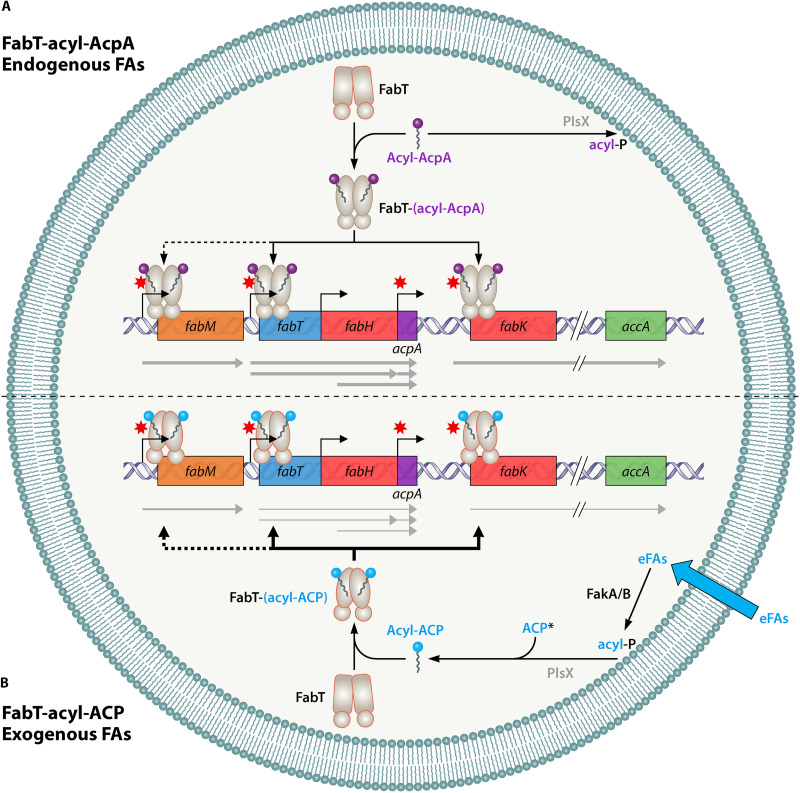
Model of the FabT repression mechanism in S. pneumoniae and E. faecalis. (A) Endogenous fatty acid (FA) synthesis: an excess of FA synthesis generates acyl-AcpA, which binds to FabT; the complex binds with low affinity to the promoter regions of its target transcriptional units, leading to weak repression of FabT directly controlled genes, including acpA. Acyl-AcpA is also a substrate for the bidirectional glycerol-3-phosphate acyltransferase PlsX, leading to phospholipid synthesis (not shown). The minor apparent regulatory role of FabT when interacting with acyl-AcpA contrasts with its prominent role when exogenous FAs are present, e.g., as is common in vivo. (B) Exogenous FA utilization: entering FAs may be phosphorylated by fatty acid kinase complex FakA coupled to one of the FA-binding FakB subunits, each of which has FA preferences (22). Acyl-P is then converted to acyl-AcpB or AcpA (36) by a reverse PlsX reaction. Acyl-ACP binds to FabT, and the complex binds with high affinity to the promoter regions of its transcriptional unit targets, strongly repressing gene expression. The information contained in this figure corresponds to results shown in at least one species. Gray arrows under the genes represent the various transcriptional units described; their thickness symbolizes the level of transcription. Black arrows above or below the genes represent the binding of acyl-Acp to promoter regions; their thickness indicates repression efficiency; dotted arrows indicate that the repression level is species dependent. Note that only FabT-related functions are indicated. eFAs: exogenous FAs; acyl-P, acyl-phosphate. Note that acyl-AcpA is the FASII product; both acyl-AcpB and acyl-AcpA appear to be involved in eFA incorporation and reverse activity of PlsX.

References

    1. Zhang YM, Rock CO. 2008. Membrane lipid homeostasis in bacteria. Nat Rev Microbiol 6:222–233. 10.1038/nrmicro1839. - DOI - PubMed
    1. Grogan DW, Cronan JE, Jr.. 1997. Cyclopropane ring formation in membrane lipids of bacteria. Microbiol Mol Biol Rev 61:429–441. 10.1128/mmbr.61.4.429-441.1997. - DOI - PMC - PubMed
    1. Osterman A, Overbeek R. 2003. Missing genes in metabolic pathways: a comparative genomics approach. Curr Opin Chem Biol 7:238–251. 10.1016/S1367-5931(03)00027-9. - DOI - PubMed
    1. Cronan JE. 2020. The Escherichia coli FadR transcription factor: too much of a good thing? Mol Microbiol 15:1080–1085. 10.1111/mmi.14663. - DOI - PMC - PubMed
    1. Zhang YM, Rock CO. 2009. Transcriptional regulation in bacterial membrane lipid synthesis. J Lipid Res 50 Suppl:S115–S119. 10.1194/jlr.R800046-JLR200. - DOI - PMC - PubMed

Publication types

LinkOut - more resources