


Patterns of social mixing in England changed in line with restrictions during the COVID-19 pandemic (September 2020 to April 2022)
- PMID: 35729196
- PMCID: PMC9212204
- DOI: 10.1038/s41598-022-14431-3
Patterns of social mixing in England changed in line with restrictions during the COVID-19 pandemic (September 2020 to April 2022)
Abstract
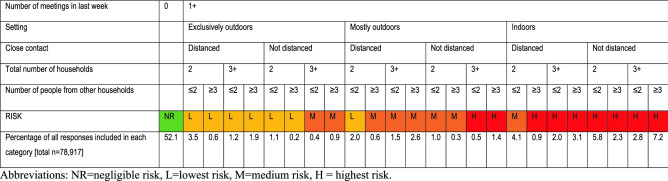
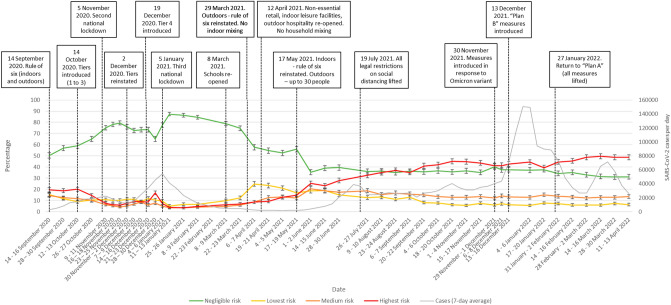
Social mixing contributes to the transmission of SARS-CoV-2. We developed a composite measure for risky social mixing, investigating changes during the pandemic and factors associated with risky mixing. Forty-five waves of online cross-sectional surveys were used (n = 78,917 responses; 14 September 2020 to 13 April 2022). We investigated socio-demographic, contextual and psychological factors associated with engaging in highest risk social mixing in England at seven timepoints. Patterns of social mixing varied over time, broadly in line with changes in restrictions. Engaging in highest risk social mixing was associated with being younger, less worried about COVID-19, perceiving a lower risk of COVID-19, perceiving COVID-19 to be a less severe illness, thinking the risks of COVID-19 were being exaggerated, not agreeing that one's personal behaviour had an impact on how COVID-19 spreads, and not agreeing that information from the UK Government about COVID-19 can be trusted. Our composite measure for risky social mixing varied in line with restrictions in place at the time of data collection, providing some validation of the measure. While messages targeting psychological factors may reduce higher risk social mixing, achieving a large change in risky social mixing in a short space of time may necessitate a reimposition of restrictions.
© 2022. The Author(s).
Conflict of interest statement
All authors had financial support from NIHR for the submitted work; RA is an employee of the UK Health Security Agency; HWWP has received additional salary support from Public Health England and NHS England; HWWP receives consultancy fees to his employer from Ipsos MORI and has a PhD student who works at and has fees paid by Astra Zeneca; NTF is a participant of an independent group advising NHS Digital on the release of patient data. At the time of writing GJR is acting as an expert witness in an unrelated case involving Bayer PLC, supported by LS. All authors were participants of the UK’s Scientific Advisory Group for Emergencies or its subgroups.
Figures
References
-
- PHE Transmission Group. Factors Contributing to Risk of SARS-CoV2 Transmission Associated with Various Settings. https://assets.publishing.service.gov.uk/government/uploads/system/uploa... (2020). Accessed 12 Oct 2021.
-
- Cabinet Office. COVID-19 Response—Spring 2021 (Summary). https://www.gov.uk/government/publications/covid-19-response-spring-2021... (2021). Accessed 12 Oct 2021.
Publication types
MeSH terms
Grants and funding
LinkOut - more resources
Full Text Sources
Medical
Miscellaneous
