. 2022 Jun 21;22(1):241.
doi: 10.1186/s12890-022-02039-2.

Beneficial short-term effect of autogenic drainage on peripheral resistance in childhood cystic fibrosis disease

Affiliations

Beneficial short-term effect of autogenic drainage on peripheral resistance in childhood cystic fibrosis disease

Plamen Bokov et al. BMC Pulm Med. .

Abstract

Background: Airway clearance techniques are supposed to be a necessary adjunct for the enhancement of impaired peripheral clearance in cystic fibrosis (CF). The objective was to assess the effect of one physiotherapy session (autogenic drainage: AD) on mucus clearance (sputum wet weight) and impulse oscillometry system (IOS) indices, including those obtained from extended Resistance-Inertance-Compliance (eRIC) modelling, considering the degree of bronchial congestion.

Methods: Thirty children with CF (median age: 12.7 years) in a stable condition prospectively underwent IOS measurements at baseline and after AD. They were divided in two groups: with (visual analog scale of bronchial congestion by the physiotherapist ≥ 5/10) and without (scale < 5/10) bronchial congestion. Paired-comparison of the effects of AD on airway resistance measurements was done with Wilcoxon test.

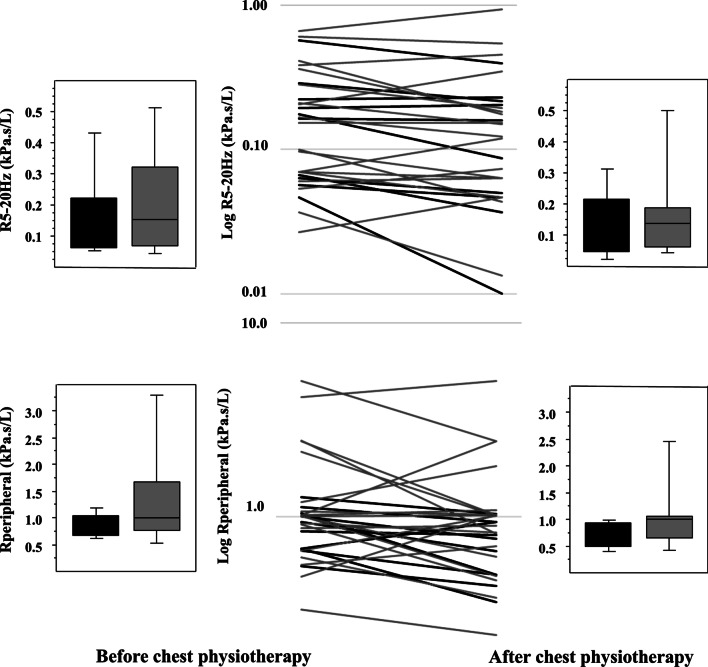
Results: The congestion scale correlated with the wet weight of sputum production during the session (Pearson test: p < 0.0001, R = 0.66). Ten children had bronchial congestion and 20 were without congestion. In the whole group, R5-20 Hz significantly decreased after AD (P = 0.049), which was related to a decrease in the children with congestion (P = 0.025), whereas it was not significantly modified in the children without congestion (P = 0.327). The eRIC model allowed the calculation of the peripheral resistance of the respiratory system, which also decreased in the children with congestion (P = 0.037), however, not modified in the children without congestion (P = 0.390).

Conclusion: One session of autogenic drainage has the ability to decrease peripheral resistance obtained from IOS measurements, more specifically in children with CF with moderate to severe bronchial congestion.

Trial registration: ClinicalTrials.gov Identifier: NCT04094441.

Keywords: Chest physiotherapy; Childhood; Cystic fibrosis; Impulse oscillometry; Lung model.


Conflict of interest statement

The authors declare that they have no competing interests.

Figures
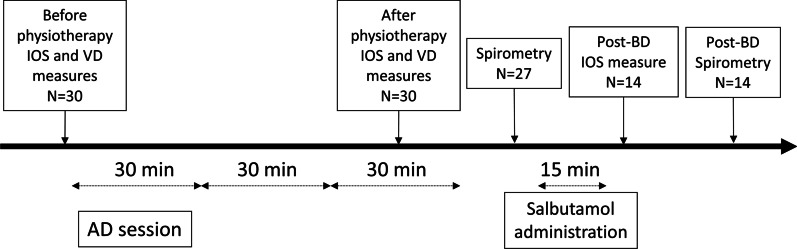
Fig. 1
Fig. 1
Timeline of study procedures. IOS denotes impulse oscillometry system; VD denotes anatomical dead space; AD denotes autogenic drainage. 27/30 children performed spirometry after the AD session and among them 14 had a bronchodilator test (salbutamol 400 µg) due to airflow limitation
Fig. 2
Fig. 2
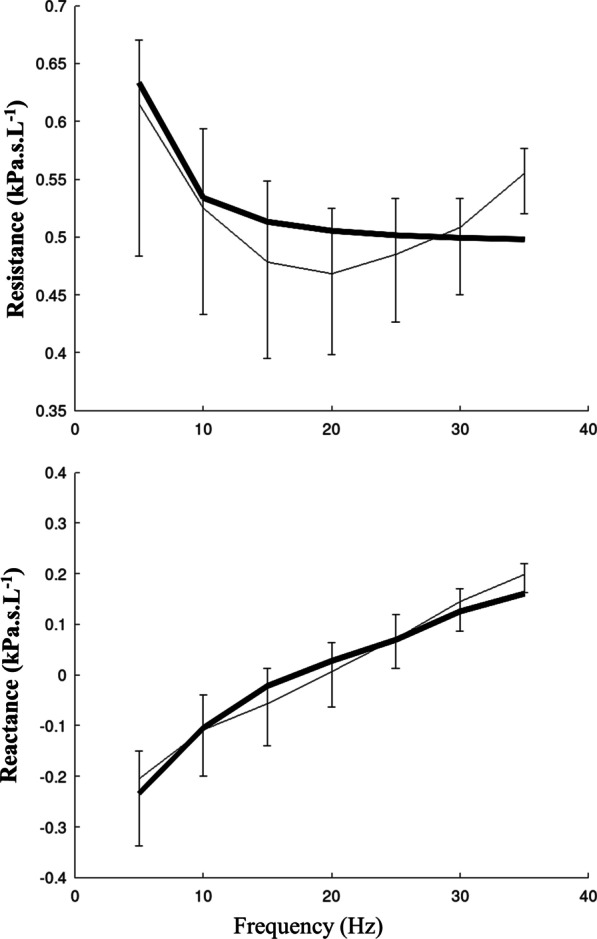
The impedance spectra obtained by fitting the model. Respiratory system resistance (upper panel) and reactance (lower panel) obtained by fitting the model (thick solid lines) to the baseline data of the experimental measurements represented by the median values and the 25th and 75th percentiles for each frequency (thin lines). Overall, the model adequately fitted experimental data
Fig. 3
Fig. 3
Indices of peripheral resistance assessed before and after AD. The upper panels describe R5-R20Hz resistance of the respiratory system before (left panel) and after (right panel) a single AD session. Box and whisker plots show median, 25th and 75th percentiles, and 10th and 90th percentiles in children with CF with (dark grey) and without (light grey) bronchial congestion. The middle panel describes individual data of the 30 children: black lines for the 10 children with bronchial congestion and light grey lines for the 20 children without bronchial congestion. To better highlight individual changes of R5–20 Hz, the Y-axis is a logarithmic base 10 scale. A significant decrease in the raw value of R5–20 Hz was observed in the children with bronchial congestion (P = 0.025) whereas it was not significant in those without congestion (P = 0.327). The lower panels describe RperipheralRS computed using eRIC model before (left panel) and after (right panel) a single AD session. Box and whisker plots show median, 25th and 75th percentiles, and 10th and 90th percentiles in children with CF with (dark grey) and without (light grey) bronchial congestion. The middle panel describes individual data of the 30 children: black lines for the 10 children with bronchial congestion and light grey lines for the 20 children without bronchial congestion. To better highlight individual changes of RperipheralRS, the Y-axis is a logarithmic base 10 scale. A significant decrease in RperipheralRS (P = 0.037) is evidenced after physiotherapy in the children with bronchial congestion, which was not significant in those without congestion (P = 0.390)

References

    1. Kirilloff LH, Owens GR, Rogers RM, Mazzocco MC. Does chest physical therapy work? Chest. 1985;88:436–444. doi: 10.1378/chest.88.3.436. - DOI - PubMed
    1. Bateman JR, Newman SP, Daunt KM, Sheahan NF, Pavia D, Clarke SW. Is cough as effective as chest physiotherapy in the removal of excessive tracheobronchial secretions? Thorax. 1981;36:683–687. doi: 10.1136/thx.36.9.683. - DOI - PMC - PubMed
    1. Warnock L, Gates A. Chest physiotherapy compared to no chest physiotherapy for cystic fibrosis. Cochrane Database Syst Rev. 2015;2015:CD001401. - PMC - PubMed
    1. Castellani C, Duff AJA, Bell SC, Heijerman HGM, Munck A, Ratjen F, et al. ECFS best practice guidelines: the 2018 revision. J Cyst Fibros. 2018;17:153–178. doi: 10.1016/j.jcf.2018.02.006. - DOI - PubMed
    1. Button BM, Wilson C, Dentice R, Cox NS, Middleton A, Tannenbaum E, et al. Physiotherapy for cystic fibrosis in Australia and New Zealand: a clinical practice guideline. Respirology. 2016;21:656–667. doi: 10.1111/resp.12764. - DOI - PMC - PubMed

Associated data