. 2022 Jul 15;11(7):2496-2503.
doi: 10.1021/acssynbio.2c00137. Epub 2022 Jun 22.

Efficient CRISPR/Cas12a-Based Genome-Editing Toolbox for Metabolic Engineering in Methanococcus maripaludis

Affiliations

Efficient CRISPR/Cas12a-Based Genome-Editing Toolbox for Metabolic Engineering in Methanococcus maripaludis

Jichen Bao et al. ACS Synth Biol. .

Abstract

The rapid-growing and genetically tractable methanogen Methanococcus maripaludis is a promising host organism for the biotechnological conversion of carbon dioxide and renewable hydrogen to fuels and value-added products. Expansion of its product scope through metabolic engineering necessitates reliable and efficient genetic tools, particularly for genome edits that affect the primary metabolism and cell growth. Here, we have designed a genome-editing toolbox by utilizing Cas12a from Lachnospiraceae bacterium ND2006 (LbCas12a) in combination with the homology-directed repair machinery endogenously present in M. maripaludis. This toolbox can delete target genes with a success rate of up to 95%, despite the hyperpolyploidy of M. maripaludis. For the purpose of demonstrating a large deletion, the M. maripaludis flagellum operon (∼8.9 kbp) was replaced by the Escherichia coli β-glucuronidase gene. To facilitate metabolic engineering and flux balancing in M. maripaludis, the relative strength of 15 different promoters was quantified in the presence of two common growth substrates, either formate or carbon dioxide and hydrogen. This CRISPR/LbCas12a toolbox can be regarded as a reliable and quick method for genome editing in a methanogen.

Keywords: CRISPR/Cas12a; Methanococcus maripaludis; genome editing; metabolic engineering; methanogens; synthetic biology.


Conflict of interest statement

The authors declare no competing financial interest.

Figures
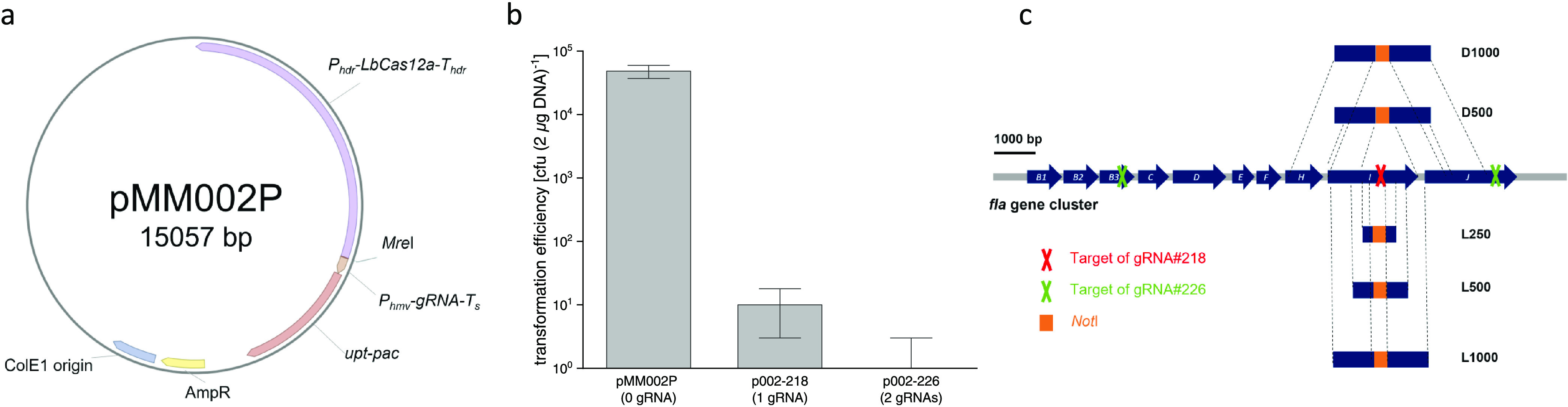
Figure 1
Figure 1
General features of the CRISPR/LbCas12a genome editing. (a) Genetic map of the CRISPR/LbCas12a pMM002P plasmid. The M. maripaludis S2 uracil phosphoribosyltransferase gene (upt), which serves as a counter-selective marker, and the codon-optimized puromycin N-acetyltransferase gene (pac) are coexpressed via the Pmcr promoter. LbCas12a expression is driven by the Phdr promoter from Methanococcus voltae A3. gRNA expression is driven by the M. voltae A3 Phmv histone promoter. Two PaqCI sites between the direct repeat sequence and the synthetic terminator in the opposite direction for spacer fusion is used for gRNA insertion (not displayed). The gRNA of the plasmid pMM002P that contains two PaqCI sites does not target the chromosome. An MreI restriction site assigned between the gRNA and Cas elements is used for RF insertion. (b) CRISPR/LbCas12a triggered DSBs. Shown are the transformation efficiencies [cfu (2 μg DNA)−1] for the CRISPR/LbCas12a pMM002P plasmids with one, two, or no gRNAs that were used to transform M. maripaludis. Error bars represent the standard deviation of the values obtained for the transformation efficiency (n = 3). (c) Schematic outline of the repair fragment edits. A NotI site is placed between the two homologous arms.
Figure 2
Figure 2
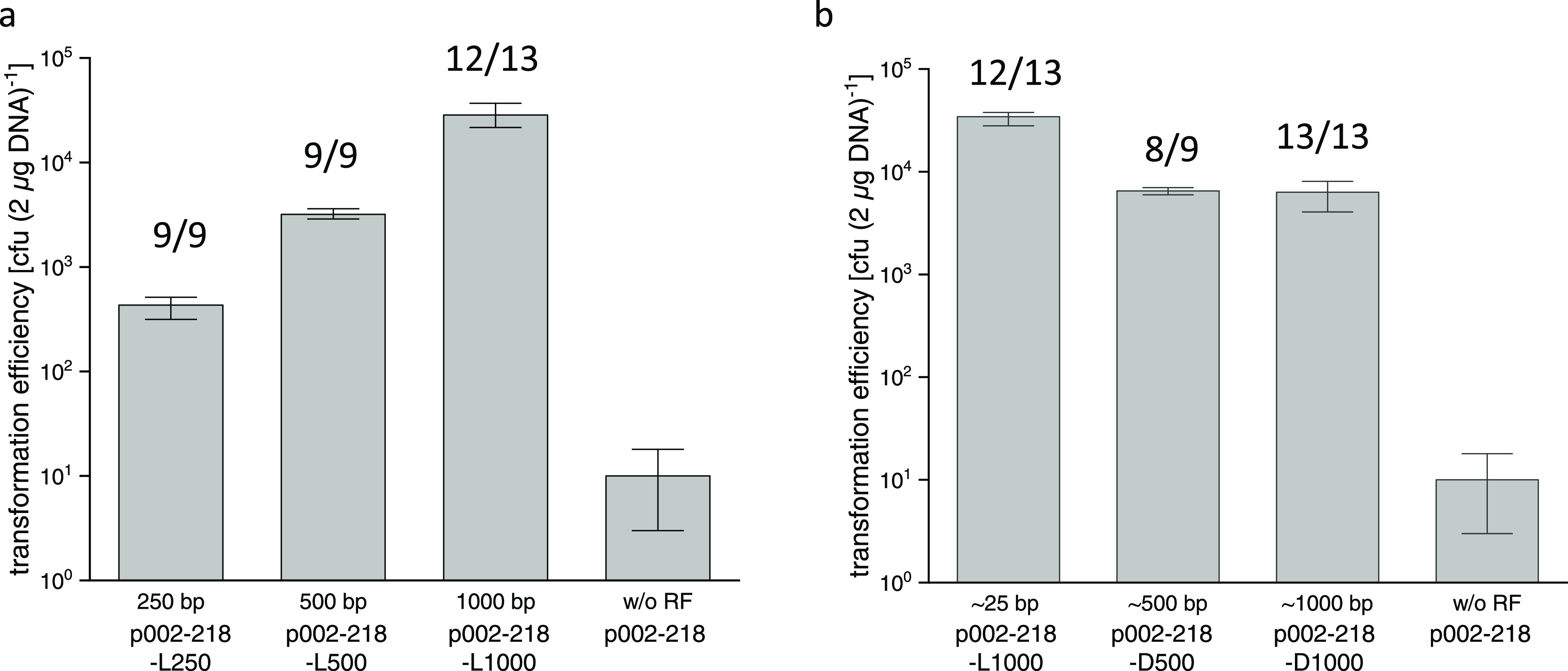
Effect on transformation and genome-editing (positive rates) efficiencies when the length and position of the RF are modified. Transformation efficiency and positive rate in relation to the length and position of the RF. Shown are the transformation efficiencies [cfu (2 μg DNA)−1] for the CRISPR/LbCas12a pMM002P-derived plasmids that were used to transform M. maripaludis. (a) CRISPR/LbCas12a plasmid p002-218, in which the lengths of the homology arms flanking the RF are 250, 500, and 1000 bp (p002-218-L250, p002-218-L500, and p002-218-L1000, respectively). The distance from the RF to DSB for all plasmids is ∼25 bp. (b) CRISPR/LbCas12a plasmid p002-218 with 1000 bp homologous arms, in which the distance between the RF and the DSB is ∼25, ∼500, and ∼1000 bp (p002-218-L1000, p002-218-D500, and p002-218-D1000, respectively). p002-218 without the RF is included as a control. Error bars represent the standard deviation of the values obtained for the transformation efficiency (n = 3). Positive rates representing the fraction of correctly edited colonies per colonies tested by PCR are shown for all plasmid transformations (numbers above bars).
Figure 3
Figure 3
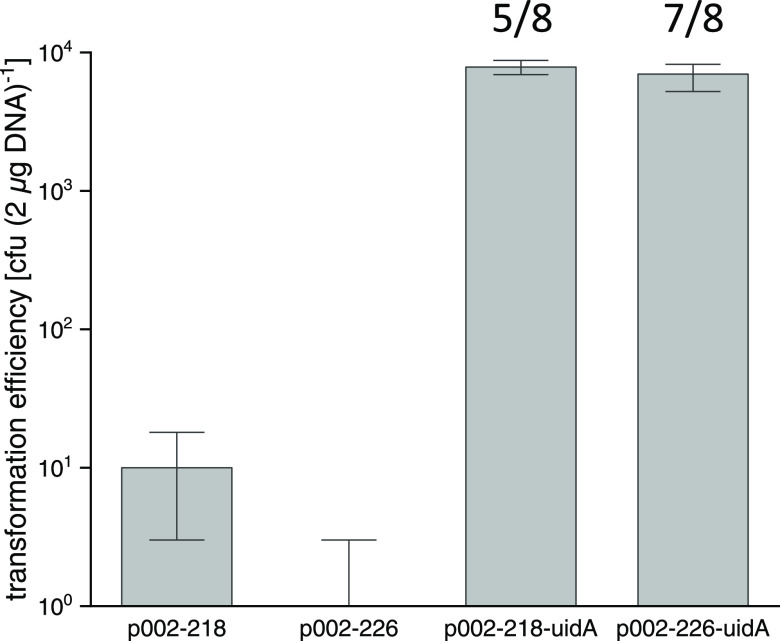
CRISPR/LbCas12a genome-edited replacement of the M. maripaludis flagellum operon with the E. coli β-glucuronidase gene (uidA). Shown are the transformation efficiencies [cfu (2 μg DNA)−1] for the CRISPR/LbCas12a pMM002P-derived plasmids that were used to transform M. maripaludis. Plasmids p002-218 and p002-226 (controls) express one and two gRNAs, respectively, and do not contain the RF. Plasmids p002-218-uidA and p002-226-uidA express one and two gRNAs, respectively, but contain the RF. Error bars represent the standard deviation of the values obtained for the transformation efficiency (n = 3). Positive rates representing the fraction of correctly edited colonies per colonies tested by PCR are shown for the p002-218-uidA and p002-226-uidA transformations (numbers above bars).
Figure 4
Figure 4
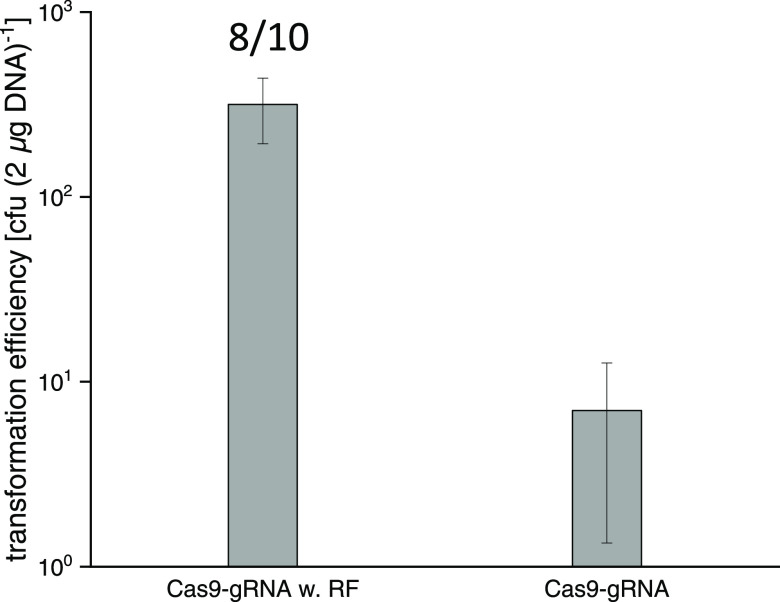
CRISPR/SpCas9 genome-edited replacement of the M. maripaludis alanine dehydrogenase–alanine racemase (ald-alr 1.9 kbp) genes with a 4.2 kbp fragment. Shown are the transformation efficiencies [cfu (2 μg DNA)−1] for the CRISPR/SpCas9 plasmids that were used to transform M. maripaludis. The left bar indicates that the cells were transformed with a suicide plasmid containing the integration cassette and a CRISPR/SpCas9 plasmid carrying a gRNA targeting to the ald-alr. The right bar indicates that the cells were only transformed with a CRISPR/SpCas9 plasmid carrying a gRNA targeting to the ald-alr. Error bars represent the standard deviation of the values obtained for the transformation efficiency (n = 3). The positive rate representing the fraction of correctly edited colonies per colonies tested by PCR is shown for the transformations (numbers above the left bar).
Figure 5
Figure 5
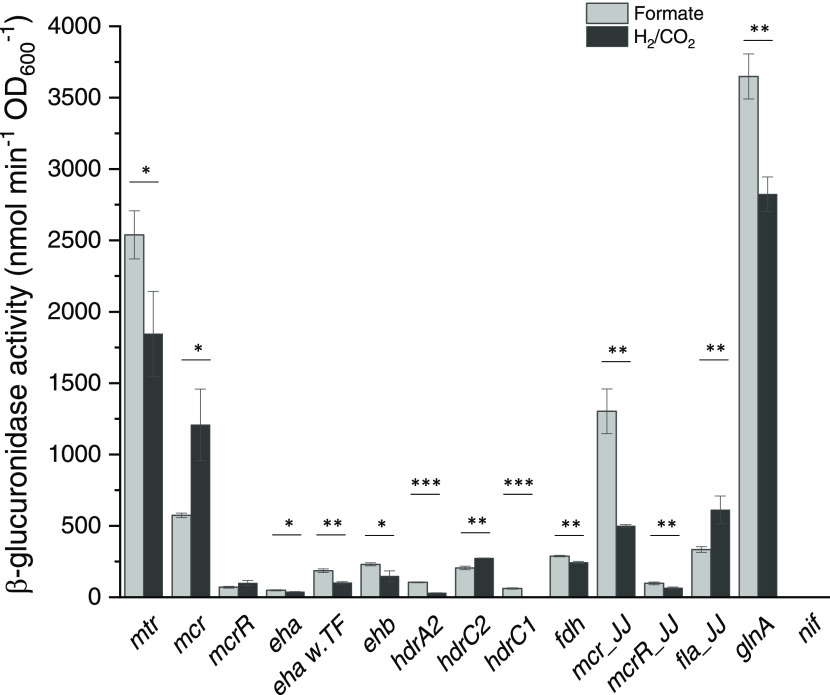
Quantification of promoter strengths for the two different growth conditions formate or H2/CO2, measured after the culture has reached OD600 = ca. 0.5. The promoters mcr_JJ, mcrR_JJ, and fla_JJ are from M. maripaludis JJ. The remaining promoters are from M. vannielii SB. Error bars represent the standard deviation (n = 3). The activity of the hdrC1 promoter in H2/CO2 medium and the nif promoter in formate and H2/CO2 medium cannot be detected. *P < 0.05; **P < 0.01; ***P < 0.001.

References

    1. Wintsche B.; Jehmlich N.; Popp D.; Harms H.; Kleinsteuber S.. Metabolic adaptation of methanogens in anaerobic digesters upon trace element limitation Front. Microbiol., 2018; Vol. 9, 1−10 10.3389/fmicb.2018.00405. - DOI - PMC - PubMed
    1. Braga Nan L.; Trably E.; Santa-Catalina G.; Bernet N.; Delgenès J. P.; Escudié R. Biomethanation processes: new insights on the effect of a high H2 partial pressure on microbial communities. Biotechnol. Biofuels 2020, 13, 1–17. 10.1186/s13068-020-01776-y. - DOI - PMC - PubMed
    1. Aldridge J.; Carr S.; et al. Anaerobic production of isoprene by engineered Methanosarcina species Archaea. Appl. Environ. Microbiol. 2021, 87, e02417–e02420. 10.1128/AEM.02417-20. - DOI - PMC - PubMed
    1. Lyu Z.; Jain R.; Smith P.; Fetchko T.; Yan Y.; Whitman W. B. Engineering the autotroph Methanococcus maripaludis for geraniol production. ACS Synth. Biol. 2016, 5, 577–581. 10.1021/acssynbio.5b00267. - DOI - PubMed
    1. Simpson P. G.; Whitman W. B.. Anabolic pathways in methanogens. In Methanogenesis; Springer, Boston: MA, 1993; 10.1007/978-1-4615-2391-8_11 pp 445–472.

Publication types

MeSH terms