Impact of Fast SARS-CoV-2 Molecular Point-Of-Care Testing on Patients' Length of Stay in an Emergency Department
- PMID: 35730967
- PMCID: PMC9431206
- DOI: 10.1128/spectrum.00636-22
Impact of Fast SARS-CoV-2 Molecular Point-Of-Care Testing on Patients' Length of Stay in an Emergency Department
Abstract
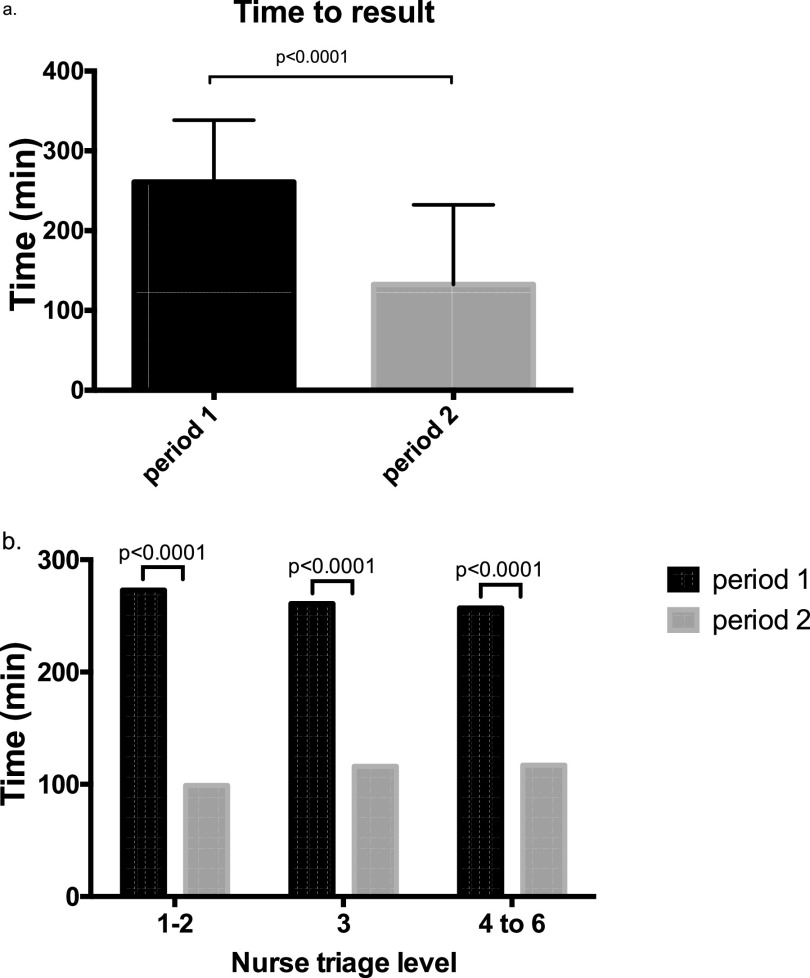
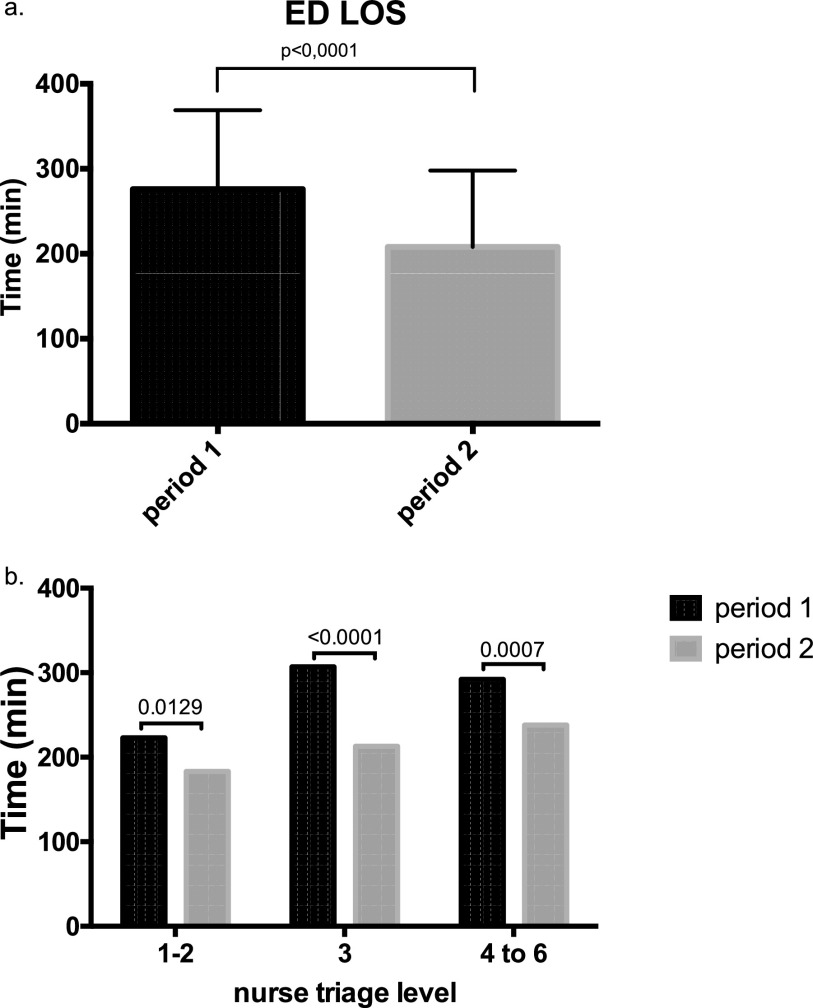
The ID NOW COVID-19 system (IDNOW) is a point-of-care test (POCT) providing results within 15 min. We evaluated the impact of IDNOW use on patient length of stay (LOS) in an emergency department (ED). In the ED of Saint-Louis Hospital, Paris, France, adult patients requiring a rapid diagnosis of SARS-CoV-2 were tested with Cepheid Xpert Xpress SARS-CoV-2 or FilmArray respiratory panel RP2 in the virology laboratory between 18 October and 3 November 2020 (period 1) and with IDNOW between 4 November and 30 November 2020 (period 2). A total of 676 patients participated in the study, 337 during period 1 and 339 during period 2. The median LOS in ED was significantly higher in period 1 than in period 2 (276 versus 208 min, P < 0.0001). More patients spent less than 4 h in the ED in period 2 (61.3%) than in period 1 (38.3%) (P < 0.0001). By univariate analysis, factors associated with ED LOS were hypertension, anosmia/ageusia, number of patients per day, and ID NOW implementation in period 2. By multivariate analysis, the period of testing remained significantly associated with ED LOS. Rapid molecular SARS-CoV-2 POCT was associated with a reduced LOS for patients admitted to an ED. IMPORTANCE During COVID-19 pandemic upsurges, emergency departments had to deal with a massive flow of incoming patients. The need for COVID-19 infection status determination before medical ward admission worsened ED overcrowding. The development of molecular point-of-care testing gave new opportunities for getting faster results of SARS-CoV-2 genome detection 24 h a day. In our study, we show, with a multivariate analysis, that the use of the POCT COVID-19 IDNOW reduced the ED length of stay by 1 h. The rate of patients who waited less than 4 h in the ED increased significantly. Our study highlights the benefit of COVID-19 molecular POCT for preventing ED overcrowding and facilitating bed allocation and SARS-CoV-2-infected patient isolation.
Keywords: COVID-19; SARS-CoV-2; length of stay; molecular detection; point of care.
Conflict of interest statement
The authors declare a conflict of interest. Jerome LeGoff received consulting fees from Abbott in 2021. Outside the submitted work, Jerome LeGoff reports consulting fees from bioMérieux and Roche Molecular (in 2018-2019); Constance Delaugerre reports to be member of a scientific board for MSD and Gilead ViiV, and a research grant from Gilead ViiV. All other authors declare no conflict of interest for the submitted work.
Figures
References
-
- Mustafa Hellou M, Górska A, Mazzaferri F, Cremonini E, Gentilotti E, De Nardo P, Poran I, Leeflang MM, Tacconelli E, Paul M. 2021. Nucleic acid amplification tests on respiratory samples for the diagnosis of coronavirus infections: a systematic review and meta-analysis. Clin Microbiol Infect 27:341–351. doi: 10.1016/j.cmi.2020.11.002. - DOI - PMC - PubMed
-
- Hinson JS, Rothman RE, Carroll K, Mostafa HH, Ghobadi K, Smith A, Martinez D, Shaw-Saliba K, Klein E, Levin S. 2021. Targeted rapid testing for SARS-CoV-2 in the emergency department is associated with large reductions in uninfected patient exposure time. J Hosp Infect 107:35–39. doi: 10.1016/j.jhin.2020.09.035. - DOI - PMC - PubMed
MeSH terms
LinkOut - more resources
Full Text Sources
Medical
Miscellaneous