Review
. 2022 Sep;11(3):319-335.
doi: 10.1007/s40119-022-00271-9. Epub 2022 Jun 22.

High-Risk Coronary Plaque Features: A Narrative Review

Affiliations
Review

High-Risk Coronary Plaque Features: A Narrative Review

Luke P Dawson et al. Cardiol Ther. 2022 Sep.

Abstract

Advances in coronary plaque imaging over the last few decades have led to an increased interest in the identification of novel high-risk plaque features that are associated with cardiovascular events. Existing practices focus on risk stratification and lipid monitoring for primary and secondary prevention of cardiac events, which is limited by a lack of assessment and treatment of vulnerable plaque. In this review, we summarize the multitude of studies that have identified plaque, haemodynamic and patient factors associated with risk of acute coronary syndrome. Future progress in multi-modal imaging strategies and in our understanding of high-risk plaque features could expand treatment options for coronary disease and improve patient outcomes.

Keywords: Acute coronary syndromes; Atherosclerosis; Coronary artery disease; Coronary imaging; High-risk plaque.


Figures

Fig. 1
Fig. 1
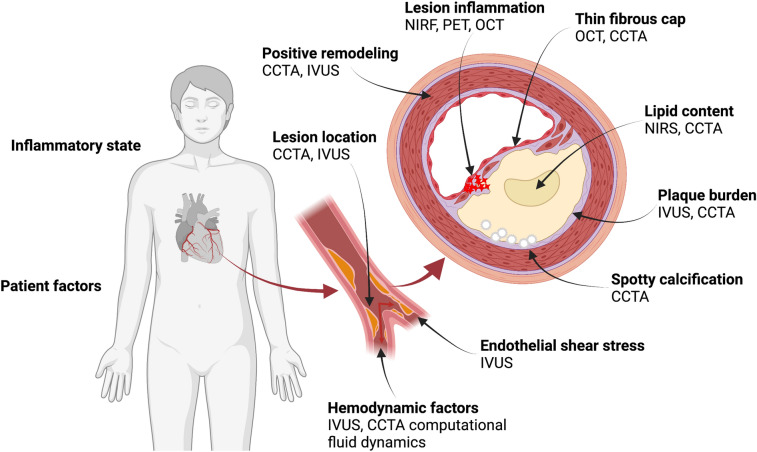
High-risk features for coronary plaque. IVUS Intravascular ultrasound, OCT optical coherence tomography, NIRS near infrared spectroscopy, CCTA coronary computed tomography angiography, PET positron emission tomography, NIRF near-infrared fluorescence
Fig. 2
Fig. 2
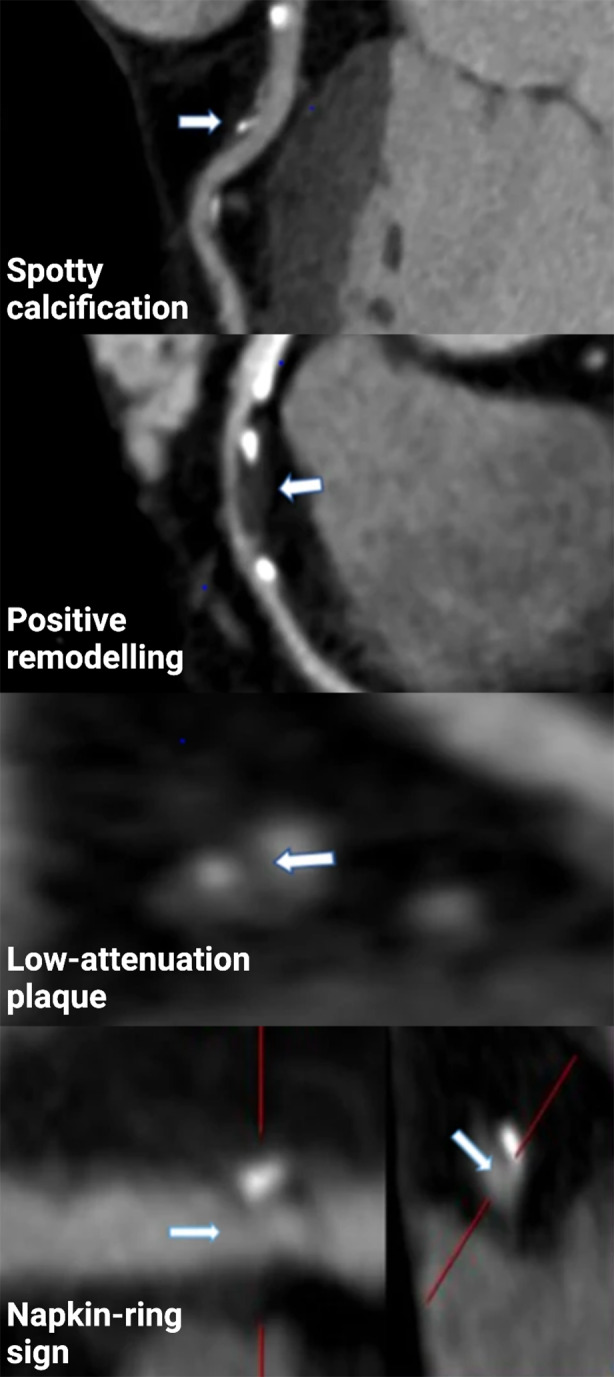
High-risk plaque features on coronary computed tomography angiography. Adapted from Yan et al. under the terms of the Creative Commons Attribution 4.0 licence [31]

References

    1. Virani SS, Alonso A, Benjamin EJ, et al. Heart disease and stroke statistics—2020 update: a report from the American Heart Association. Circulation. 2020;141(9):e139–e596. doi: 10.1161/CIR.0000000000000757. - DOI - PubMed
    1. Tomaniak M, Katagiri Y, Modolo R, et al. Vulnerable plaques and patients: state-of-the-art. Eur Heart J. 2020;41(31):2997–3004. doi: 10.1093/eurheartj/ehaa227. - DOI - PMC - PubMed
    1. Arbab-Zadeh A, Fuster V. From detecting the vulnerable plaque to managing the vulnerable patient: JACC state-of-the-art review. J Am Coll Cardiol. 2019;74(12):1582–1593. doi: 10.1016/j.jacc.2019.07.062. - DOI - PubMed
    1. Li J, Montarello NJ, Hoogendoorn A, et al. Multimodality intravascular imaging of high-risk coronary plaque. JACC Cardiovasc Imaging. 2022;15(1):145–159. doi: 10.1016/j.jcmg.2021.03.028. - DOI - PubMed
    1. Virmani R, Burke AP, Farb A, Kolodgie FD. Pathology of the vulnerable plaque. J Am Coll Cardiol. 2006;47(8 Suppl):C13–C18. doi: 10.1016/j.jacc.2005.10.065. - DOI - PubMed

LinkOut - more resources