Trends in Diet Quality and Cardiometabolic Risk Factors Among Korean Adults, 2007-2018
- PMID: 35731513
- PMCID: PMC9218851
- DOI: 10.1001/jamanetworkopen.2022.18297
Trends in Diet Quality and Cardiometabolic Risk Factors Among Korean Adults, 2007-2018
Abstract
Importance: Few studies have examined the dietary trends in Korea beyond evaluating selected food groups. To help prevent cardiometabolic disease burdens, a comprehensive investigation of the trends in overall diet quality and identification of possible contributing factors would be useful.
Objective: To investigate the trends and independent associations of age, period, and birth cohort with diet quality and cardiometabolic risk factors among Korean adults.
Design, setting, and participants: Serial cross-sectional and age-period-cohort analyses were conducted of nationally representative 24-hour dietary recall data from the Korea National Health and Nutrition Examination Survey 2007-2018. The study population included 65 416 Korean adults aged 19 to 79 years. Data analyses were conducted from March 1, 2020, through April 30, 2021.
Exposures: Age, calendar year, birth cohort, and population sociodemographic characteristics.
Main outcomes and measures: Korean Healthy Eating Index (KHEI), a validated diet quality score (range, 0-90, with higher scores indicating greater diet quality), and 8 cardiometabolic risk factors (waist circumference and systolic blood pressure, diastolic blood pressure, serum total cholesterol, low-density lipoprotein cholesterol, high-density lipoprotein cholesterol, triglyceride, and fasting blood glucose levels).
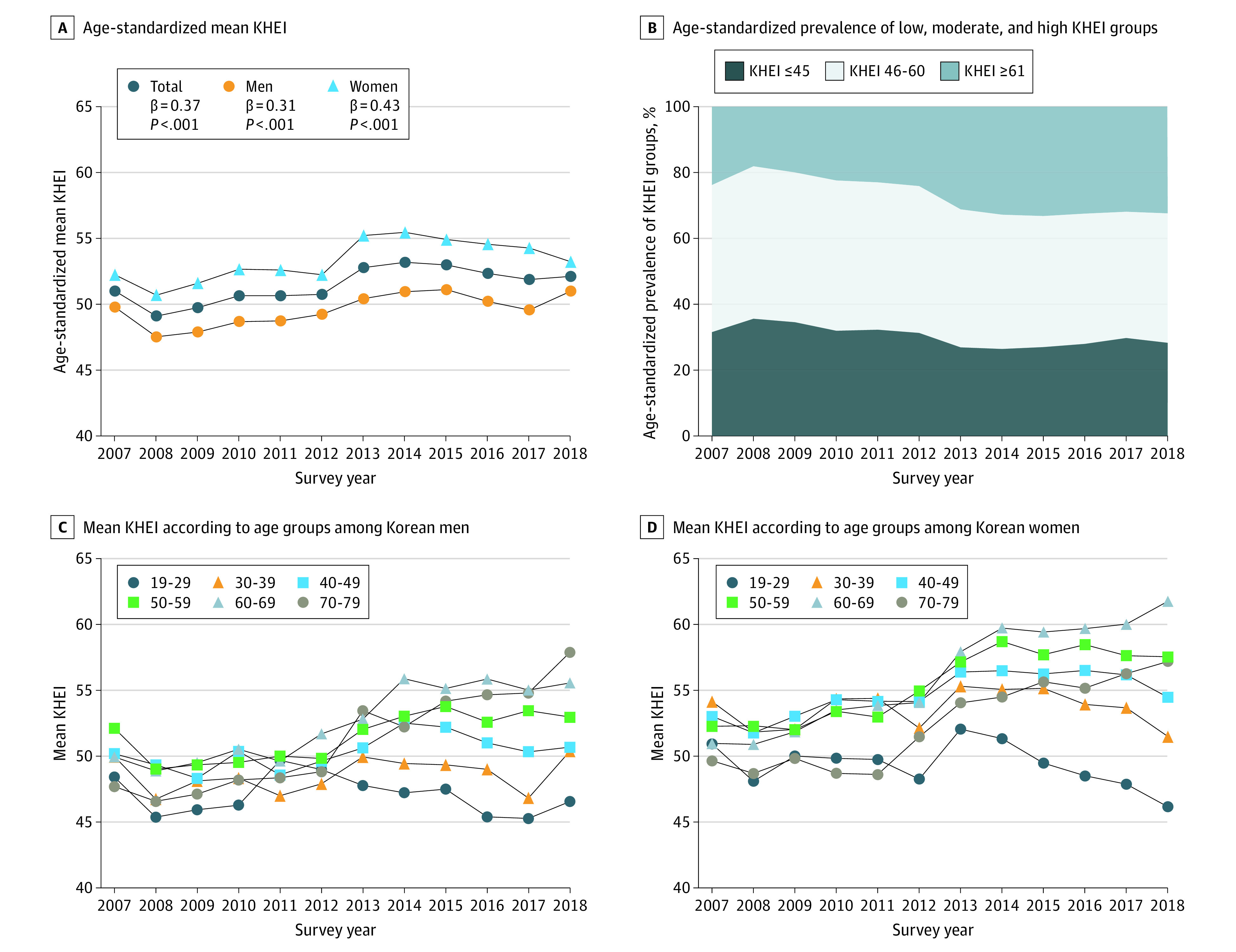
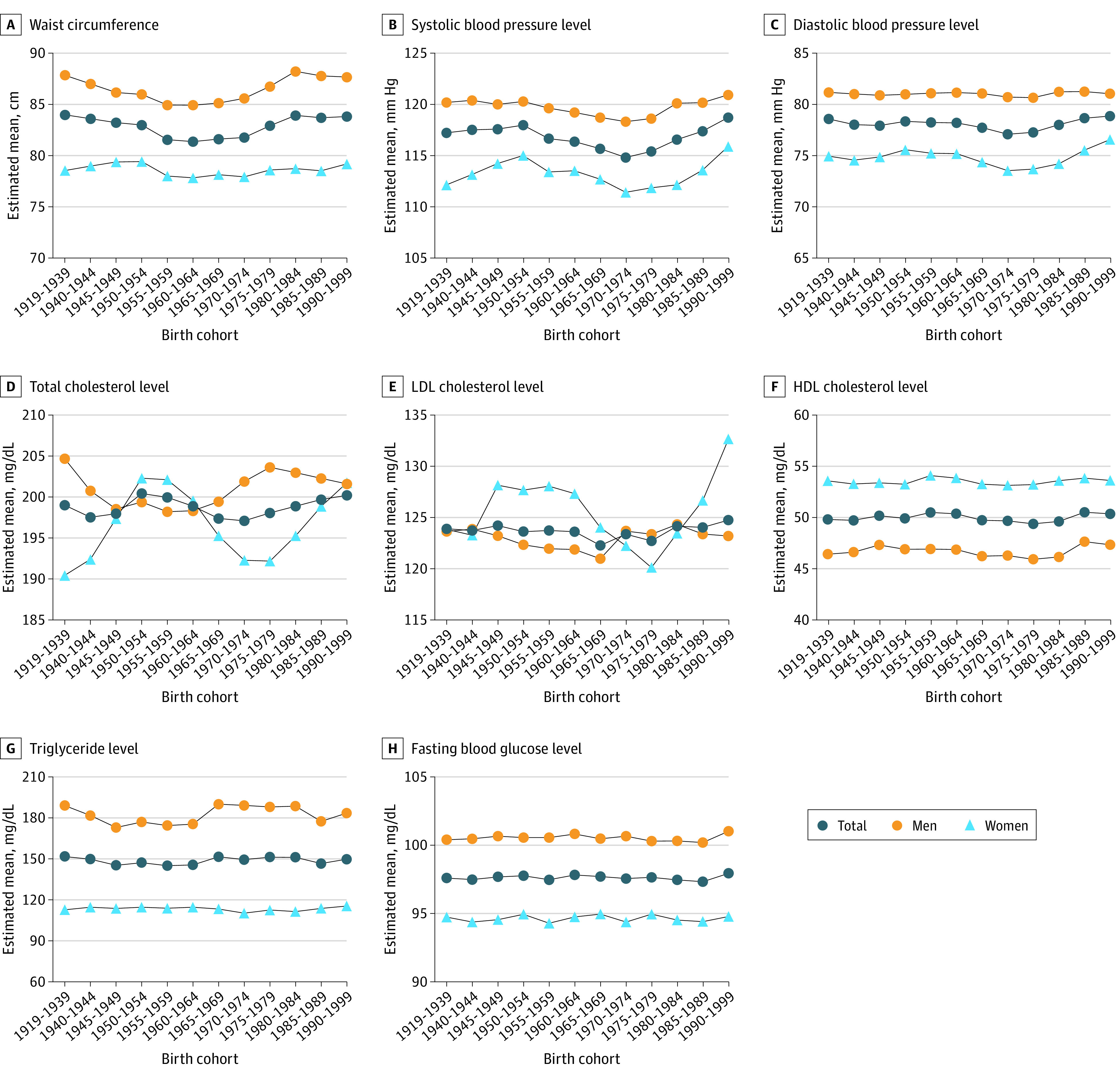
Results: Among 65 416 participants, mean age (SD) was 44.5 (0.1) years and 36 631 were women (55.8%). In 2007-2018, the age-standardized mean (SE) KHEI score increased from 51.0 (0.4) to 52.1 (0.5), which was associated with reduced sodium intake and increased whole grain, dairy, and protein-rich food intakes. The mean (SE) KHEI score was lowest at age 39 years (50.1 [0.3]) and increased at older ages (58.0 [0.3] at 79 years). Controlling for age and period effects, the highest KHEI score was observed among the birth cohorts of 1960-1964 (53.6 [0.9]) and decreased in subsequent cohorts (45.5 [1.2] in the 1990-1999 birth cohort). Similar cohort effects in cardiometabolic risk factors were observed, showing the lowest waist circumference, blood pressure, and total cholesterol levels among the birth cohorts of the 1960s and 1970s and higher levels among more recent birth cohorts (1990-1999 vs 1960-1964: waist circumference, 83.8 [0.5] vs 81.4 [0.4] cm; systolic blood pressure, 118.7 [0.7] vs 116.4 [0.4] mm Hg; total cholesterol, 200.2 [0.9] vs 198.9 [0.7] mg/dL). At most ages, periods, and birth cohorts, the mean KHEI score was consistently higher in adults living in urban areas (at age 45 years: 50.5 [1.0] vs 49.7 [0.9] rural) and among high-income (at age 45 years: 50.7 [1.1] vs 49.3 [0.9] low income) and educational levels (at age 45 years: 53.1 [0.9] vs 49.1 [1.0] low educational level).
Conclusions and relevance: The findings of this study suggest that, from 2007 to 2018, the diet quality of Korean adults modestly improved. Despite the improvement, inequalities in diet among age, birth cohort, and socioeconomic subgroups persisted, suggesting that more intense interventions may be needed to target the susceptible groups.
Conflict of interest statement
Figures


References
-
- Yusuf S, Joseph P, Rangarajan S, et al. . Modifiable risk factors, cardiovascular disease, and mortality in 155 722 individuals from 21 high-income, middle-income, and low-income countries (PURE): a prospective cohort study. Lancet. 2020;395(10226):795-808. doi:10.1016/S0140-6736(19)32008-2 - DOI - PMC - PubMed
-
- GBD 2017 Cirrhosis Collaborators . The global, regional, and national burden of cirrhosis by cause in 195 countries and territories, 1990-2017: a systematic analysis for the Global Burden of Disease Study 2017. Lancet Gastroenterol Hepatol. 2020;5(3):245-266. doi:10.1016/S2468-1253(19)30349-8 - DOI - PMC - PubMed
Publication types
MeSH terms
Substances
LinkOut - more resources
Full Text Sources
Miscellaneous