. 2022 Jun 24;8(25):eabn8932.
doi: 10.1126/sciadv.abn8932. Epub 2022 Jun 22.

Untethered small-scale magnetic soft robot with programmable magnetization and integrated multifunctional modules

Affiliations

Untethered small-scale magnetic soft robot with programmable magnetization and integrated multifunctional modules

Yue Dong et al. Sci Adv. .

Abstract

Intelligent magnetic soft robots capable of programmable structural changes and multifunctionality modalities depend on material architectures and methods for controlling magnetization profiles. While some efforts have been made, there are still key challenges in achieving programmable magnetization profile and creating heterogeneous architectures. Here, we directly embed programmed magnetization patterns (magnetization modules) into the adhesive sticker layers to construct soft robots with programmable magnetization profiles and geometries and then integrate spatially distributed functional modules. Functional modules including temperature and ultraviolet light sensing particles, pH sensing sheets, oil sensing foams, positioning electronic component, circuit foils, and therapy patch films are integrated into soft robots. These test beds are used to explore multimodal robot locomotion and various applications related to environmental sensing and detection, circuit repairing, and gastric ulcer coating, respectively. This proposed approach to engineering modular soft material systems has the potential to expand the functionality, versatility, and adaptability of soft robots.


Figures

Fig. 1.
Fig. 1.. The schematic diagram of integrating magnetized NdFeB patterns and functional modules for programmable and multifunctional magnetic soft robots and their applications.
PET, polyethylene glycol terephthalate.
Fig. 2.
Fig. 2.. The fabrication and transfer of NdFeB patterns.
(A) The fabrication process of NdFeB patterns. The optical images of (B) wax mask on PEI tape, (C) NdFeB patterns and wax mask on PEI tape, (D) NdFeB patterns on PEI tape after wax removal, (E) NdFeB patterns in the double-sided tape. The cross-sectional SEM images of NdFeB microparticles on (F) PEI and (G) double-sided tapes. (H) The enlarged optical images and (I) SEM image of magnetized and unmagnetized NdFeB microparticles in double-sided tapes with different thicknesses. (J) The magneto-optical microscope images of magnetized NdFeB patterns [uniform (in-plane and out-of-plane) and nonuniform magnetization] before transfer and after transfer. (K) The transfer efficiency of NdFeB microparticles in double-sided tapes. The stability of NdFeB patterns with (L) uniform and (M) nonuniform magnetization in the double-sided tape after magnetic stimuli for 2000 times.
Fig. 3.
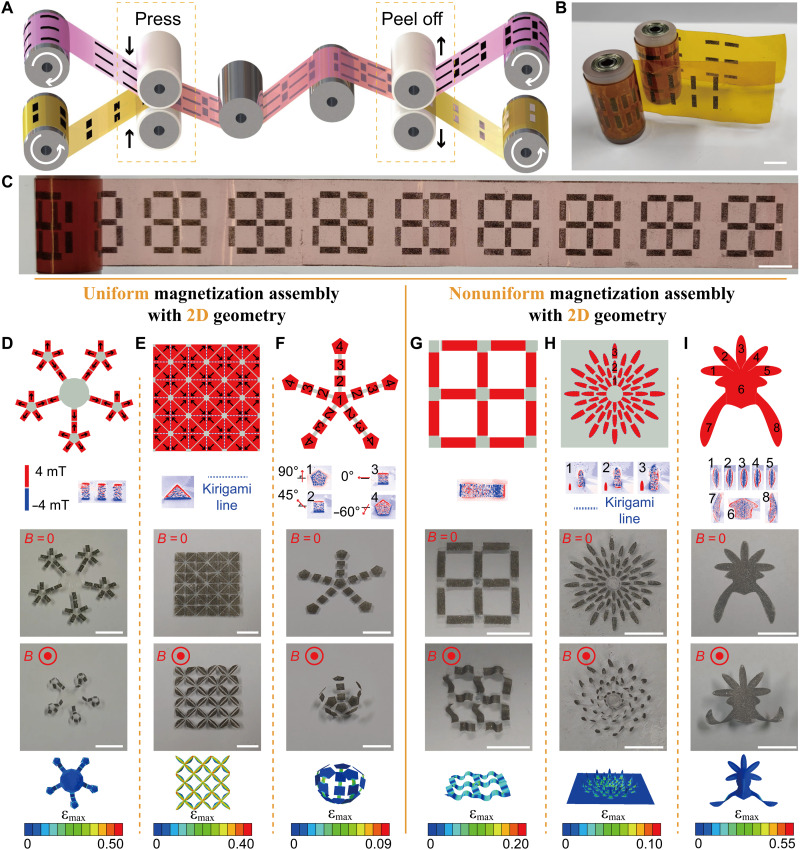
Fig. 3.. The soft robots with uniform and nonuniform magnetization assembly and 2D geometries.
(A) The schematic diagram of assembly process with roll-to-roll technology. (B) Magnetized NdFeB patterns fixed on the roller. (C) The assembled soft robots with high reproductivity. The designed shapes with distributed magnetizations, optical images before and after magnetic stimulus, and simulated deformation results of soft robots with 2D geometries fabricated by (D to F) uniform magnetization assembly and (G to I) nonuniform magnetization assembly. [The inset images are the magneto-optical microscope images of magnetized NdFeB patterns. Scale bars, 1.0 cm; color bars, the range of “maximum principal strain (logarithmic strain)”].
Fig. 4.
Fig. 4.. The soft robots with uniform and nonuniform magnetization assembly and 3D geometries.
The designed shapes with distributed magnetizations, bonding processes, optical images before and after magnetic stimulus and simulated deformation results of soft robots with 3D geometries fabricated by (A and B) discrete magnetization assembly and (C and D) mixed magnetization assembly. [Scale bars, 1 cm; color bars, the range of maximum principal strain (logarithmic strain)].
Fig. 5.
Fig. 5.. Multiple applications of MFMLS robot.
(A) The schematic diagram of MFMLS robot with functional modules (circuit, positioning, oil detection, temperature sensing, UV sensing, and pH sensing) and their response under various stimuli. N, North; S, South. (B) The optical images of all functional modules. (C) The multidirectional temperature sensing of MFMLS robot. (D) The multidirectional UV light sensing of MFMLS robot. (E) Multimodal motion for water quality testing of MFMLS robot: (1) the locomotion on the water and pH sensing, (2) the diving and crawling in the water and oil adsorption, and (3) the floating to the water surface (the inset image is the bottom view of MFMLS robot). (F) The replacement process of oil removal module (PDMS foam) after oil adsorption.
Fig. 6.
Fig. 6.. The circuit repairing process in a narrow and hard-to-reach space.
(A) The connecting of failure point in a hard-to-reach region by the joint action of robot’s locomotion, circuit module, and positioning module (the inset images are the internal structure of the region and the positioning principle). (B) The logical process to judge the position of MFMLS robot by RSSI value. (C) The entering and approaching process of MFMLS robot to the failure point. (D) The process of failure point connecting and coming out. (E) The real-time RSSI value recorded by the RFID reader (the red dashed box indicates that the center of the robot is below the failure point).
Fig. 7.
Fig. 7.. The therapy patch transfer by soft robot in stomach.
(A) The back and front sides of the soft robot. (B) Five mainly deformed structures of soft robot controlled by a magnet. (C) Six actuation modes of soft robot in stomach. (D) The total process for covering gastric ulcer by therapy patch with the soft robot. (E) The transfer process (stages I, II, and III) and (F) the return process (stages IV, V, and VI) of soft robot. (G) The schematic diagram of the combination of soft robot and endoscope. (H) Multimodal actuation under the observation by endoscope. (Scale bars, 1 cm)

References

    1. Hu W., Lum G. Z., Mastrangeli M., Sitti M., Small-scale soft-bodied robot with multimodal locomotion. Nature 554, 81–85 (2018). - PubMed
    1. Xu T., Zhang J., Salehizadeh M., Onaizah O., Diller E., Millimeter-scale flexible robots with programmable three-dimensional magnetization and motions. Sci. Robot. 4, eaav4494 (2019). - PubMed
    1. Alapan Y., Karacakol A. C., Guzelhan S. N., Isik I., Sitti M., Reprogrammable shape morphing of magnetic soft machines. Sci. Adv. 6, eabc6414 (2020). - PMC - PubMed
    1. Dong Y., Wang J., Guo X., Yang S., Ozen M. O., Chen P., Liu X., Du W., Xiao F., Demirci U., Liu B.-F., Multi-stimuli-responsive programmable biomimetic actuator. Nat. Commun. 10, 4087 (2019). - PMC - PubMed
    1. Li C., Lau G. C., Yuan H., Aggarwal A., Dominguez V. L., Liu S., Sai H., Palmer L. C., Sather N. A., Pearson T. J., Freedman D. E., Amiri P. K., De La Cruz M. O., Stupp S. I., Fast and programmable locomotion of hydrogel-metal hybrids under light and magnetic fields. Sci. Robot. 5, eabb9822 (2020). - PubMed