. 2022 Sep 2;31(9):1849-1857.
doi: 10.1158/1055-9965.EPI-22-0114.

Oral Cancer Prevalence, Mortality, and Costs in Medicaid and Commercial Insurance Claims Data

Affiliations

Oral Cancer Prevalence, Mortality, and Costs in Medicaid and Commercial Insurance Claims Data

Eric P Tranby et al. Cancer Epidemiol Biomarkers Prev. .

Abstract

Background: This study compared prevalence, incidence, mortality rates, treatment costs, and risk factors for oral and oropharyngeal cancer (OC/OPC) between two large United States adult cohorts in 2012-2019.

Methods: Medicaid and commercial claims data came from the IBM Watson Health MarketScan Database. Logistic regression analyses estimated incidence and risk factors for OC/OPC. Mortality was calculated by merging deceased individuals' files with those of the existing cancer cohort. Summing costs of outpatient and inpatient services determined costs.

Results: Prevalence of OC/OPC in Medicaid enrollees decreased each year (129.8 cases per 100,000 enrollees in 2012 to 88.5 in 2019); commercial enrollees showed a lower, more stable prevalence (64.7 per 100,000 in 2012 and 2019). Incidence trended downward in both cohorts, with higher incidence in the Medicaid (51.4-37.6 cases per 100,000) than the commercial cohort (31.9-31.0 per 100,000). Mortality rates decreased for Medicaid enrollees during 2012-2014 but increased in the commercial cohort. OC/OPC treatment costs were higher for commercial enrollees by $8.6 million during 2016-2019. OC/OPC incidence was higher among adults who were older, male, and white; used tobacco or alcohol; or had prior human immunodeficiency virus/acquired immune deficiency syndrome diagnosis and lower among those who had seen a dentist the prior year.

Conclusions: Medicaid enrollees experienced higher OC/OPC incidence, prevalence, and mortality compared with commercially insured adults. Having seen a dentist within the prior year was associated with a lower risk of OC/OPC diagnosis.

Impact: Expanding Medicaid dental benefits may allow OC/OPC to be diagnosed at earlier stages through regular dental visits.


Figures

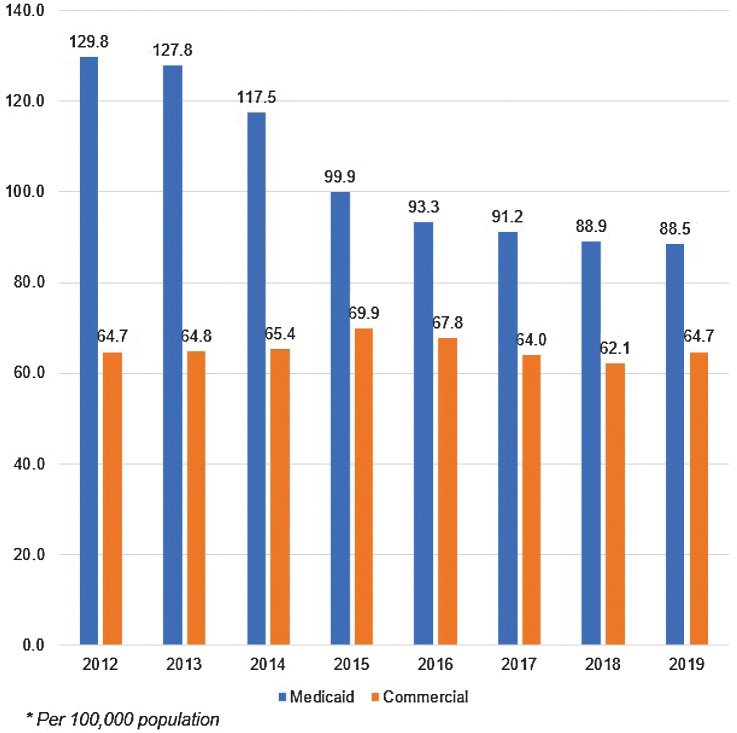
Figure 1. Prevalence of oral/oropharyngeal cancer among Medicaid and commercial insurance cohorts, by year, 2012–2019. Between 2012 and 2019, the prevalence of OC/OPC in the Medicaid claims cohort gradually decreased each year, from 129.8 cases per 100,000 enrollees in 2012 to 88.5 cases per 100,000 in 2019. The commercial cohort showed a lower but more stable prevalence across the same period, with prevalence ranging between 69.9 and 64.8 per 100,000 between 2012 and 2016, then dropping slightly to 64.0, 62.1, and 64.7 in 2017, 2018, and 2019, respectively.
Figure 1.
Prevalence of oral/oropharyngeal cancer among Medicaid and commercial insurance cohorts, by year, 2012–2019. Between 2012 and 2019, the prevalence of OC/OPC in the Medicaid claims cohort gradually decreased each year, from 129.8 cases per 100,000 enrollees in 2012 to 88.5 cases per 100,000 in 2019. The commercial cohort showed a lower but more stable prevalence across the same period, with prevalence ranging between 64.7 and 69.9 per 100,000 between 2012 and 2016, then dropping slightly to 64.0, 62.1, and 64.7 in 2017, 2018, and 2019, respectively.
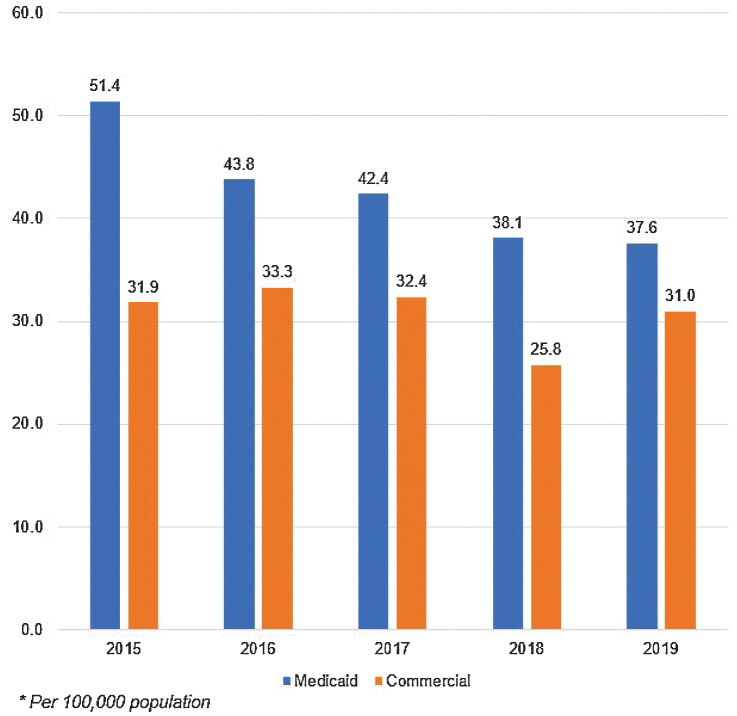
Figure 2. Annual incidence of oral/oropharyngeal cancer among Medicaid and commercial insurance cohorts, by year, 2015–2019. The incidence rates of OC/OPC trended downward in the Medicaid data from 2015 (51.4 cases per 100,000) through 2019 (37.6 per 100,000). The commercial data showed a lower overall incidence rate compared with the Medicaid data with a slight decline over time, beginning with 31.9 cases per 100,000 in 2015 and decreasing to 31.0 per 100,000 in 2019.
Figure 2.
Annual incidence of oral/oropharyngeal cancer among Medicaid and commercial insurance cohorts, by year, 2015–2019. The incidence rates of OC/OPC trended downward in the Medicaid data from 2015 (51.4 cases per 100,000) through 2019 (37.6 per 100,000). The commercial data showed a lower overall incidence rate compared with the Medicaid data, with a slight decline over time, beginning with 31.9 cases per 100,000 in 2015 and decreasing to 31.0 per 100,000 in 2019.
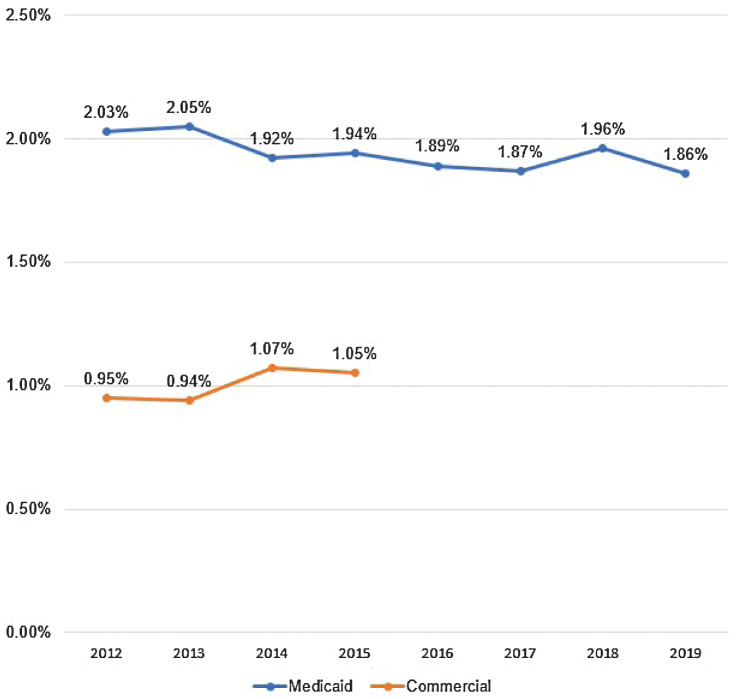
Figure 3. OC/OPC annual mortality rate, by cohort and year. Between 2012 and 2014, OC/OPC annual mortality rates in the Medicaid cohort decreased while rates among the commercial insurance cohort increased. In 2012, the mortality rate was 2.03% for Medicaid enrollees and 0.95% for commercial enrollees. By 2014, the gap between the two groups had narrowed slightly, showing a mortality rate of 1.92% and 1.07% for Medicaid and commercial enrollees, respectively. Beginning in 2016, there was a leveling off in mortality rate for Medicaid enrollees across the next four years, from 1.89% in 2016 to 1.86% in 2019.
Figure 3.
OC/OPC annual mortality rate, by cohort and year. Between 2012 and 2014, OC/OPC annual mortality rates in the Medicaid cohort decreased while rates among the commercial insurance cohort increased. In 2012, the mortality rate was 2.03% for Medicaid enrollees and 0.95% for commercial enrollees. By 2014, the gap between the two groups had narrowed slightly, showing a mortality rate of 1.92% and 1.07% for Medicaid and commercial enrollees, respectively. Beginning in 2016, there was a leveling off in mortality rate for Medicaid enrollees across the next four years, from 1.89% in 2016 to 1.86% in 2019.

References

    1. Rivera C. Essentials of oral cancer. Int J Clin Exp Pathol 2015;8:11884–94. - PMC - PubMed
    1. Sarode G, Maniyar N, Sarode SC, Jafer M, Patil S, Awan KH. Epidemiologic aspects of oral cancer. Dis Mon 2020;66:100988. - PubMed
    1. Vigneswaran N, Williams MD. Epidemiologic trends in head and neck cancer and aids in diagnosis. Oral Maxillofac Surg Clin North Am 2014;26:123–41. - PMC - PubMed
    1. Sung H, Ferlay J, Siegel RL, Laversanne M, Soerjomataram I, Jemal A, et al. Global cancer statistics 2020: GLOBOCAN estimates of incidence and mortality worldwide for 36 cancers in 185 countries. CA Cancer J Clin 2021;71:209–49. - PubMed
    1. Bray F, Ferlay J, Soerjomataram I, Siegel RL, Torre LA, Jemal A. Global cancer statistics 2018: GLOBOCAN estimates of incidence and mortality worldwide for 36 cancers in 185 countries. CA Cancer J Clin 2018;68:394–424. - PubMed