. 2022 Jun 22;12(1):10581.
doi: 10.1038/s41598-022-14241-7.

The impact of Rhodiola rosea on biomarkers of diabetes, inflammation, and microbiota in a leptin receptor-knockout mouse model

Affiliations

The impact of Rhodiola rosea on biomarkers of diabetes, inflammation, and microbiota in a leptin receptor-knockout mouse model

Mahtab Jafari et al. Sci Rep. .

Abstract

Type 2 diabetes is the most prevalent endocrine disease in the world, and recently the gut microbiota have become a potential target for its management. Recent studies have illustrated that this disease may predispose individuals to certain microbiome compositions, and treatments like metformin have been shown to change gut microbiota and their associated metabolic pathways. However, given the limitations and side effects associated with pharmaceuticals currently being used for therapy of diabetes, there is a significant need for alternative treatments. In this study, we investigated the effects of a root extract from Rhodiola rosea in a Leptin receptor knockout (db/db) mouse model of type 2 diabetes. Our previous work showed that Rhodiola rosea had anti-inflammatory and gut microbiome-modulating properties, while extending lifespan in several animal models. In this study, treatment with Rhodiola rosea improved fasting blood glucose levels, altered the response to exogenous insulin, and decreased circulating lipopolysaccharide and hepatic C-reactive protein transcript levels. We hypothesize that these changes may in part reflect the modulation of the microbiota, resulting in improved gut barrier integrity and decreasing the translocation of inflammatory biomolecules into the bloodstream. These findings indicate that Rhodiola rosea is an attractive candidate for further research in the management of type 2 diabetes.


Conflict of interest statement

The authors declare no competing interests.

Figures
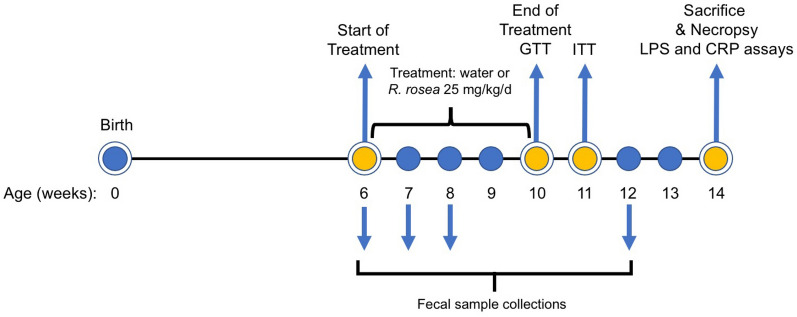
Figure 1
Figure 1
Timeline and experimental design. Cohorts of db/db mice were treated beginning at 6 weeks of age with R. rosea extract (25 mg/kg daily by oral gavage) or with water for a total of 4 weeks. A glucose tolerance test (GTT) was administered at the end of treatment (week 10), and an insulin tolerance test (ITT) administered 1 week later (week 11). Fecal samples were collected for microbiome analysis before treatment at week 6, and subsequently at weeks 7, 8 and 12.
Figure 2
Figure 2
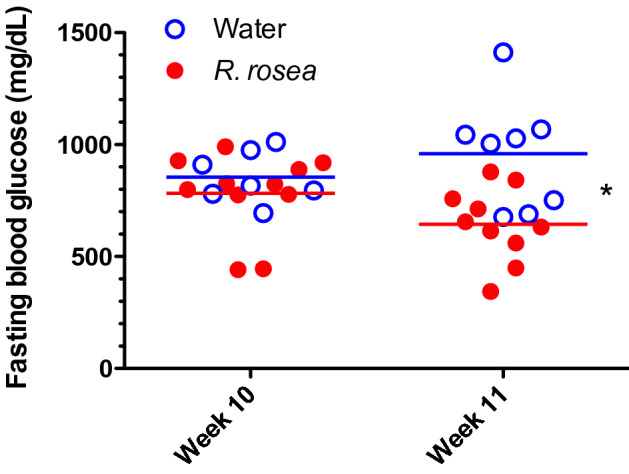
Rhodiola rosea improves fasting blood glucose in db/db mice. Folowing a 4 h fast, blood glucose levels were determined at the end of treatment (week 10) and 1 week later. The difference in mean blood glucose level at week 11 was significant (*P = 0.0303, repeated measures ANOVA). n = 8 control, n = 11 R. rosea-treated; one control sample from week 10 and one R-rosea-treated sample from week 11 did not give interpretable results and were omitted.
Figure 3
Figure 3
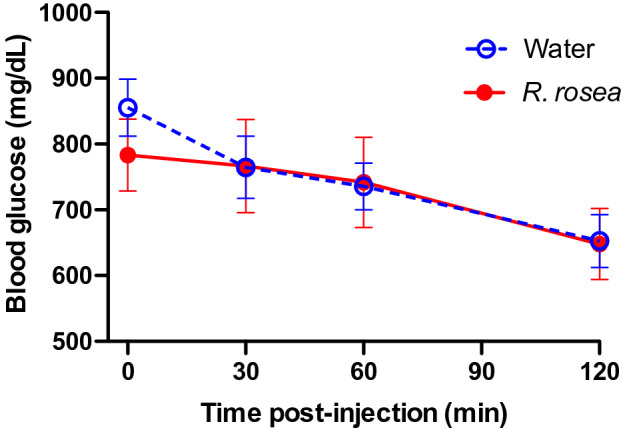
Lack of effect of Rhodiola rosea on glucose tolerance in db/db mice. Cohorts of mice (n = 7 control, n = 11 R. rosea-treated) at the end of the treatment period (week 10) were fasted for 4 h and then challenged with 0.5 g/kg glucose by intraperitoneal injection, followed by determination of blood glucose levels at 30, 60, and 120 min post-injection. None of the differences between control and R. rosea-treated mice were significant (one-way repeated measures ANOVA).
Figure 4
Figure 4
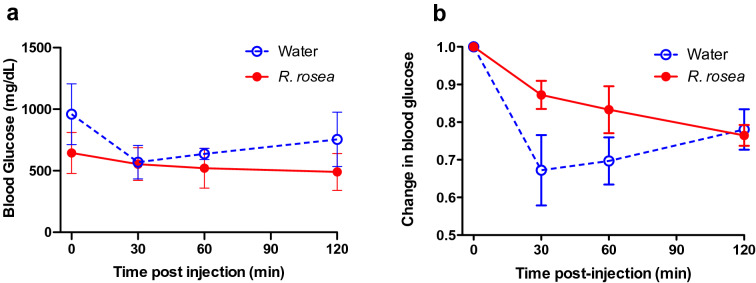
Altered insulin tolerance in Rhodiola rosea-treated db/db mice. Insulin tolerance test (ITT) of db/db mice. ITT was conducted at 11 weeks of age. Following a 4 h fast, mice were injected intraperitoneally with 0.75 IU/kg insulin. Blood was sampled pre-injection and at 30, 60 and 120 minues post-injection and glucose levels determined. The difference between the two data sets is significant (P < 0.05, one-way repeated measures ANOVA; n = 7 for water and n = 11 for R. rosea-treated).
Figure 5
Figure 5
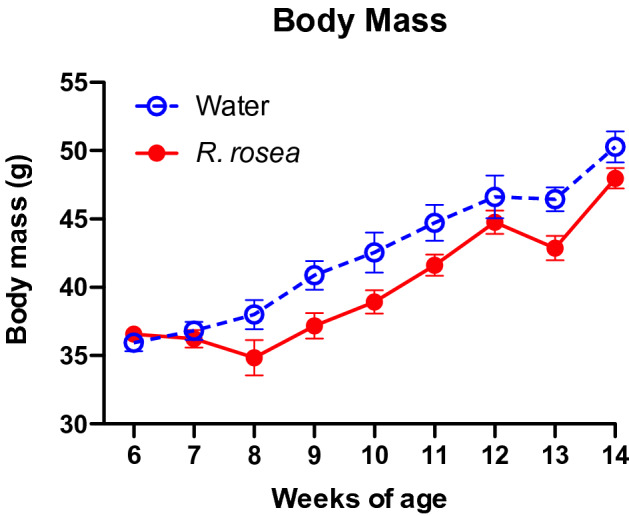
Effect of Rhodiola rosea treatment on body weight of db/db mice. Mice in each cohort (n = 8 water-treated, n = 11 R. rosea-treated) were weighed weekly starting just before initiation of treatment (week 6). None of the paired differences in weight were significant (one-way repeated measures ANOVA).
Figure 6
Figure 6
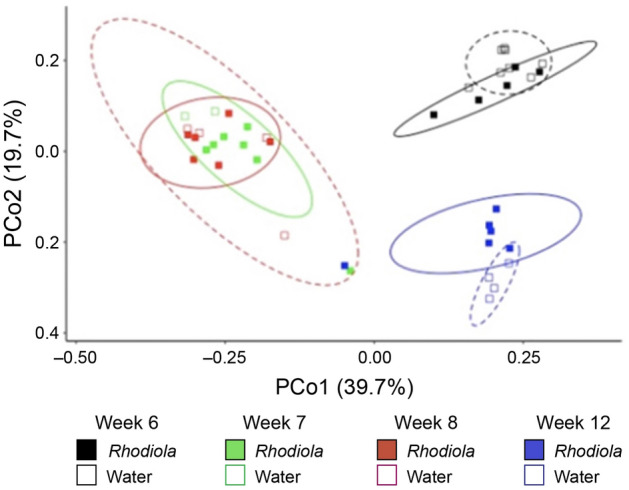
Effects of Rhodiola rosea on the fecal microbiome of db/db mice. Bray–Curtis principal coordinate ordination of the data from Supplemental Fig. 1. The corresponding PERMANOVA (Table 1) identifies significant differences in microbiota composition with treatment and time. The number of fecal samples from different mice analyzed is n = 5 (R. rosea week 6), n = 7 (R. rosea week 7), n = 6 (R. rosea week 8), n = 6 (R. rosea week 12), n = 8 (water week 6), n = 2 (water week 7), n = 4 (water week 8), and n = 4 (water week 12).
Figure 7
Figure 7
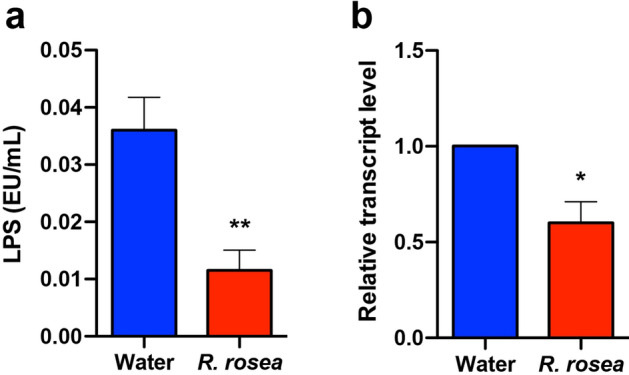
Rhodiola rosea treatment reduces circulating LPS and hepatocyte CRP expression. At 14 weeks of age, mice were sacrificed and serum and liver tissue obtained. (a) Serum LPS levels, measured by the LAL assay (n = 8 for water-treated and n = 6 for R. rosea-treated mice). **P < 0.01, Mann–Whitney U test. (b) Relative expression of CRP transcripts in mouse liver, calculated by the ΔΔCt method (n = 6 for water-treated and n = 5 for R. rosea-treated mice). *P < 0.05, one sample Wilcoxon test.

References

    1. Lin X, et al. Global, regional, and national burden and trend of diabetes in 195 countries and territories: An analysis from 1990 to 2025. Sci. Rep. 2020;10:14790. doi: 10.1038/s41598-020-71908-9. - DOI - PMC - PubMed
    1. Mambiya M, et al. The play of genes and non-genetic factors on type 2 diabetes. Front. Public Health. 2019;7:349. doi: 10.3389/fpubh.2019.00349. - DOI - PMC - PubMed
    1. Association AD. Diagnosis and classification of diabetes mellitus. Diabetes Care. 2013;36(Suppl 1):S67–S74. doi: 10.2337/dc13-S067. - DOI - PMC - PubMed
    1. Murea M, Ma L, Freedman BI. Genetic and environmental factors associated with type 2 diabetes and diabetic vascular complications. Rev. Diabet. Stud. 2012;9:6–22. doi: 10.1900/RDS.2012.9.6. - DOI - PMC - PubMed
    1. Smyth S, Heron A. Diabetes and obesity: The twin epidemics. Nat. Med. 2006;12:75–80. doi: 10.1038/nm0106-75. - DOI - PubMed

Publication types