


Active surveillance of carbapenem-resistant gram-negative bacteria to guide antibiotic therapy: a single-center prospective observational study
- PMID: 35733230
- PMCID: PMC9215019
- DOI: 10.1186/s13756-022-01103-0
Active surveillance of carbapenem-resistant gram-negative bacteria to guide antibiotic therapy: a single-center prospective observational study
Abstract
Background: Carbapenem-resistant gram-negative bacteria (CRGNB) have become a public health concern worldwide. The risk factors associated with CRGNB infection after colonization are unknown, nor is the optimal timing of antibiotic treatment, warranting further investigation.
Methods: A 4-year single-center prospective observational study was conducted. CRGNB-colonized patients were incorporated on admission into our observation cohort for an active surveillance culture program, and analysis of risk factors associated with infections after CRGNB colonization was performed. We divided patients into empirical antibiotic therapy groups and standard antibiotic therapy groups according to whether antibiotics were used before or after cultures yielded a result to explore the relationship between the timing of antibiotics and clinical efficacy.
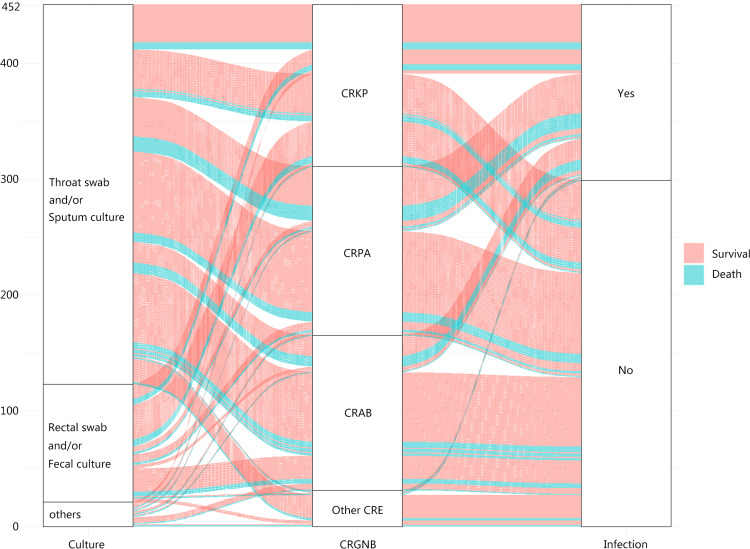
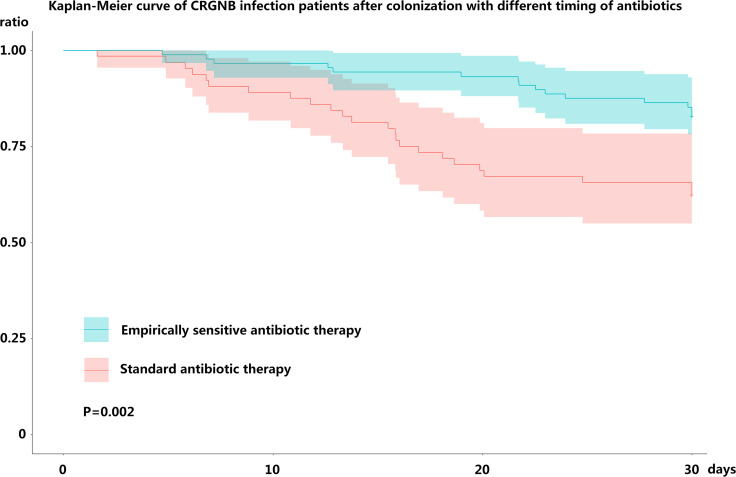
Results: 152 out of 451 CRGNB-colonized patients in the prospective observational cohort developed CRGNB infection. The risk factors associated with CRGNB infection after colonization included CRKP (P < 0.001, OR = 3.27) and CRPA (P < 0.001, OR = 2.97) colonization, history of carbapenems use (P < 0.001, OR = 5.48), and immunocompromise (P < 0.001, OR = 7.07). There were 88 infected patients in the empirical antibiotic therapy groups and 64 in standard antibiotic therapy groups. The mortality was lower in empirical therapy groups than standard therapy groups (17.0% vs. 37.5%, P = 0.004, OR = 0.32).
Conclusions: CRGNB colonized patients who are prone to infection have some high-risk factors included CRKP and CRPA colonization, immunocompromise, and prior carbapenems use. Once infection occurs in CRGNB-colonized patients, early use of effective antibiotics may be associated with reduced mortality, but more studies are needed.
Keywords: Active surveillance; Carbapenem-resistant gram-negative bacteria; Empirical antibiotic therapy; Infection after colonization; Nosocomial infection prevention and control.
© 2022. The Author(s).
Conflict of interest statement
The authors declare that they have no competing interests.
Figures
References
-
- Tamma PD, Aitken SL, Bonomo RA, Mathers AJ, van Duin D, Clancy CJ. Diseases Society of America guidance on the treatment of extended-spectrum beta-lactamase producing enterobacterales (ESBL-E), carbapenem-resistant enterobacterales (CRE), and Pseudomonas aeruginosa with difficult-to-treat resistance (DTR-P. aeruginosa) Clin Infect Dis. 2021;72(7):1109–1116. doi: 10.1093/cid/ciab295. - DOI - PubMed
-
- Karampatakis T, Tsergouli K, Iosifidis E, Antachopoulos C, Karapanagiotou A, Karyoti A, et al. Impact of active surveillance and infection control measures on carbapenem-resistant gram-negative bacterial colonization and infections in intensive care. J Hosp Infect. 2018;99(4):396–404. doi: 10.1016/j.jhin.2018.05.010. - DOI - PubMed
Publication types
MeSH terms
Substances
LinkOut - more resources
Full Text Sources
