. 2022 Jun 6:10:862035.
doi: 10.3389/fped.2022.862035. eCollection 2022.

Cannabidiol Reduces Inflammatory Lung Damage After Meconium Aspiration in Newborn Piglets

Affiliations

Cannabidiol Reduces Inflammatory Lung Damage After Meconium Aspiration in Newborn Piglets

Luis Arruza et al. Front Pediatr. .

Abstract

Aim: To assess the effects of cannabidiol (CBD) on lung damage in a piglet model of meconium aspiration syndrome (MAS).

Materials and methods: Meconium aspiration syndrome was modelled in newborn piglets via intratracheal instillation of 20% meconium in saline collected from healthy newborn humans. Piglets were treated i.v. with 5 mg/kg CBD (MAS + CBD) or Vehicle (MAS + VEH) 30 min after MAS induction and monitored for 6 h. Ventilated piglets without meconium instillation served as controls (CTL). Ventilatory and haemodynamic monitoring, histological and biochemical studies assessed the effects of treatment.

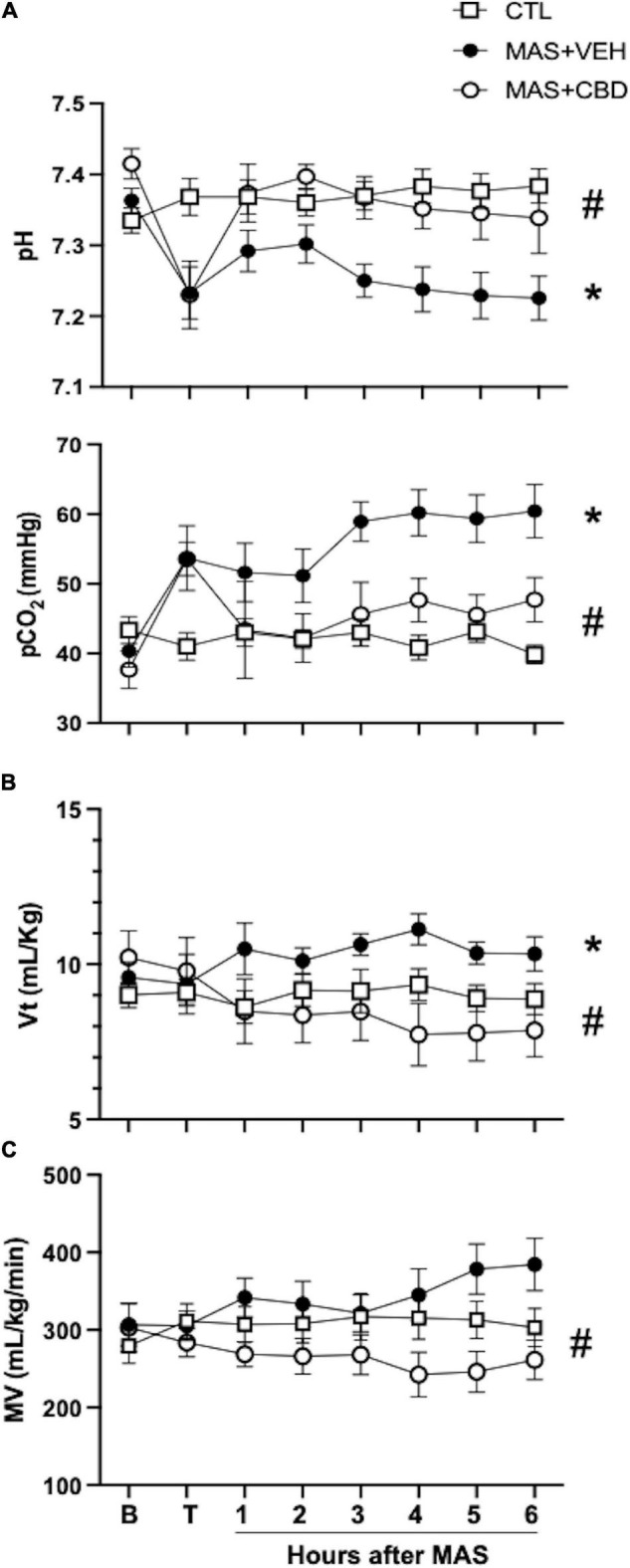
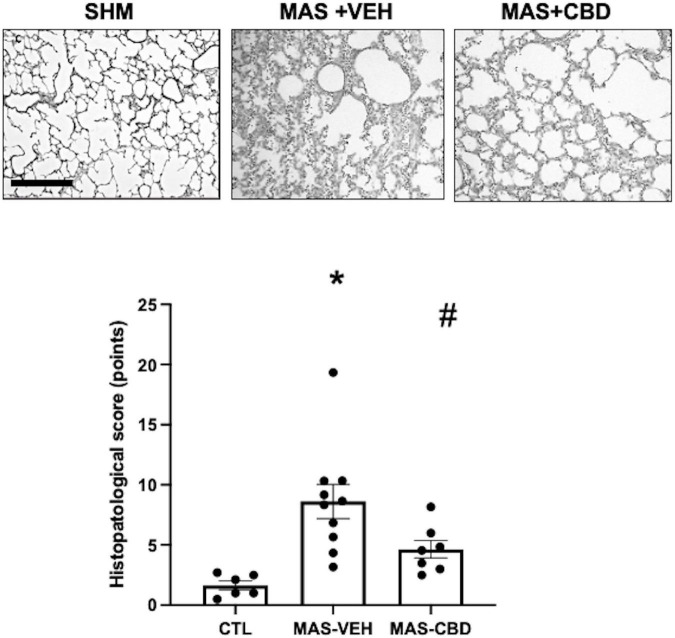
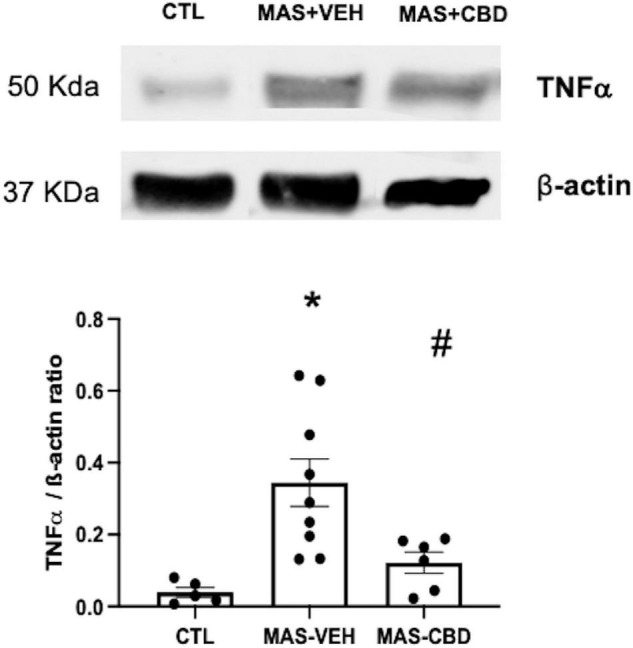
Results: Post-insult administration of CBD reduced MAS-induced deterioration of gas exchange, improving respiratory acidosis (final pH 7.38 ± 0.02, 7.22 ± 0.03 and 7.33 ± 0.03 and final pCO2 39.8 ± 1.3, 60.4 ± 3.8 and 45.7 ± 3.1 mmHg for CTL, MAS + VEH and MAS + CBD, respectively, p < 0.05). These beneficial effects were obtained despite the less aggressive ventilatory settings required for CBD-treated animals (final minute volume 230 ± 30, 348 ± 33 and 253 ± 24 mL/kg/min and final Oxygenation Index 1.64 ± 0.04, 12.57 ± 3.10 and 7.42 ± 2.07 mmHg for CTL, MAS + VEH and MAS + CBD, respectively, p < 0.05). CBD's beneficial effects on gas exchange were associated with reduced histological lung damage, reduced leucocyte infiltration and oedema (histopathological score 1.6 ± 0.3, 8.6 ± 1.4 and 4.6 ± 0.7 points for CTL, MAS + VEH and MAS + CBD, respectively, p < 0.05), as well as reduced TNFα production (0.04 ± 0.01, 0.34 ± 0.06 and 0.12 ± 0.02 A.U. for CTL, MAS + VEH and MAS + CBD, respectively, p < 0.05). Moreover, CBD improved blood pressure stability (final mean blood pressure 74.5 ± 0.2, 62.2 ± 6.2, and 78.67 ± 4.1 mmHg for CTL, MAS + VEH and MAS + CBD, respectively, p < 0.05).

Conclusion: Cannabidiol reduces histologic lung damage and inflammation in a piglet model of MAS. This translates into improved gas exchange and blood pressure stability.

Keywords: cannabidiol; inflammation; meconium aspiration syndrome (MAS); piglet; translational research.


Conflict of interest statement

JM-O had a Research Agreement with GW Research Ltd. (Cambridge, United Kingdom) when these experiments were performed. WH was an employee of GW Research Ltd. (Cambridge, United Kingdom) where he received salary and held shares. The remaining authors declare that the research was conducted in the absence of any commercial or financial relationships that could be construed as a potential conflict of interest.

Figures
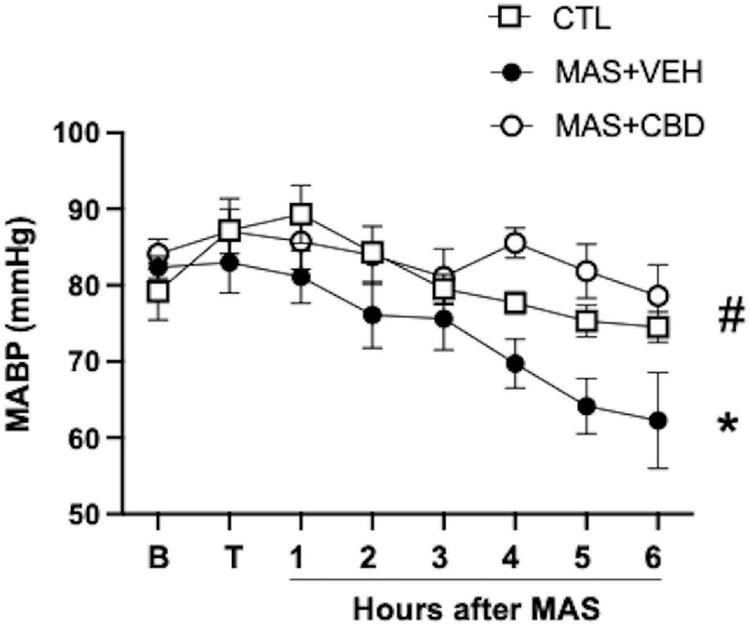
FIGURE 1
FIGURE 1
Change over time on mean arterial blood pressure (MABP) in ventilated control (CTL, n = 6) animals and piglets submitted to meconium aspiration (MAS) and then treated with i.v. vehicle (VEH, n = 10) or CBD (n = 6). B, basal (pre-MAS); T, treatment administered (30 min after MAS). Data presented as mean ± SEM. Two-way ANOVA with Holm-Šidák’s post-hoc test for multiple comparisons. (*) p < 0.05 vs. CTH, (#) p < 005 vs. MAS + VEH.
FIGURE 2
FIGURE 2
Changes over time on blood gases (A) and ventilator settings (B,C) in ventilated control (CTL, n = 6) animals and piglets submitted to meconium aspiration (MAS) and then treated with i.v. vehicle (VEH, n = 10) or CBD (n = 6). B, basal (pre-MAS); T, treatment administered (30 min after MAS); Vt, tidal volume; MV, minute volume. Data presented as mean ± SEM. Two-way ANOVA with Holm-Šidák’s post-hoc test for multiple comparisons. (*) p < 0.05 vs. CTH, (#) p < 005 vs. MAS + VEH.
FIGURE 3
FIGURE 3
Histopathological score as assessed after haematoxylin-eosin staining in lung tissue from ventilated control (CTL, n = 6) animals and piglets submitted to meconium aspiration (MAS) and then treated with i.v. vehicle (VEH, n = 10) or CBD (n = 6). Top: Representative light microphotographs. In lung from MAS-VEH animals there is interstitial leukocyte infiltration, haemorrhage and interstitial oedema, which was reduced by CBD treatment. Original magnification x200, bar: 200 μm. Bottom: quantification of lung damage by a severity score. Results are expressed as mean ± SEM of 6–10 animals. (*) p < 0.05 vs. CTL, (#) p < 0.05 vs. MAS + VEH by one-way ANOVA with Holm-Šidák’s post-hoc test for multiple comparisons.
FIGURE 4
FIGURE 4
Concentration of TNFα as measured by western blot in lung tissue from ventilated control (CTL, n = 6) animals and piglets submitted to meconium aspiration (MAS) and then treated with i.v. vehicle (VEH, n = 10) or CBD (n = 6). Bars represent the mean (SEM) of 6–10 animals. Protein levels were normalised to β-actin loading and expressed as TNF-α/β-actin ratio. (*) p < 0.05 vs. CTL, (#) p < 0.05 vs. MAS + VEH by one-way ANOVA with Holm-Šidák’s post-hoc test for multiple comparisons.

References

    1. Vain NE, Batton DG. Meconium “aspiration” (or respiratory distress associated with meconium-stained amniotic fluid?). Semin Fetal Neonatal Med. (2017) 22:214–9. 10.1016/j.siny.2017.04.002 - DOI - PubMed
    1. Haakonsen Lindenskov PH, Castellheim A, Saugstad OD, Mollnes TE. Meconium aspiration syndrome: possible pathophysiological mechanisms and future potential therapies. Neonatology. (2015) 107:225–30. 10.1159/000369373 - DOI - PubMed
    1. Singh BS, Clark RH, Powers RJ, Spitzer AR. Meconium aspiration syndrome remains a significant problem in the NICU: outcomes and treatment patterns in term neonates admitted for intensive care during a ten-year period. J Perinatol. (2009) 29:497–503. 10.1038/jp.2008.241 - DOI - PubMed
    1. Moses D, Holm B, Spitale P, Liu M, Enhorning G. Inhibition of pulmonary surfactant function by meconium. Am J Obstet Gynecol. (1991) 164:477–81. 10.1016/S0002-9378(11)80003-7 - DOI - PubMed
    1. Mokra D, Mokry J. Glucocorticoids in the treatment of neonatal meconium aspiration syndrome. Eur J Pediatr. (2011) 170:1495–505. 10.1007/s00431-011-1453-2 - DOI - PMC - PubMed

LinkOut - more resources