


Volume-controlled ventilation versus pressure-controlled ventilation during spine surgery in the prone position: A meta-analysis
- PMID: 35734701
- PMCID: PMC9207057
- DOI: 10.1016/j.amsu.2022.103878
Volume-controlled ventilation versus pressure-controlled ventilation during spine surgery in the prone position: A meta-analysis
Abstract
Background: Many studies have investigated a comparison of the potency and safety of PCV versus VCV modes in spinal surgery in prone position. However, controversy about the maximal benefits of which ventilation modes remains. The main purpose of this meta-analysis was to investigate which one is the optimal ventilation for surgery patients undergoing spine surgery in prone position between the two ventilation modes as PCV and VCV.
Methods: We conducted a comprehensive search of PubMed, Embase, Web of Science, the Cochrane Library, and Google Scholar for potentially eligible articles. The continuous outcomes were analyzed using the mean difference and the associated 95% confidence interval. Meta-analysis was performed using Review Manager 5.4 software.
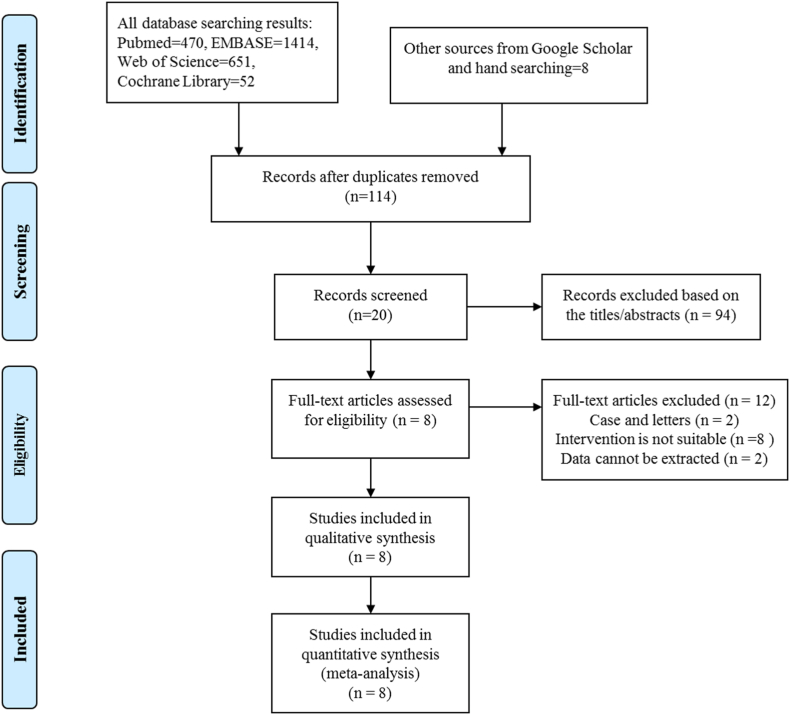
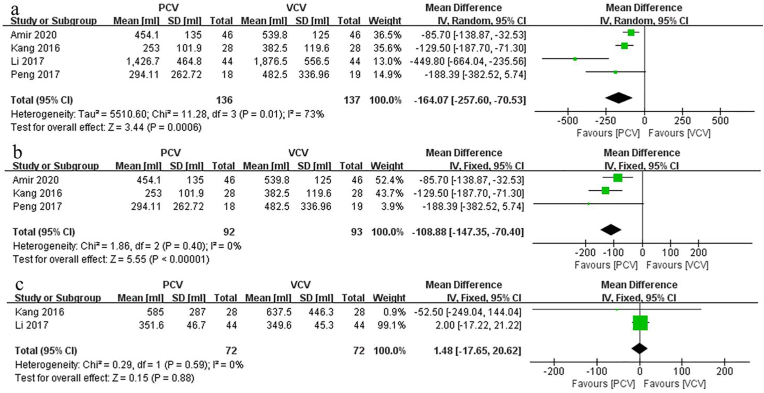
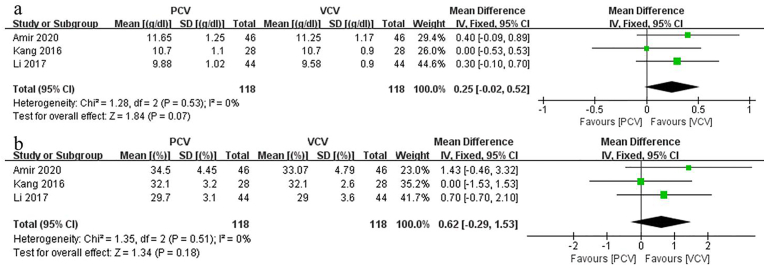
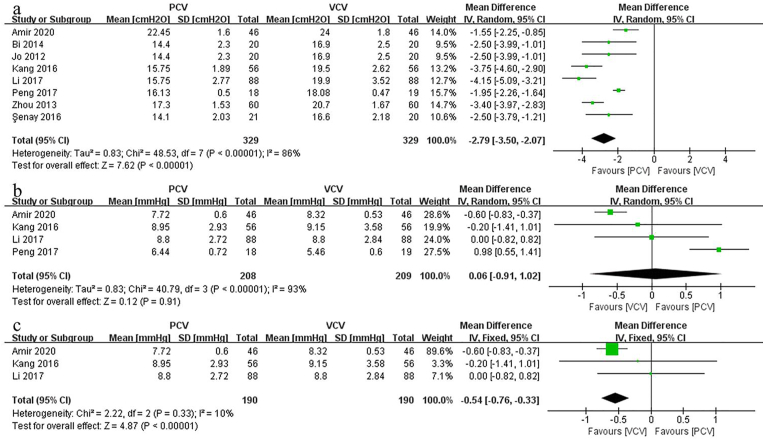
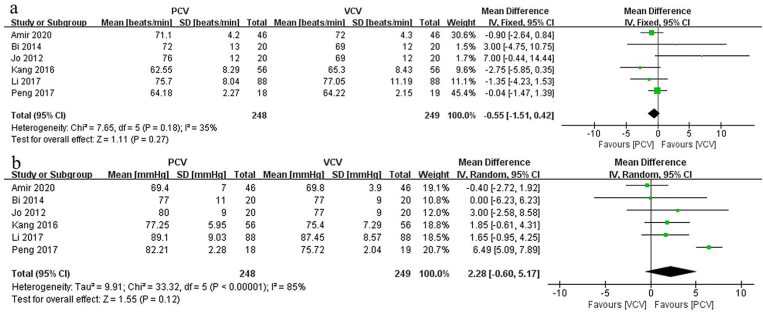
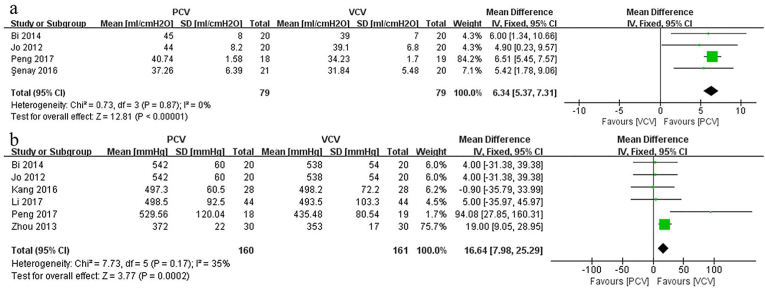
Results: Our meta-analysis included 8 RCTs involving a total of 454 patients between 2012 and 2020. The results demonstrated that IOB, Ppeak and CVP for VCV are significantly superior to PCV in spinal surgery in prone position. And PCV had higher Cdyn and PaO2/FiO2 than VCV. But there was no significant difference between PCV and VCV in terms of POB, Hb, HCT, HR and MAP.
Conclusions: The PCV mode displayed a more satisfying effect than VCV mode. Compared to VCV mode in same preset of tidal volume, the patients with PCV mode in prone position demonstrated less IOB, lower Ppeak and CVP, and higher PaO2/FiO2 in spinal surgery. However, there is no obvious difference between PCV and VCV in terms of hemodynamics variables (HR and MAP).
Keywords: ASA, American Society of Anesthesiologists; BMI, body mass index; CVP, central venous pressure; Cdyn, dynamic compliance; HCT, hematocrit; HR, heart rates; Hb, hemoglobin; IOB, intra-operation blood loss; MAP, mean arterial pressure; MD, mean difference; Meta-analysis; NP, not provided; PCV, pressure controlled ventilation; PEEP, Positive End Expiratory Pressure; PILF, Posterior Lumbar Interbody Fusion; POB, post-operation blood loss; Pressure-controlled ventilation; Prone position; RCT, randomized controlled trial; Randomized controlled trials; Spine surgery; VCV, volume controlled ventilation; VT, tidal volume; Volume-controlled ventilation.
© 2022 The Authors.
Conflict of interest statement
The authors declare no relevant conflict of interest.
Figures
References
-
- Bendixen H.H., Hedley-Whyte J., Laver M.B. Impaired oxygenation in surgical patients during general anesthesia with controlled ventilation. A concept of atelectasis. N. Engl. J. Med. 1963;269:991–996. - PubMed
-
- Serpa Neto A., Cardoso S.O., Manetta J.A., Pereira V.G., Esposito D.C., Pasqualucci Mde O., Damasceno M.C., Schultz M.J. Association between use of lung-protective ventilation with lower tidal volumes and clinical outcomes among patients without acute respiratory distress syndrome: a meta-analysis. JAMA. 2012;308(16):1651–1659. - PubMed
-
- Palmon S.C., Kirsch J.R., Depper J.A., Toung T.J. The effect of the prone position on pulmonary mechanics is frame-dependent. Anesth. Analg. 1998;87(5):1175–1180. - PubMed
-
- Kolobow T., Moretti M.P., Fumagalli R., Mascheroni D., Prato P., Chen V., Joris M. Severe impairment in lung function induced by high peak airway pressure during mechanical ventilation. An experimental study. Am. Rev. Respir. Dis. 1987;135(2):312–315. - PubMed
Publication types
LinkOut - more resources
Full Text Sources
Miscellaneous
