


Advancements in Testing Strategies for COVID-19
- PMID: 35735558
- PMCID: PMC9220779
- DOI: 10.3390/bios12060410
Advancements in Testing Strategies for COVID-19
Abstract
The SARS-CoV-2 coronavirus, also known as the disease-causing agent for COVID-19, is a virulent pathogen that may infect people and certain animals. The global spread of COVID-19 and its emerging variation necessitates the development of rapid, reliable, simple, and low-cost diagnostic tools. Many methodologies and devices have been developed for the highly sensitive, selective, cost-effective, and rapid diagnosis of COVID-19. This review organizes the diagnosis platforms into four groups: imaging, molecular-based detection, serological testing, and biosensors. Each platform's principle, advancement, utilization, and challenges for monitoring SARS-CoV-2 are discussed in detail. In addition, an overview of the impact of variants on detection, commercially available kits, and readout signal analysis has been presented. This review will expand our understanding of developing advanced diagnostic approaches to evolve into susceptible, precise, and reproducible technologies to combat any future outbreak.
Keywords: SARS-CoV-2; coronavirus; diagnosis; immunoassays; variants.
Conflict of interest statement
The authors declare no conflict of interest.
Figures
 ) to a quencher (
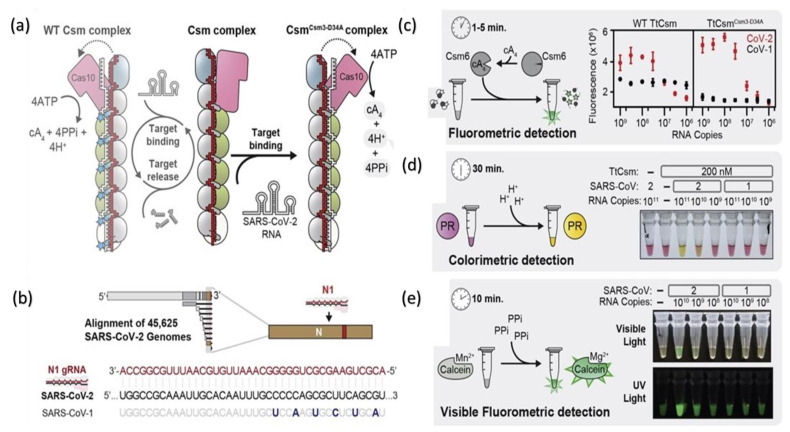
 ). Mutant in the right graph showed a lower LOD (3-folds) than the wild in the left graph. (d) Colorimetric detection of SARS-CoV-2 by mutant N1 complex by a dye phenol red (a pH-sensitive dye) incubated at 60 °C for 30 min. (e) Visible fluorometric detection by the mutant N1 complex using calcein, incubated for 60 min at 60 °C [102].
References
-
- Peiris J.S.M. Coronaviruses. In: Greenwood D., Barer M., Slack R., Irving W., editors. Medical Microbiology (Eighteenth Edition) Churchill Livingstone; Edinburgh, UK: 2012. pp. 587–593.
Publication types
MeSH terms
LinkOut - more resources
Full Text Sources
Medical
Miscellaneous
