


Comparative Study on the Performance of Three Detection Methods for the Quantification of Pacific Ciguatoxins in French Polynesian Strains of Gambierdiscus polynesiensis
- PMID: 35736151
- PMCID: PMC9229625
- DOI: 10.3390/md20060348
Comparative Study on the Performance of Three Detection Methods for the Quantification of Pacific Ciguatoxins in French Polynesian Strains of Gambierdiscus polynesiensis
Abstract
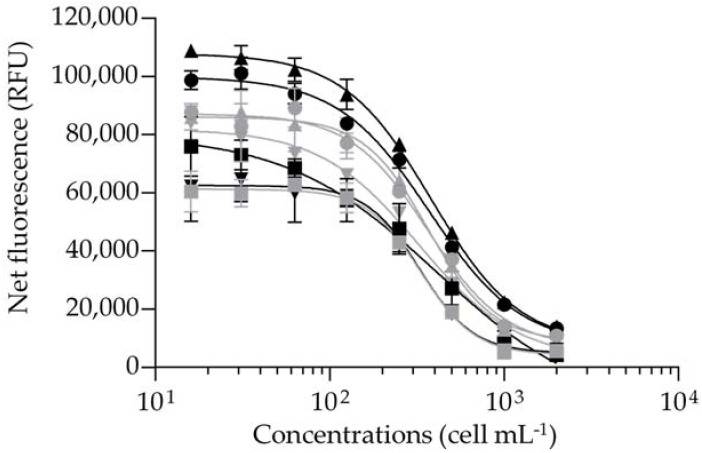
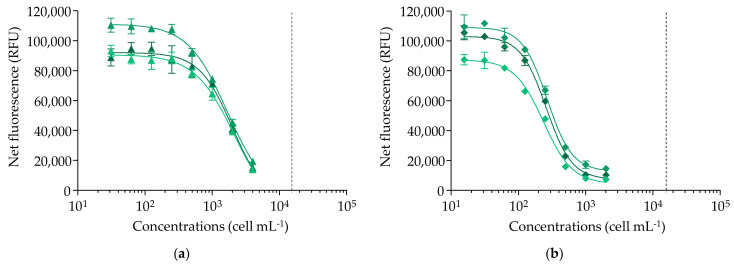
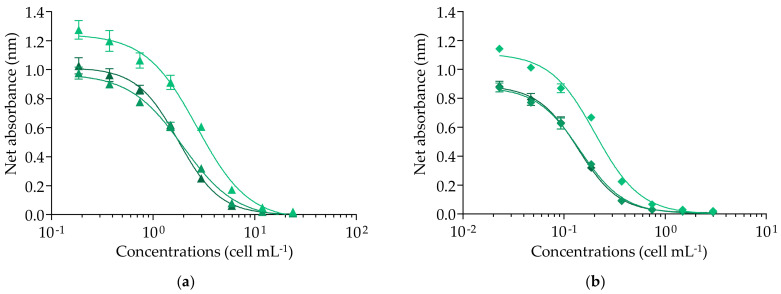
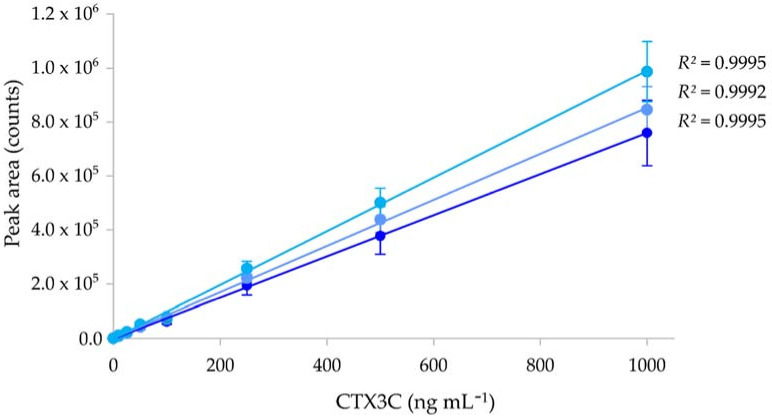
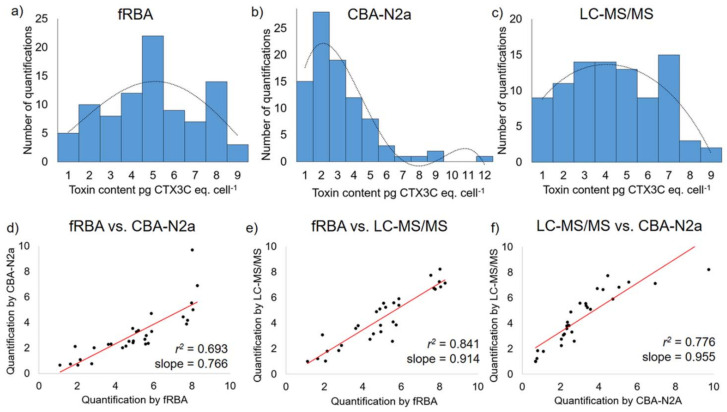
Gambierdiscus and Fukuyoa dinoflagellates produce a suite of secondary metabolites, including ciguatoxins (CTXs), which bioaccumulate and are further biotransformed in fish and marine invertebrates, causing ciguatera poisoning when consumed by humans. This study is the first to compare the performance of the fluorescent receptor binding assay (fRBA), neuroblastoma cell-based assay (CBA-N2a), and liquid chromatography tandem mass spectrometry (LC-MS/MS) for the quantitative estimation of CTX contents in 30 samples, obtained from four French Polynesian strains of Gambierdiscus polynesiensis. fRBA was applied to Gambierdiscus matrix for the first time, and several parameters of the fRBA protocol were refined. Following liquid/liquid partitioning to separate CTXs from other algal compounds, the variability of CTX contents was estimated using these three methods in three independent experiments. All three assays were significantly correlated with each other, with the highest correlation coefficient (r2 = 0.841) found between fRBA and LC-MS/MS. The CBA-N2a was more sensitive than LC-MS/MS and fRBA, with all assays showing good repeatability. The combined use of fRBA and/or CBA-N2a for screening purposes and LC-MS/MS for confirmation purposes allows for efficient CTX evaluation in Gambierdiscus. These findings, which support future collaborative studies for the inter-laboratory validation of CTX detection methods, will help improve ciguatera risk assessment and management.
Keywords: Gambierdiscus polynesiensis; ciguatera poisoning; ciguatoxins; fluorescent receptor binding assay; liquid chromatography tandem mass spectrometry; neuroblastoma cell-based assay; risk assessment.
Conflict of interest statement
J.R.M. owns a company, SeaTox Research Inc, that commercializes an fRBA kit similar to the assay assessed in this project. However, J.R.M. was separated from data collection, had no influence on the results, and limited participation to statistical analysis and other consultation. All other authors declare no conflict of interest. The funders had no role in the design of the study; in the collection, analyses, or interpretation of data; in the writing of the manuscript; or in the decision to publish the results.
Figures



References
-
- Adachi R., Fukuyo Y. The Thecal Structure of a Marine Toxic Dinoflagellate Gambierdiscus toxicus gen. et sp. nov. Collected in a Ciguatera-endemic Area. Bull. Jpn. Soc. Sci. Fish. 1979;45:67–71. doi: 10.2331/suisan.45.67. - DOI
-
- Faust M.A. Observation of sand-dwelling toxic dinoflagellates (Dinophyceae) from widely differing sites, including two new species1. J. Phycol. 1995;31:996–1003. doi: 10.1111/j.0022-3646.1995.00996.x. - DOI
-
- Chinain M., Faust M.A., Pauillac S. Morphology and molecular analyses of three toxic species of Gambierdiscus (Dinophyceae): G. pacificus, sp. nov., G. australes, sp. nov., and G. polynesiensis, sp. nov. J. Phycol. 1999;35:1282–1296. doi: 10.1046/j.1529-8817.1999.3561282.x. - DOI
-
- Litaker R.W., Vandersea M.W., Faust M.A., Kibler S.R., Chinain M., Holmes M.J., Holland W.C., Tester P.A. Taxonomy of Gambierdiscus including four new species, Gambierdiscus caribaeus, Gambierdiscus carolinianus, Gambierdiscus carpenteri and Gambierdiscus ruetzleri (Gonyaulacales, Dinophyceae) Phycologia. 2009;48:344–390. doi: 10.2216/07-15.1. - DOI
-
- Fraga S., Rodríguez F., Caillaud A., Diogène J., Raho N., Zapata M. Gambierdiscus excentricus sp. nov. (Dinophyceae), a benthic toxic dinoflagellate from the Canary Islands (NE Atlantic Ocean) Harmful Algae. 2011;11:10–22. doi: 10.1016/j.hal.2011.06.013. - DOI
MeSH terms
Substances
Grants and funding
LinkOut - more resources
Full Text Sources
