


Evaluation of Different Capture Solutions for Ammonia Recovery in Suspended Gas Permeable Membrane Systems
- PMID: 35736280
- PMCID: PMC9228927
- DOI: 10.3390/membranes12060572
Evaluation of Different Capture Solutions for Ammonia Recovery in Suspended Gas Permeable Membrane Systems
Abstract
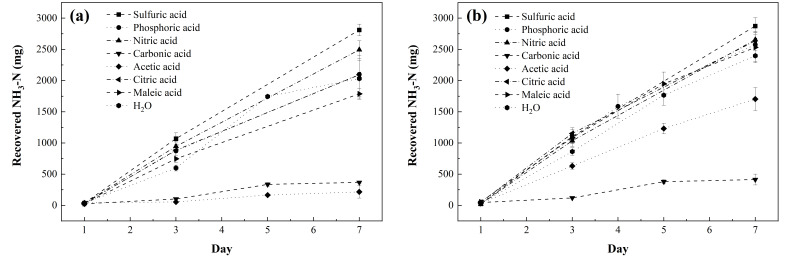
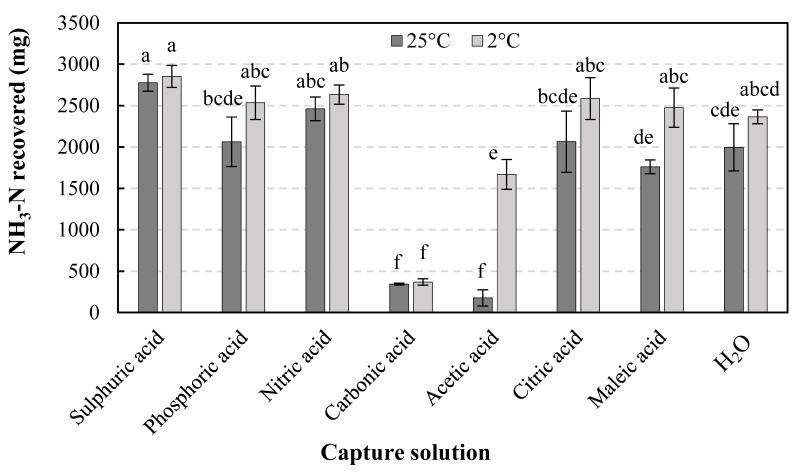
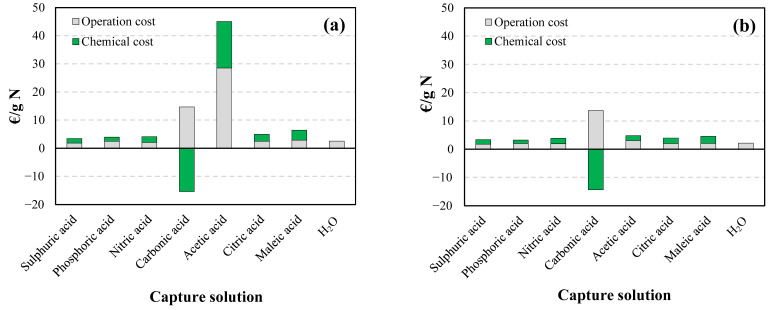
Gas permeable membranes (GPM) are a promising technology for the capture and recovery of ammonia (NH3). The work presented herein assessed the impact of the capture solution and temperature on NH3 recovery for suspended GPM systems, evaluating at a laboratory scale the performance of eight different trapping solutions (water and sulfuric, phosphoric, nitric, carbonic, carbonic, acetic, citric, and maleic acids) at 25 and 2 °C. At 25 °C, the highest NH3 capture efficiency was achieved using strong acids (87% and 77% for sulfuric and nitric acid, respectively), followed by citric and phosphoric acid (65%) and water (62%). However, a remarkable improvement was observed for phosphoric acid (+15%), citric acid (+16%), maleic acid (+22%), and water (+12%) when the capture solution was at 2 °C. The economic analysis showed that water would be the cheapest option at any working temperature, with costs of 2.13 and 2.52 €/g N (vs. 3.33 and 3.43 €/g N for sulfuric acid) in the winter and summer scenarios, respectively. As for phosphoric and citric acid, they could be promising NH3 trapping solutions in the winter months, with associated costs of 3.20 and 3.96 €/g N, respectively. Based on capture performance and economic and environmental considerations, the reported findings support that water, phosphoric acid, and citric acid can be viable alternatives to the strong acids commonly used as NH3 adsorbents in these systems.
Keywords: ammonia adsorbents; ammonia recovery; citric acid; organic acids; phosphoric acid; water.
Conflict of interest statement
The authors declare no conflict of interest. The funders had no role in the design of the study; in the collection, analyses, or interpretation of data; in the writing of the manuscript, or in the decision to publish the results.
Figures
References
-
- Vanotti M.B., García-González M.C., Szögi A.A., Harrison J.H., Smith W.B., Moral R. Removing and Recovering Nitrogen and Phosphorus from Animal Manure. Anim. Manure Prod. Charact. Environ. Concerns Manag. 2020;67:275–321. doi: 10.2134/asaspecpub67.c22. - DOI
-
- Bouwman L., Goldewijk K.K., Van Der Hoek K.W., Beusen A.H.W., Van Vuuren D.P., Willems J., Rufino M.C., Stehfest E. Erratum: Exploring global changes in nitrogen and phosphorus cycles in agriculture induced by livestock production over the 1900–2050 period. Proc. Natl. Acad. Sci. USA. 2013;110:21196. doi: 10.1073/pnas.1012878108. - DOI - PMC - PubMed
-
- Leip A., Billen G., Garnier J., Grizzetti B., Lassaletta L., Reis S., Simpson D., Sutton M.A., De Vries W., Weiss F., et al. Impacts of European livestock production: Nitrogen, sulphur, phosphorus and greenhouse gas emissions, land-use, water eutrophication and biodiversity. Environ. Res. Lett. 2015;10:115004. doi: 10.1088/1748-9326/10/11/115004. - DOI
LinkOut - more resources
Full Text Sources
Research Materials
