Review
. 2022 Jun 19;12(6):564.
doi: 10.3390/metabo12060564.

The Potential Role of Metabolomics in Drug-Induced Liver Injury (DILI) Assessment

Affiliations
Review

The Potential Role of Metabolomics in Drug-Induced Liver Injury (DILI) Assessment

Marta Moreno-Torres et al. Metabolites. .

Abstract

Drug-induced liver injury (DILI) is one of the most frequent adverse clinical reactions and a relevant cause of morbidity and mortality. Hepatotoxicity is among the major reasons for drug withdrawal during post-market and late development stages, representing a major concern to the pharmaceutical industry. The current biochemical parameters for the detection of DILI are based on enzymes (alanine aminotransferase (ALT), aspartate aminotransferase (AST), gamma-glutamyl transpeptidase (GGT), alkaline phosphatase (ALP)) and bilirubin serum levels that are not specific of DILI and therefore there is an increasing interest on novel, specific, DILI biomarkers discovery. Metabolomics has emerged as a tool with a great potential for biomarker discovery, especially in disease diagnosis, and assessment of drug toxicity or efficacy. This review summarizes the multistep approaches in DILI biomarker research and discovery based on metabolomics and the principal outcomes from the research performed in this field. For that purpose, we have reviewed the recent scientific literature from PubMed, Web of Science, EMBASE, and PubTator using the terms "metabolomics", "DILI", and "humans". Despite the undoubted contribution of metabolomics to our understanding of the underlying mechanisms of DILI and the identification of promising novel metabolite biomarkers, there are still some inconsistencies and limitations that hinder the translation of these research findings into general clinical practice, probably due to the variability of the methods used as well to the different mechanisms elicited by the DILI causing agent.

Keywords: DILI; biomarkers; diagnostic; hepatotoxicity; metabolomics.


Conflict of interest statement

The authors declare no competing financial interest.

Figures
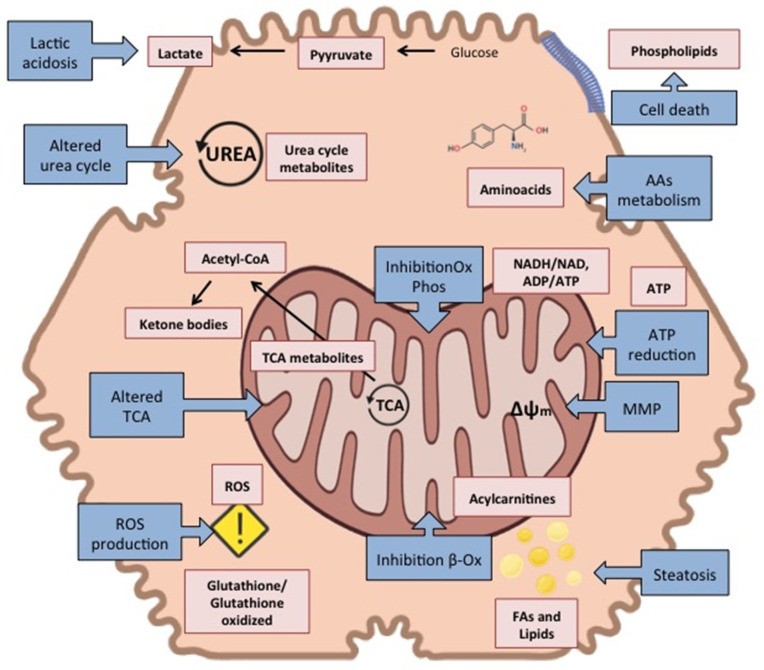
Figure 1
Figure 1
Schematic representation of the principal biochemical mechanisms of drug-induced hepatocellular damage and the metabolite alterations involved.
Figure 2
Figure 2
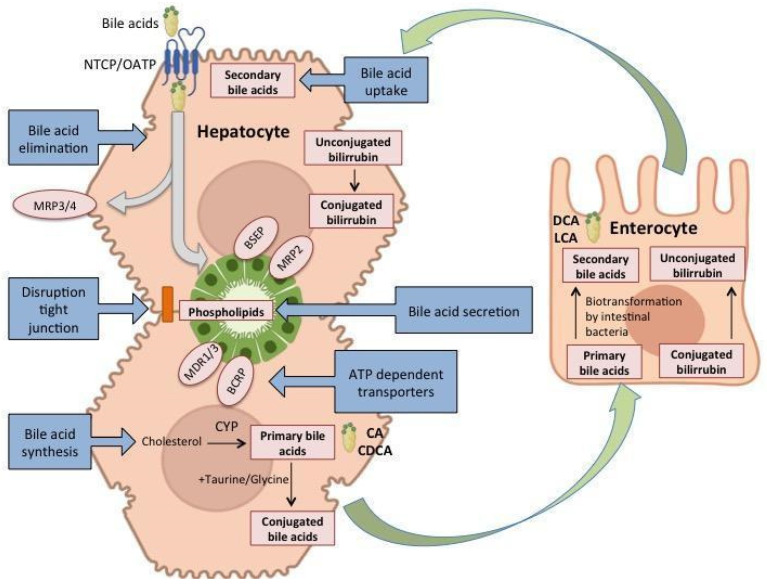
Schematic representation of the biochemical mechanisms in drug-induced cholestasis. Primary bile acids cholic and chenodeoxycholic acid are synthesized by hepatocytes, conjugated with taurine, glycine, and sulphate, and excreted into bile, reaching the intestine. There, the bacterial flora modifies them, de-conjugating and oxidizing to deoxycholic and lithocholic acid which is reabsorbed into blood, uptake by hepatocytes and conjugated again. There are ca. 40 different bile acid species in humans that can be properly analysed by metabolomics [49] and help to discriminate among the different causes of cholestasis.
Figure 3
Figure 3
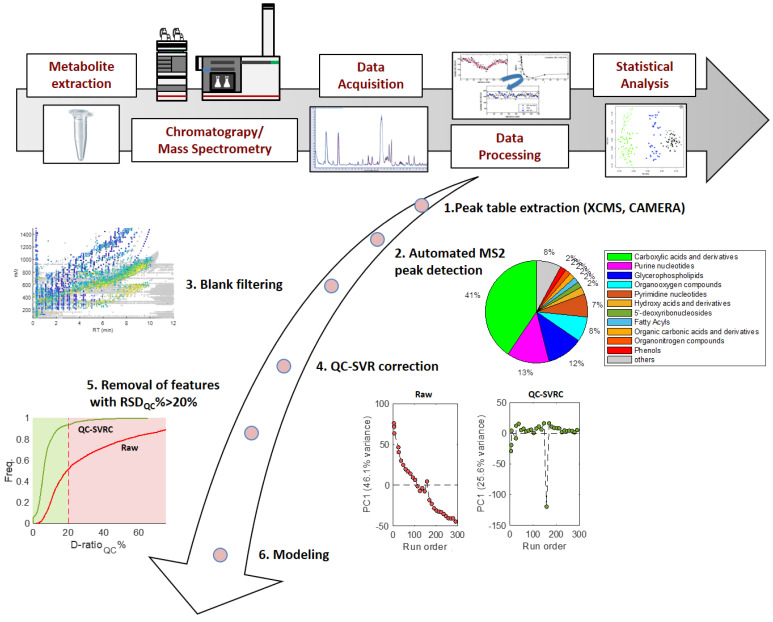
The overall workflow in metabolomic analysis. Robust data acquisition from DILI patients, normalisation and elimination of sources of variability and contamination are key for conclusive bioinformatic analysis that will allow identification of DILI biomarkers.
Figure 4
Figure 4
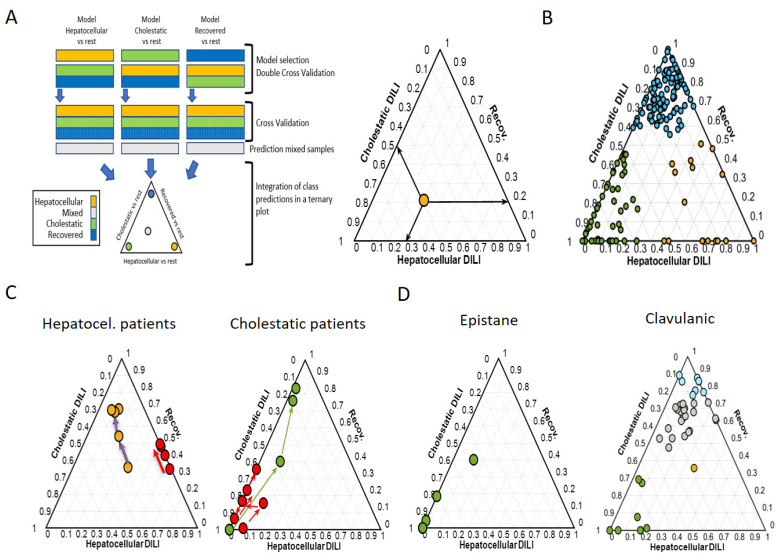
Schematic workflow of data analysis and modelling strategy to represent and interpret data in a ternary plot. (A) First, a PLS–DA analysis of each phenotype (hepatocellular DILI, cholestatic DILI and recovered patients) vs. the rest was carried out using the complete set of features. The set of y predicted values from the selected models were integrated into a ternary plot. A ternary plot is a two-dimensional graphical representation of three variables that sum to a constant. As PLS–DA “y” predicted values used for sample classification are unbound, “y” predicted values higher than 1 or lower than 0 were replaced by 1 or 0, respectively, and the position within the ternary plot was defined by the relative constrained “y” values. By doing this, the ternary plot was an equilateral triangle with edges to graphically depict the constrained “y”-predicted values for DILI (PLS–DA model: recovered vs. non-recovered), cholestasis (PLS–DA model: cholestasis vs. non-cholestatic), and hepatocellular (PLS–DA model: hepatocellular vs. non-cholestatic) damages. (B) Example of a ternary plot used to describe the different phenotypes of DILI (cholestatic, hepatocellular, and mixed, as well as those from recovered patients) predicted using the PLS–DA models. (C) Time-course monitoring of two patients initially diagnosed as hepatocellular and mixed-type (left triangle) or pure cholestatic (right triangle) DILI, and their evolution along the time course of the disease. While in some cases there is a clear improvement towards recovery (yellow and green dots), in others the situation worsened (red dots). (D) Not always that a given drug displays the same DILI phenotype in all patients. A given drug may or may not display the same DILI phenotype in all patients. While in the case of epistane all patients consistently displayed a cholestatic pattern (left triangle), in the case of clavulanic acid a wide range of mixed type DILI was observed (right panel). Dot colour represents the clinical classification at each point: green: cholestatic DILI; orange: hepatocellular DILI; gray: mixed DILI; blue: recovered patient (colour figure online). Panel A was obtained from [92].
Figure 5
Figure 5
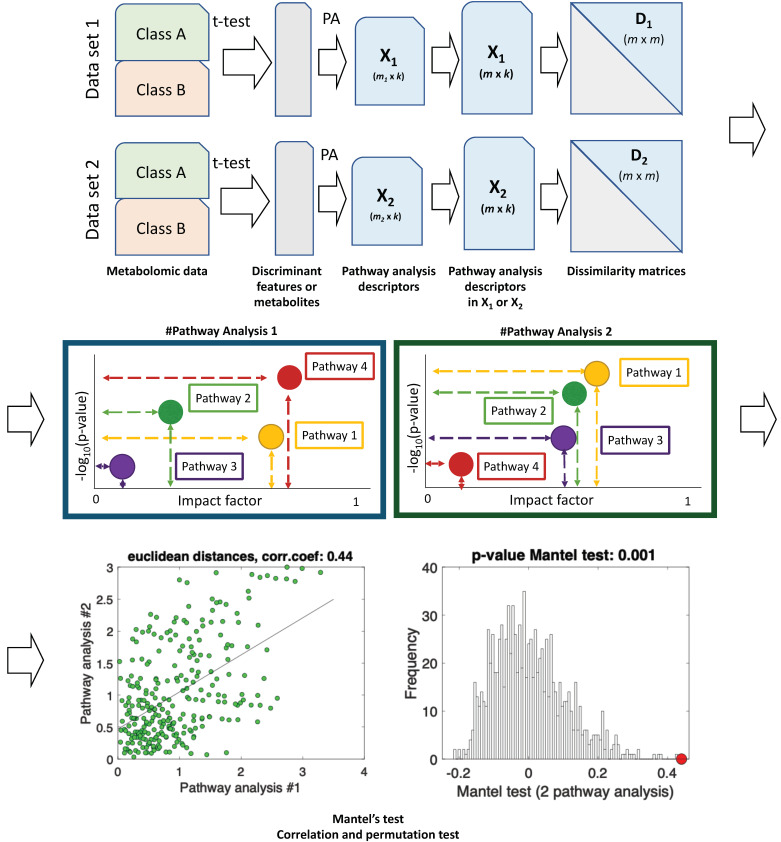
Schematic workflow for the functional correlation analysis of results from metabolic pathway analysis. Metabolomics data between two groups is compared by t-test analyses in two different datasets. Discriminant features or metabolites are identified, and metabolic pathway analysis performed. Results from pathway analysis are summarized with 2 k descriptors (the log10 (p-value), and the enrichment or impact factor) as coordinates of two data matrices X1 (m1 × k) and X2 (m2 × k) (m = pathways). As the number and identity of the pathways included in the results may vary across studies, for those pathways present in a single analysis, the p-values and the enrichment or impact factors are imputed as 1, and 0, respectively, in the other one (X1(m × k), X2(m × k). For each matrix × (m × k), a distance or dissimilarity matrix is computed (i.e., D1(m × m) and D2(m × m)) using a selected measure such as the Euclidean or the standardized Euclidean distance. Then, the lower triangular part of each dissimilarity matrix is unfolded into two vectors (d1 and d2) to calculate the pairwise linear correlation coefficient, (e.g., Pearson coefficient, or the rank-based Spearman correlation coefficient if non-linearity is expected) between them. The statistical significance of the calculated correlation coefficient between pathway analysis #1 and #2 is estimated using a permutation test and the correlation coefficient is computed for each permutation. Original figure from [73].

References

    1. Vuppalanchi R., Liangpunsakul S., Chalasani N. Etiology of new-onset jaundice: How often is it caused by idiosyncratic drug-induced liver injury in the United States? Am. J. Gastroenterol. 2007;102:558–693; quiz 693. doi: 10.1111/j.1572-0241.2006.01019.x. - DOI - PubMed
    1. Walker P.A., Ryder S., Lavado A., Dilworth C., Riley R.J. The evolution of strategies to minimise the risk of human drug-induced liver injury (DILI) in drug discovery and development. Arch. Toxicol. 2020;94:2559–2585. doi: 10.1007/s00204-020-02763-w. - DOI - PMC - PubMed
    1. Larson A.M., Polson J., Fontana R.J., Davern T.J., Lalani E., Hynan L., Reisch J.S., Schiødt F.V., Ostapowicz G., Shakil A.O., et al. Acetaminophen-induced acute liver failure: Results of a United States multicenter, prospective study. Hepatology. 2005;42:1364–1372. doi: 10.1002/hep.20948. - DOI - PubMed
    1. Ostapowicz G., Fontana R.J., Schiødt F.V., Larson A., Davern T.J., Han S.H., McCashland T.M., Shakil A.O., Hay J.E., Hynan L., et al. Results of a Prospective Study of Acute Liver Failure at 17 Tertiary Care Centers in the United States. Ann. Intern. Med. 2002;137:947–954. doi: 10.7326/0003-4819-137-12-200212170-00007. - DOI - PubMed
    1. Björnsson E., Jerlstad P., Bergqvist A., Olsson R. Fulminant drug-induced hepatic failure leading to death or liver transplantation in Sweden. Scand. J. Gastroenterol. 2005;40:1095–1101. doi: 10.1080/00365520510023846. - DOI - PubMed

LinkOut - more resources