


Environmentally Friendly Wheat Farming: Biological and Economic Efficiency of Three Treatments to Control Fungal Diseases in Winter Wheat (Triticum aestivum L.) under Field Conditions
- PMID: 35736716
- PMCID: PMC9228977
- DOI: 10.3390/plants11121566
Environmentally Friendly Wheat Farming: Biological and Economic Efficiency of Three Treatments to Control Fungal Diseases in Winter Wheat (Triticum aestivum L.) under Field Conditions
Abstract
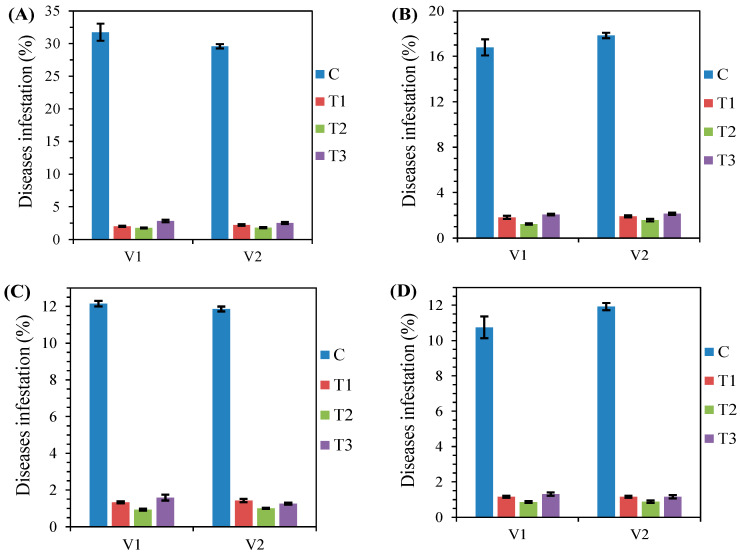
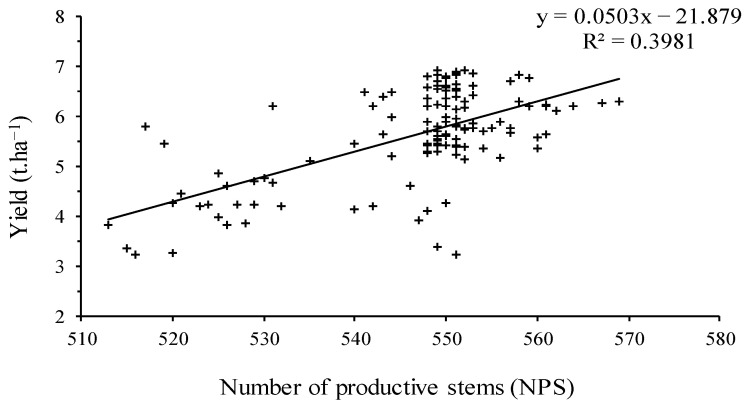
The control of wheat diseases using bioagents is not well studied under field conditions. The present study was aimed at investigating, during four consecutive growing seasons (2017-2020), the efficacy of two integrated crop protection (ICP) systems to control the common wheat diseases for enhancing the productivity and profitability of winter wheat crops and ensuring nutritional and food security. Two environmental-friendly treatments were tested, biological (T1), which contained bioagents and fertilizers, and combined (T2), which included fertilizers and bioagents coupled with lower doses of fungicides. The chemical treatment (T3) was used for comparison with (T1) and (T2). Furthermore, two Russian winter wheat varieties (Nemchinovskaya 17 (V1) and Moscovskaya 40 (V2)) were studied. A randomized complete block design was used with four replicates. Diseases infestation rates for snow mold (SM), root rot (RR), powdery mildew (PM), and Fusarium (Fus), yield performances, and grain quality (measured through protein content) were determined according to the tested treatments, and the economic efficiency was calculated for each treatment. The combined treatment (T2) was the most effective against fungal diseases with 1.8% (SM), 1.2% (RR), 0.9% (PM), and 0.9% (Fus). The highest grain yield (6.8 t·ha-1), protein content (15.2%), and 1000-grain weight (43.7%) were observed for winter wheat variety Moscovskaya 40 with the combined treatment (T2). The highest number of productive stems (N.P.S) (556 stems/m2) was attained for combined treatment (T2), followed by biological treatment (T1) (552 stems/m2) with the variety Nemchinovskaya 17. The profitability (cost-benefit ratio) of the combined treatment (T2) was 2.38 with the Moscovskaya 40 variety (V2), while 2.03 was recorded for the biological treatment. Applying environmentally friendly combined and biological treatments resulted in high wheat yield and net income, as well as healthy products.
Keywords: biopesticide; biotic stress; conservation agriculture; farm economics; fungal pathogens.
Conflict of interest statement
The authors declare no conflict of interest.
Figures


References
-
- Alcamo J., Dronin N., Endejan M., Golubev G., Kirilenko A. A new assessment of climate change impacts on food produc-tion shortfalls and water availability in Russia. Glob. Environ. Chang. 2007;17:429–444. doi: 10.1016/j.gloenvcha.2006.12.006. - DOI
-
- Zargar M., Rebouh N.Y., Pakina E., Gadzhikurbanov A., Lyashko M., Ortskhanov B. Impact of climate change on cereal production in the highlands of eastern Algeria. Res. Crops. 2017;18:575–582. doi: 10.5958/2348-7542.2017.00098.5. - DOI
-
- FAO . Cereal Supply and Demand Brief. Food and Agriculture Organization of the United Nations; Washington, DC, USA: 2021.
-
- Liu W., Sun C., Zhao Y., Xu F., Song Y., Fan J., Zhou Y., Xu X. Monitoring of wheat powdery mildew under different ni-trogen input levels using hyperspectral remote sensing. Remote Sens. 2021;13:3753. doi: 10.3390/rs13183753. - DOI
-
- Bernhoft A., Wang J., Leifert C. Effect of organic and conventional cereal production methods on Fusarium head blightand mycotoxin contamination levels. Agronomy. 2022;12:797. doi: 10.3390/agronomy12040797. - DOI
LinkOut - more resources
Full Text Sources
Research Materials
