


Research Progress of Safety of Zearalenone: A Review
- PMID: 35737047
- PMCID: PMC9230539
- DOI: 10.3390/toxins14060386
Research Progress of Safety of Zearalenone: A Review
Abstract
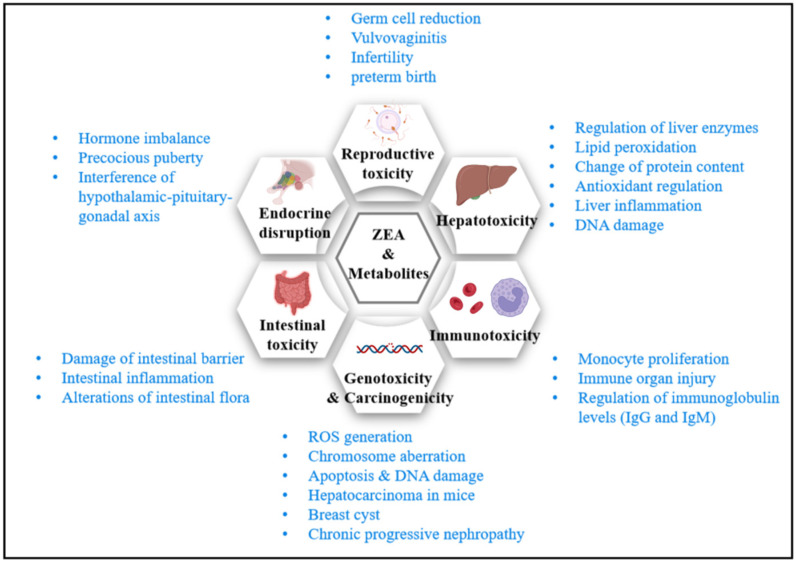
Zearalenone, a mycotoxin produced by fungi of the genus Fusarium, widely exists in animal feed and human food. The structure of zearalenone is similar to estrogen, so it mainly has estrogenic effects on various organisms. Products contaminated with zearalenone can pose risks to animals and humans. Therefore, it is imperative to carry out toxicological research on zearalenone and evaluate its risk to human health. This paper briefly introduces the production, physical, and chemical properties of zearalenone and the research progress of its toxicity kinetics, focusing on its genetic toxicity, reproductive toxicity, hepatotoxicity, immunotoxicity, carcinogenicity, endocrine interference, and its impact on intestinal health. Finally, the progress of the risk assessment of human exposure is summarized to provide a reference for the follow-up study of zearalenone.
Keywords: endocrine interference; intestinal health; mycotoxin; risk assessment; toxicity; zearalenone.
Conflict of interest statement
The authors declare no conflict of interest.
Figures
References
-
- Urry W.H., Wehrmeister H.L., Hodge E.B., Hidy P.H. The structure of zearalenone. Tetrahedron Lett. 1966;7:3109–3114. doi: 10.1016/S0040-4039(01)99923-X. - DOI
-
- EFSA Panel on Contaminants in the Food Chain Scientific Opinion on the risks for public health related to the presence of zearalenone in food. EFSA J. 2011;9:2197. doi: 10.2903/j.efsa.2011.2197. - DOI
Publication types
MeSH terms
Substances
LinkOut - more resources
Full Text Sources
