LUNCH-Lung Ultrasound for early detection of silent and apparent aspiratioN in infants and young CHildren with cerebral palsy and other developmental disabilities: study protocol of a randomized controlled trial
- PMID: 35739502
- PMCID: PMC9219199
- DOI: 10.1186/s12887-022-03413-z
LUNCH-Lung Ultrasound for early detection of silent and apparent aspiratioN in infants and young CHildren with cerebral palsy and other developmental disabilities: study protocol of a randomized controlled trial
Abstract
Background: Children with neurological impairment may have dysphagia and/or gastro-esophageal reflux disease (GERD), which predispose to complications affecting the airways, increasing risk for aspiration-induced acute and chronic lung disease, or secondarily malnutrition, further neurodevelopmental disturbances, stressful interactions with their caregivers and chronic pain. Only multidisciplinary clinical feeding evaluation and empirical trials are applied to provide support to the management of feeding difficulties related to dysphagia or GERD, but no standardized feeding or behavioral measure exists at any age to assess aspiration risk and support the indication to perform a videofluoroscopic swallowing study (VFSS) or a fibre-optic endoscopic examination of swallowing (FEES), in particular in newborns and infants with neurological impairments. Lung ultrasound (LUS) has been proposed as a non-invasive, radiation-free tool for the diagnosis of pulmonary conditions in infants, with high sensitivity and specificity.
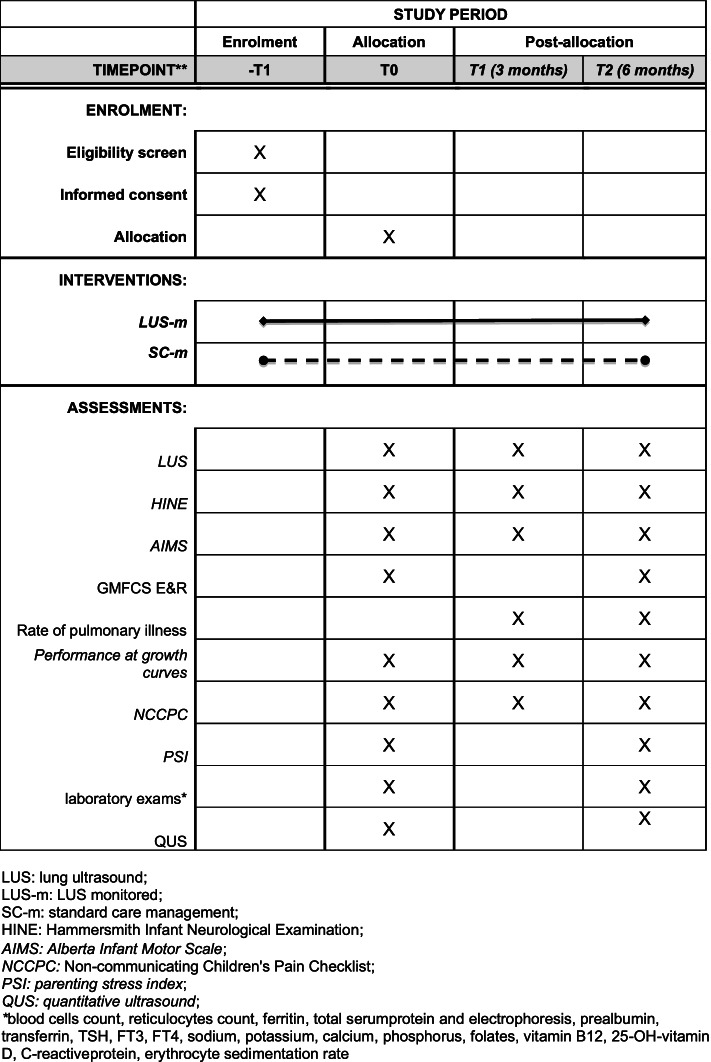
Methods: A RCT will be conducted in infants aged between 0 and 6 years having, or being at risk for, cerebral palsy, or other neurodevelopmental disease that determines abnormal muscular tone or motor developmental delay assessed by a quantitative scale for infants or if there is the suspicion of GERD or dysphagia based on clinical symptoms. Infants will be allocated in one of 2 groups: 1) LUS-monitored management (LUS-m); 2) Standard care management (SC-m) and after baseline assessment (T0), both groups will undergo an experimental 6-months follow-up. In the first 3 months, infants will be evaluated a minimum of 1 time per month, in-hospital, for a total of 3 LUS-monitored meal evaluations. Primary and secondary endpoint measures will be collected at 3 and 6 months.
Discussion: This paper describes the study protocol consisting of a RCT with two main objectives: (1) to evaluate the benefits of the use of LUS for monitoring silent and apparent aspiration in the management of dysphagia and its impact on pulmonary illness and growth and (2) to investigate the impact of the LUS management on blood sample and bone metabolism, pain and interaction with caregivers.
Trial registration: Trial registration date 02/05/2020; ClinicalTrials.gov Identifier: NCT04253951 .
Keywords: Aspiration; Dysphagia; GERD; Infant; Lung ultrasound (LUS); Neurological impairment.
© 2022. The Author(s).
Conflict of interest statement
Authors have no competing interests to declare.
Figures