. 2022 Aug 15:436:129255.
doi: 10.1016/j.jhazmat.2022.129255. Epub 2022 Jun 1.

Indirect effects of COVID-19 on the environment: How plastic contamination from disposable surgical masks affect early development of plants

Affiliations

Indirect effects of COVID-19 on the environment: How plastic contamination from disposable surgical masks affect early development of plants

Enikő Mészáros et al. J Hazard Mater. .

Abstract

Personal protective equipment, used extensively during the COVID-19 pandemic, heavily burdened the environment due to improper waste management. Owing to their fibrous structure, layered non-woven polypropylene (PP) disposable masks release secondary fragments at a much higher rate than other plastic waste types, thus, posing a barely understood new form of ecological hazard. Here we show that PP mask fragments of different sizes induce morphogenic responses in plants during their early development. Using in vitro systems and soil-filled rhizotrons, we found that several PP mask treatments modified the root growth of Brassica napus (L.) regardless of the experimental system. The environment around the root and mask fragments seemed to influence the effect of PP fabric fragment contamination on early root growth. In soil, primary root length was clearly inhibited by larger PP mask fragments at 1 % concentration, while the two smallest sizes of applied mask fragments caused distinct, concentration-dependent changes in the lateral root numbers. Our results indicate that PP can act as a stressor: contamination by PP surgical masks affects plant growth and hence, warrants attention. Further investigations regarding the effects of plastic pollution on plant-soil interactions involving various soil types are urgently needed.

Keywords: Brassica napus; Non-woven fabric; Polypropylene; Root system architecture.


Conflict of interest statement

The authors declare that they have no known competing financial interests or personal relationships that could have appeared to influence the work reported in this paper.

Figures
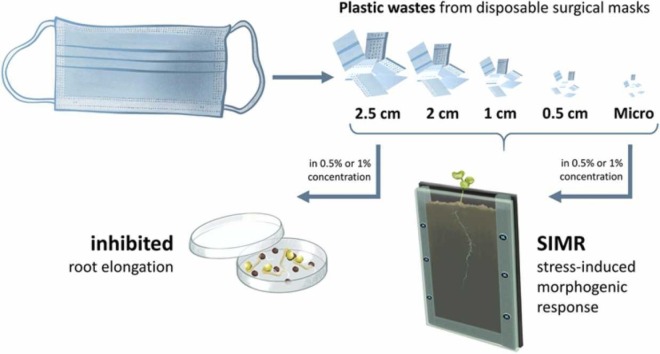
ga1
Graphical abstract
Fig. 1
Fig. 1
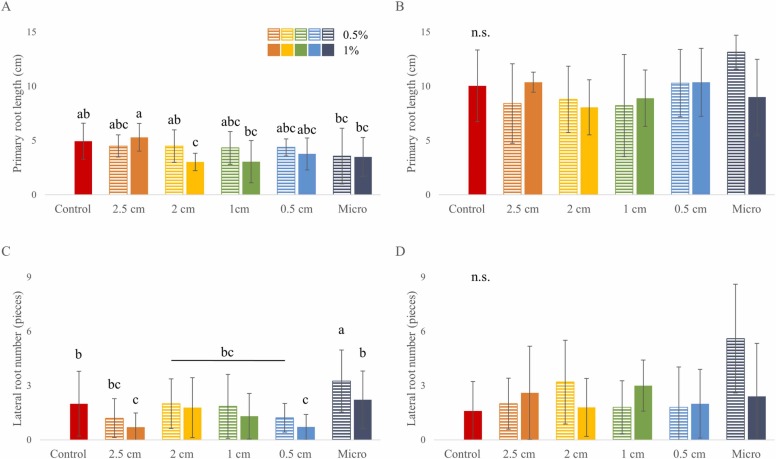
Root growth parameters of 5-days-old B. napus seedlings grown in two experimental setups supplemented with PP surgical mask fragments of different sizes at 0.5 % and 1 % concentrations: (A) primary root lengths in the in vitro and (B) in the rhizotron systems; (C) lateral root numbers in the in vitro and (D) in the rhizotron systems. Different letters indicate significant differences according to Duncan-test (p ≤ 0.05), n.s.: no significant difference.
Fig. 2
Fig. 2
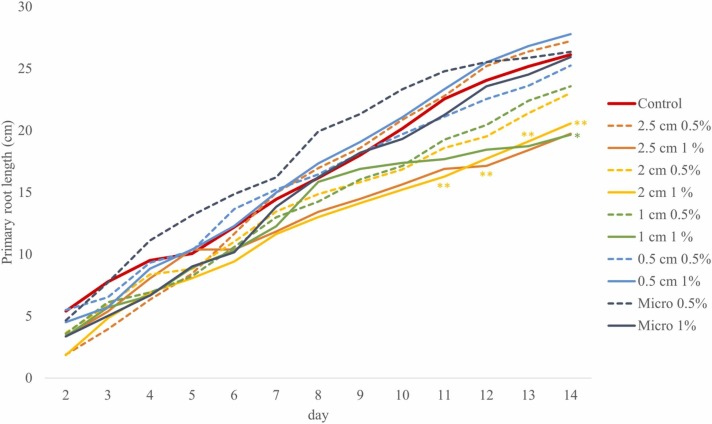
Primary root lengths of B. napus seedlings grown in soil-filled rhizotron systems supplemented with PP surgical mask fragments of different sizes at 0.5 % and 1 % concentrations. Significant differences compared to the control are marked according to Student’s t-test (*p ≤ 0.05, **p ≤ 0.01, ***p ≤ 0.001).
Fig. 3
Fig. 3
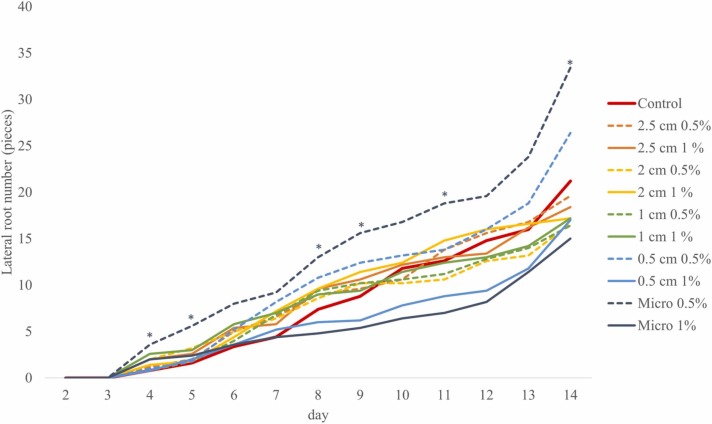
Lateral root numbers of B. napus seedlings grown in soil-filled rhizotron systems supplemented with PP surgical mask fragments of different sizes at 0.5 % and 1 % concentrations. Significant differences compared to the control are marked according to Student’s t-test (*p ≤ 0.05, **p ≤ 0.01, ***p ≤ 0.001).
Fig. 4
Fig. 4
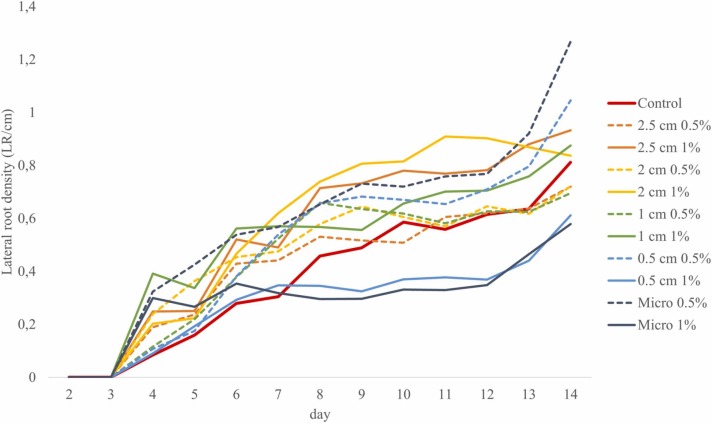
Lateral root density of B. napus throughout the 14 days of growing period in the soil-filled rhizotron system, supplemented with PP surgical mask fragments of different sizes at 0.5 % and 1 % concentrations.
Fig. 5
Fig. 5
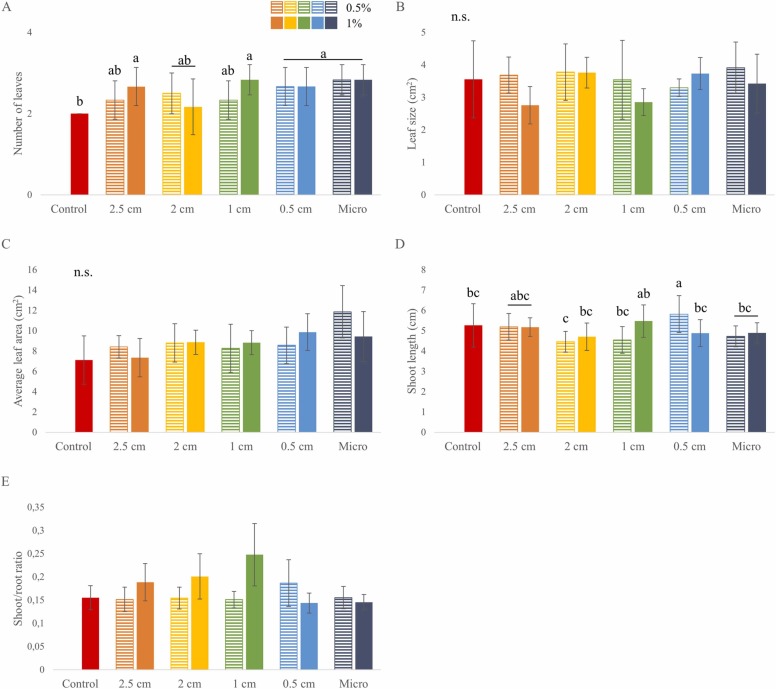
Shoot growth parameters of the 14-days-old B. napus seedlings grown in the rhizotron system supplemented with PP surgical mask fragments of different sizes at 0.5 or 1 % concentrations: (A) number of leaves per plant; (B) average leaf size; (C) average leaf area per plant; (D) shoot length; and (E) shoot/root ratio. Different letters indicate significant differences according to Duncan-test (p ≤ 0.05), n.s.: no significant difference.
Fig. 6
Fig. 6
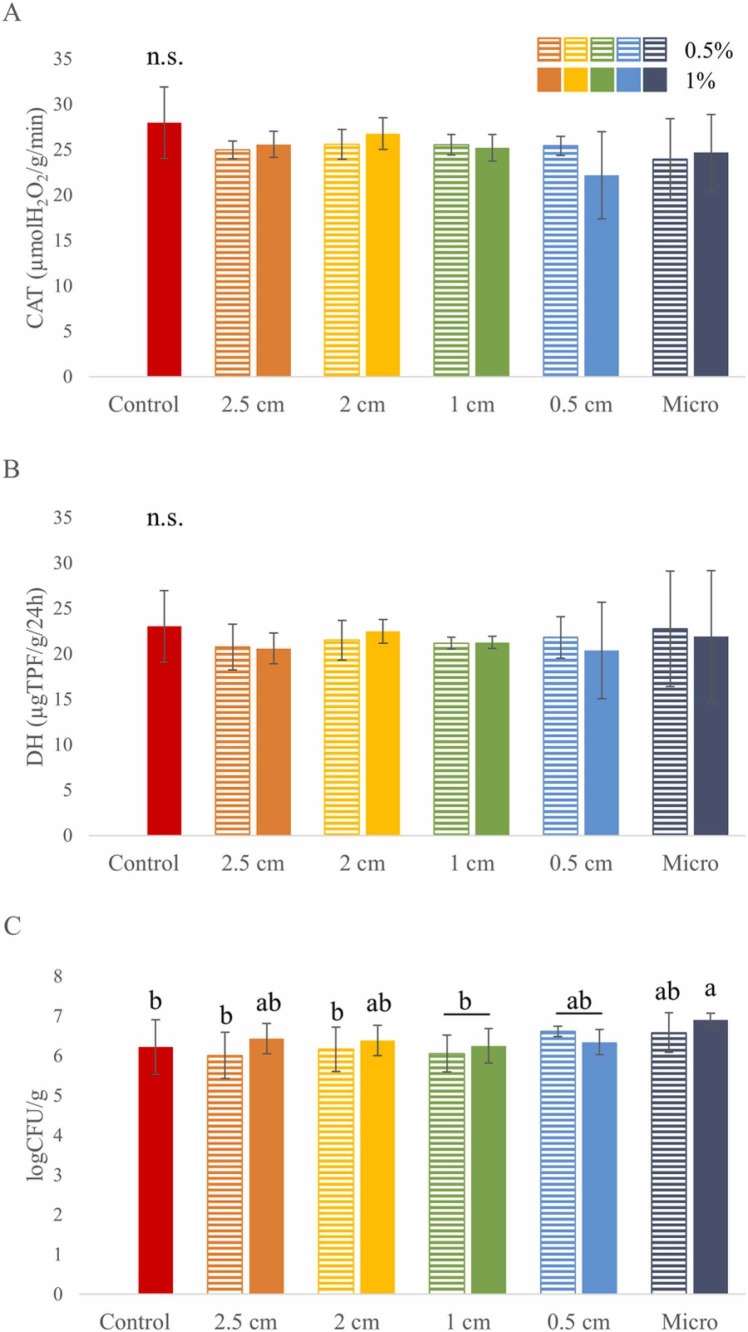
The activity of (A) catalase (CAT) and (B) dehydrogenase (DH) enzymes, and (C) the number of aerobic heterotrophic bacteria number measured in the rhizotron soils on the14th day. Different letters indicate significant differences according to Duncan-test (p ≤ 0.05), n.s.: no significant difference.

References

    1. Abedin M., Khandaker M.U., Uddin M., Karim M., Ahamad M., Islam M., Idris A.M. PPE pollution in the terrestrial and aquatic environment of the Chittagong city area associated with the COVID-19 pandemic and concomitant health implications. Environ. Sci. Pollut. Res. 2022:1–13. - PMC - PubMed
    1. Ammendolia J., Saturno J., Brooks A.L., Jacobs S., Jambeck J.R. An emerging source of plastic pollution: environmental presence of plastic personal protective equipment (PPE) debris related to COVID-19 in a metropolitan city. Environ. Pollut. 2021;269 - PMC - PubMed
    1. Aragaw T.A. Surgical face masks as a potential source for microplastic pollution in the COVID-19 scenario. Mar. Pollut. Bull. 2020;159 - PMC - PubMed
    1. Ardusso M., Forero-López A.D., Buzzi N.S., Spetter C.V., Fernández-Severini M.D. COVID-19 pandemic repercussions on plastic and antiviral polymeric textile causing pollution on beaches and coasts of South America. Sci. Total Environ. 2021;763 - PMC - PubMed
    1. Balestri E., Menicagli V., Ligorini V., Fulignati S., Galletti A.M.R., Lardicci C. Phytotoxicity assessment of conventional and biodegradable plastic bags using seed germination test. Ecol. Indic. 2019;102:569–580.

Publication types