Review
. 2022 Jun 18;12(12):1578.
doi: 10.3390/ani12121578.

Epidemiology, Diagnosis, and Prevention of Sparganosis in Asia

Affiliations
Review

Epidemiology, Diagnosis, and Prevention of Sparganosis in Asia

Wei Liu et al. Animals (Basel). .

Abstract

Sparganosis is a zoonotic parasitic disease caused by the larvae (spargana) of the genus Spirometra, which is widely distributed globally and threatens human health. More than 60 species of Spirometra have already been identified, and over 2000 cases have been reported. This review summarizes the prevalence of humans, frogs, snakes, and other animals with spargana. Furthermore, the infection mode, distribution, and site are summarized and analyzed. We also describe the epidemiology, molecular diagnosis, and other aspects which are of considerable significance to preventing sparganum.

Keywords: epidemiological investigation; molecular diagnosis; sparganum.


Conflict of interest statement

The authors declare no conflict of interest. The funders had no role in the study’s design; in the collection, analyses, or interpretation of data; in the writing of the manuscript; or in the decision to publish the results.

Figures

Figure 1
Figure 1
The life cycle of Spirometra tapeworm. 1: Spirometra adult worms; 2: eggs; 3: eggs hatch in water; 4: coracidia; 5: procercoid larvae; 6: sparganum: A: the definitive hosts: dogs and cats; B: the first intermediate hosts: cyclops; C: the second intermediate hosts: frogs and tadpoles; D, E: the paratenic hosts: human beings and snakes.
Figure 2
Figure 2
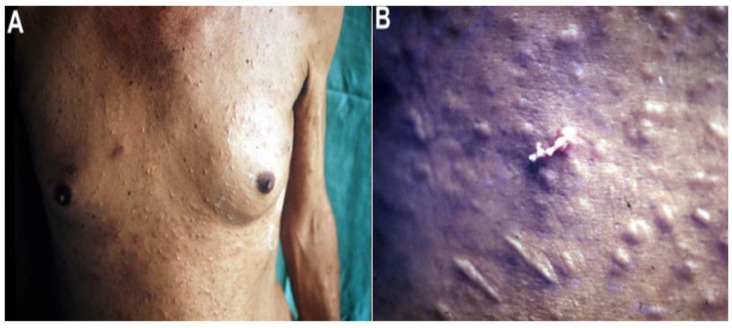
Proliferative sparganosis in a patient showing (A) dermal nodules on the chest wall and (B) Sparganum proliferum plerocercoid squeezing out of the skin. (This figure is from Kikuchi et al., [15]).
Figure 3
Figure 3
Geographical distribution of human sparganosis in mainland China.
Figure 4
Figure 4
Geographical distribution of human sparganosis in Asia.

References

    1. Zhang X., Duan J.Y., Shi Y.L., Jiang P., Zeng J., Wang Z.Q., Cui J. Comparative mitochondrial genomics among Spirometra (Cestoda: Diphyllobothriidae) and the molecular phylogeny of related tapeworms. Mol. Phylogenet. Evol. 2017;117:75–82. doi: 10.1016/j.ympev.2017.06.003. - DOI - PubMed
    1. Kuchta R., Kołodziej-Sobocińska M., Brabec J., Młocicki D., Sałamatin R., Scholz T. Sparganosis (Spirometra) in Europe in the Molecular Era. Clin. Infect. Dis. 2021;72:882–890. doi: 10.1093/cid/ciaa1036. - DOI - PubMed
    1. Kuchta R., Scholz T. Planetary Biodiversity Inventory (2008–2017): Tapeworms from Vertebrate Bowels of the Earth. Natural History Museum, University of Kansas; Lawrence, KS, USA: 2017. pp. 167–189. Special Publication No. 25.
    1. Jeon H.K., Park H., Lee D., Choe S., Sohn W.M., Eom K.S. Molecular Detection of Spirometra decipiens in the United States. Korean J. Parasitol. 2016;54:503–507. doi: 10.3347/kjp.2016.54.4.503. - DOI - PMC - PubMed
    1. Anantaphruti M.T., Nawa Y., Vanvanitchai Y. Human sparganosis in Thailand: An overview. Acta Trop. 2011;118:171–176. doi: 10.1016/j.actatropica.2011.03.011. - DOI - PubMed

LinkOut - more resources