


Clinical Determinants Predicting Clostridioides difficile Infection among Patients with Chronic Kidney Disease
- PMID: 35740191
- PMCID: PMC9220164
- DOI: 10.3390/antibiotics11060785
Clinical Determinants Predicting Clostridioides difficile Infection among Patients with Chronic Kidney Disease
Abstract
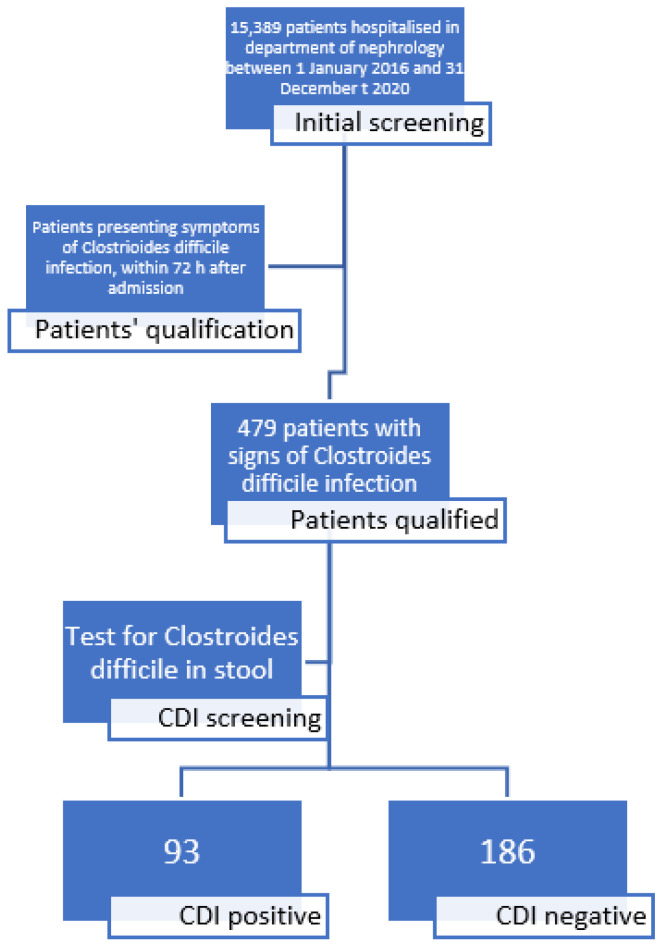
The majority of recently published studies indicate a greater incidence rate and mortality due to Clostridioides difficile infection (CDI) in patients with chronic kidney disease (CKD). The aim of this study was to assess the clinical determinants predicting CDI among hospitalized patients with CKD and refine methods of prevention. We evaluated the medical records of 279 patients treated at a nephrological department with symptoms suggesting CDI, of whom 93 tested positive for CDI. The survey showed that age, poor kidney function, high Padua prediction score (PPS) and patients' classification of care at admission, treatment with antibiotics, and time of its duration were significantly higher or more frequent among patients who suffered CDI. Whereas BMI, Norton scale (ANSS) and serum albumin concentration were significantly lowered among CDI patients. In a multivariate analysis we proved the stage of CKD and length of antibiotics use increased the risk of CDI, whereas higher serum albumin concentration and ANSS have a protective impact.
Keywords: Clostridioides difficile; chronic kidney disease; malnutrition; pseudomembranous enterocolitis.
Conflict of interest statement
The authors declare no conflict of interest.
Figures
References
-
- McDonald L.C., Gerding D.N., Johnson S., Bakken J.S., Carroll K.C., Coffin S.E., Dubberke E.R., Garey K.W., Gould C.V., Kelly C., et al. Clinical Practice Guidelines for Clostridium difficile Infection in Adults and Children: 2017 Update by the Infectious Diseases Society of America (IDSA) and Society for Healthcare Epidemiology of America (SHEA) Clin. Infect. Dis. 2018;66:e1–e48. doi: 10.1093/cid/cix1085. - DOI - PMC - PubMed
-
- Czepiel J., Krutova M., Mizrahi A., Khanafer N., Enoch D.A., Patyi M., Deptuła A., Agodi A., Nuvials X., Pituch H., et al. Mortality Following Clostridioides difficile Infection in Europe: A Retrospective Multicenter Case-Control Study. Antibiotics. 2021;10:299. doi: 10.3390/antibiotics10030299. - DOI - PMC - PubMed
LinkOut - more resources
Full Text Sources
