. 2022 Jun 11;11(6):793.
doi: 10.3390/antibiotics11060793.

The Role of Gut Microbiota in the Skeletal Muscle Development and Fat Deposition in Pigs

Affiliations

The Role of Gut Microbiota in the Skeletal Muscle Development and Fat Deposition in Pigs

Qi Han et al. Antibiotics (Basel). .

Abstract

Pork quality is a factor increasingly considered in consumer preferences for pork. The formation mechanisms determining meat quality are complicated, including endogenous and exogenous factors. Despite a lot of research on meat quality, unexpected variation in meat quality is still a major problem in the meat industry. Currently, gut microbiota and their metabolites have attracted increased attention in the animal breeding industry, and recent research demonstrated their significance in muscle fiber development and fat deposition. The purpose of this paper is to summarize the research on the effects of gut microbiota on pig muscle and fat deposition. The factors affecting gut microbiota composition will also be discussed, including host genetics, dietary composition, antibiotics, prebiotics, and probiotics. We provide an overall understanding of the relationship between gut microbiota and meat quality in pigs, and how manipulation of gut microbiota may contribute to increasing pork quality for human consumption.

Keywords: diet composition; fat deposition; gut microbiota; host genetics; muscle fiber; pork.


Conflict of interest statement

The authors declare no conflict of interest.

Figures
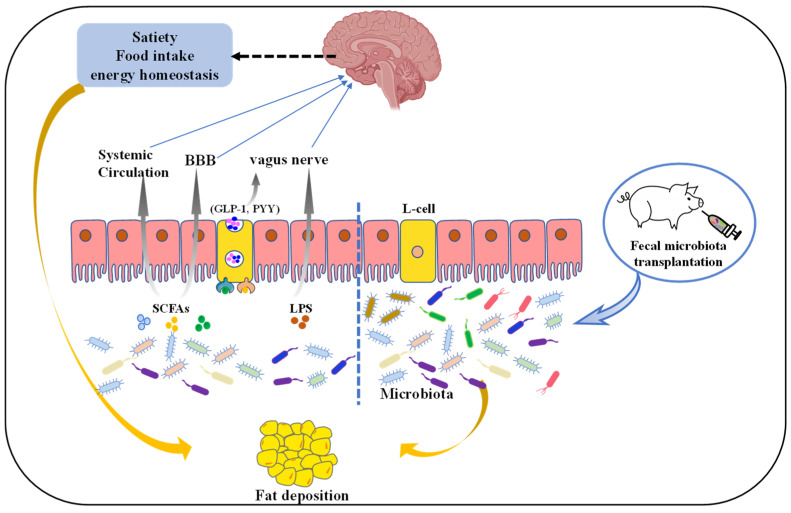
Figure 1
Figure 1
The mechanism of gut microbiota regulates pig fat deposition. Microbiota-derived metabolites such as SCFAs or lipopolysaccharide (LPS) affect satiety, food intake, or energy homeostasis directly via the vagus nerve (VN) or indirectly blood–brain barrier (BBB) and systemic circulation. L-cells are activated by these microbial metabolites through activation of different receptors, resulting in the production of gut hormones such as glucagon-like peptide-1 (GLP-1) and peptide YY (PYY). These intestinal hormones signal from the gut to the nucleus tractus solitarius in the brain via the VN and direct secretion into the circulatory system. Additionally, fecal microbiota transplantation (FMT), where fecal microbiota from a donor is transplanted into a recipient GI tract, has the potential to be an effective option to regulate fat deposition.
Figure 2
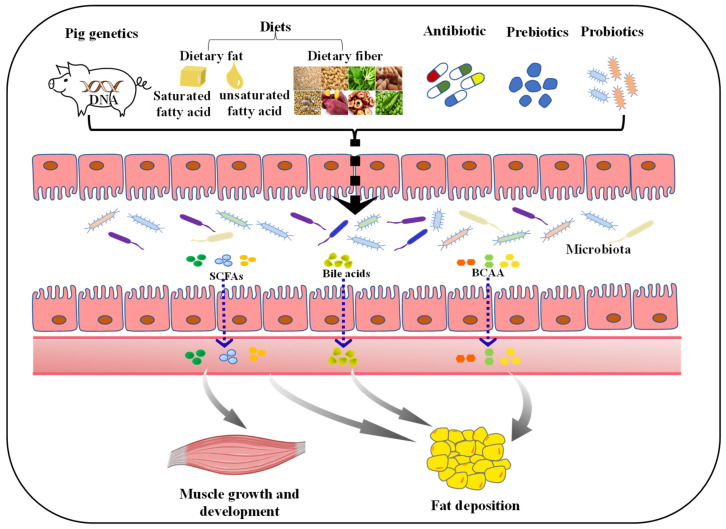
Figure 2
Factors affecting porcine muscle growth and development, and fat deposition via regulating gut microbiota. The diversity of gut microbiota can be influenced by many factors. Both host genetics and diet composition (such as dietary fat, fiber) play a pivotal role in shaping the gut microbiota. Moreover, subtherapeutic doses of antibiotics applied in commercial farming can negatively impact the microbiota. The addition of probiotics and prebiotics could improve gut microbiota diversity. Ultimately, these factors can affect the growth and development of muscle, and fat deposition in pigs by regulating the composition and metabolites (such as SCFAs, bile acids and BCAA) of gut microbiota. SCFAs, short-chain fatty acids; BCAA, branched-chain amino acids.

References

    1. OECD. Food and Agriculture Organization of the United Nations . OECD-FAO Agricultural Outlook 2021–2030. OECD Publishing; Paris, France: 2021. - DOI
    1. Li X., Zhang D., Ren C., Bai Y., Ijaz M., Hou C., Chen L. Effects of protein posttranslational modifications on meat quality: A review. Compr. Rev. Food Sci. Food Saf. 2021;20:289–331. doi: 10.1111/1541-4337.12668. - DOI - PubMed
    1. Kearney J. Food consumption trends and drivers. Philos. Trans. R. Soc. Lond. B Biol. Sci. 2010;365:2793–2807. doi: 10.1098/rstb.2010.0149. - DOI - PMC - PubMed
    1. Yang H., Xiang Y., Robinson K., Wang J., Zhang G., Zhao J., Xiao Y. Gut Microbiota Is a Major Contributor to Adiposity in Pigs. Front. Microbiol. 2018;9:3045. doi: 10.3389/fmicb.2018.03045. - DOI - PMC - PubMed
    1. Valdes A.M., Walter J., Segal E., Spector T.D. Role of the gut microbiota in nutrition and health. BMJ. 2018;361:k2179. doi: 10.1136/bmj.k2179. - DOI - PMC - PubMed

LinkOut - more resources