. 2022 Jun 3;10(6):1315.
doi: 10.3390/biomedicines10061315.

Identification of the Potential Molecular Mechanisms Linking RUNX1 Activity with Nonalcoholic Fatty Liver Disease, by Means of Systems Biology

Affiliations

Identification of the Potential Molecular Mechanisms Linking RUNX1 Activity with Nonalcoholic Fatty Liver Disease, by Means of Systems Biology

Laia Bertran et al. Biomedicines. .

Abstract

Nonalcoholic fatty liver disease (NAFLD) is the most prevalent chronic hepatic disease; nevertheless, no definitive diagnostic method exists yet, apart from invasive liver biopsy, and nor is there a specific approved treatment. Runt-related transcription factor 1 (RUNX1) plays a major role in angiogenesis and inflammation; however, its link with NAFLD is unclear as controversial results have been reported. Thus, the objective of this work was to determine the proteins involved in the molecular mechanisms between RUNX1 and NAFLD, by means of systems biology. First, a mathematical model that simulates NAFLD pathophysiology was generated by analyzing Anaxomics databases and reviewing available scientific literature. Artificial neural networks established NAFLD pathophysiological processes functionally related to RUNX1: hepatic insulin resistance, lipotoxicity, and hepatic injury-liver fibrosis. Our study indicated that RUNX1 might have a high relationship with hepatic injury-liver fibrosis, and a medium relationship with lipotoxicity and insulin resistance motives. Additionally, we found five RUNX1-regulated proteins with a direct involvement in NAFLD motives, which were NFκB1, NFκB2, TNF, ADIPOQ, and IL-6. In conclusion, we suggested a relationship between RUNX1 and NAFLD since RUNX1 seems to regulate NAFLD molecular pathways, posing it as a potential therapeutic target of NAFLD, although more studies in this field are needed.

Keywords: NAFLD; NASH; RUNX1; metabolism; systems biology.


Conflict of interest statement

The authors declare no conflict of interest.

Figures
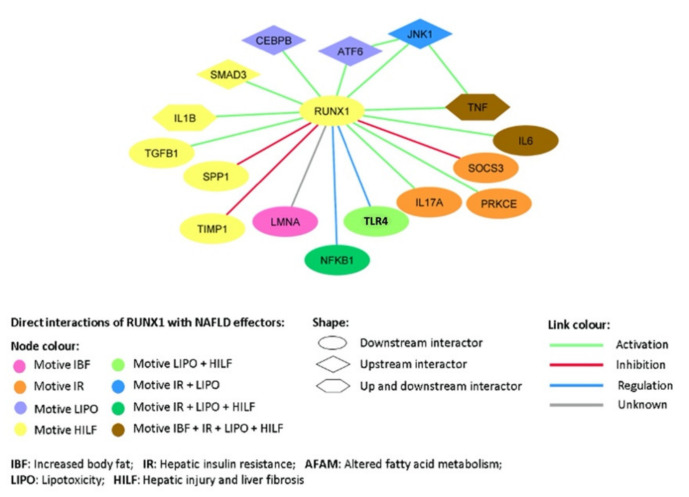
Figure 1
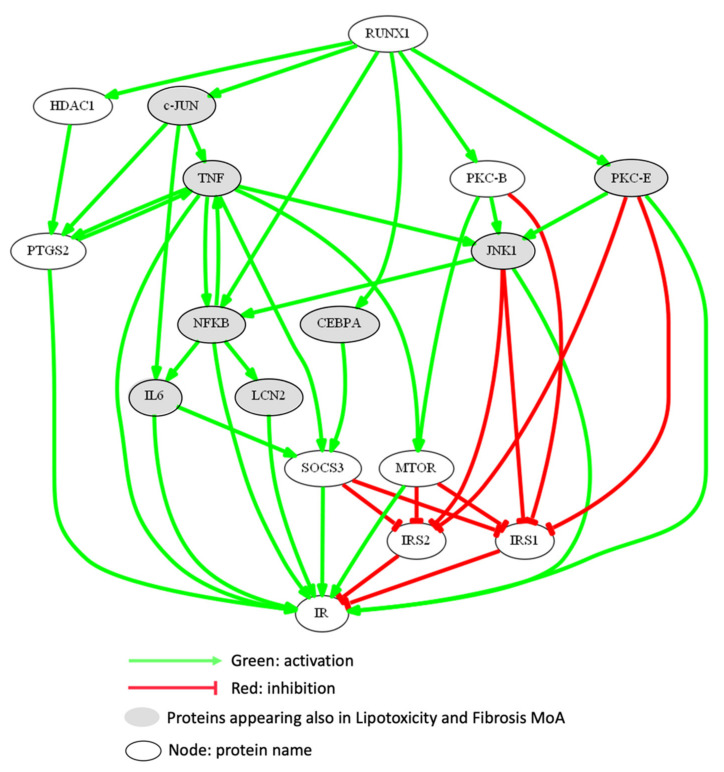
Figure 1
NAFLD effector proteins interacting with RUNX1 at distance 1 (direct link). RUNX1, runt-related protein 1; CEBPB, CCAAT/enhancer-binding protein beta; ATF-6, AMP-dependent transcription factor 6; JNK1, c-Jun N-terminal kinase 1; TNF, tumour necrosis factor; IL6, interleukin 6; SOCS3, suppressor of cytokine signaling 3; PKCE, protein kinase C epsilon type; IL17A, interleukin 17A; TLR4, toll-like receptor 4; NFKB1, nuclear factor kappa B 1; LMNA, lamin-A/C; TIMP1, metalloproteinase inhibitor 1; SPP1, secreted phosphoprotein 1; TFGB1, transforming growth factor beta-1 proprotein; IL1B, interleukin 1 beta; SMAD3, mothers against decapentaplegic homolog 3.
Figure 2
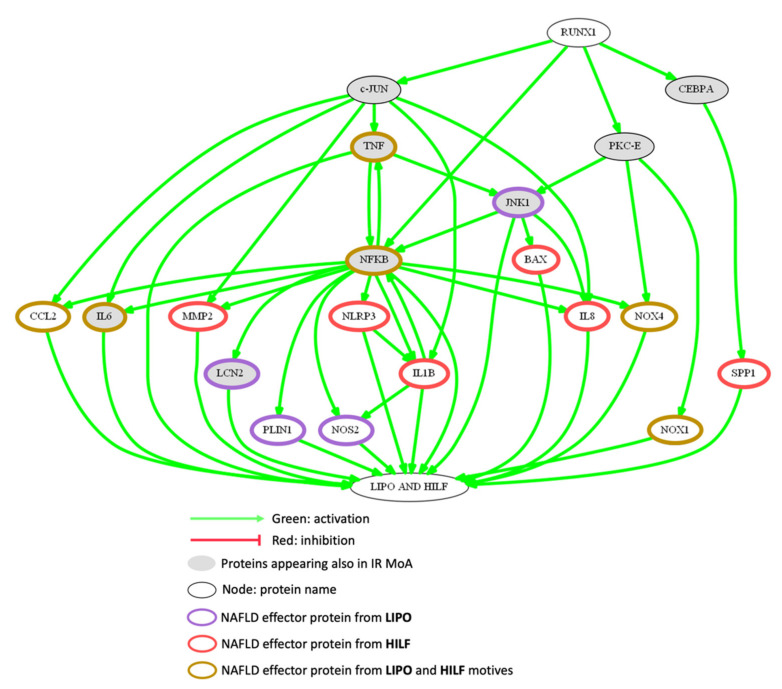
Figure 2
Most represented MoA of RUNX1 promoting IR in NAFLD in the population of TPMS model solutions. Gene names are used in the representations. RUNX1, runt-related protein 1; HDA1C, histone deacetylase 1; PTGS2, prostaglandin G/H synthase 2; c-Jun, protein encoded by JUN gene; TNF, tumour necrosis factor; NFκB, nuclear factor kappa B; IL6, interleukin 6; LCN2, neutrophil gelatinase-associated lipocalin 2; CEBPA, CCAAT/enhancer-binding protein beta; SOCS3, suppressor of cytokine signaling 3; PKC, protein kinase C; JNK1, c-Jun N-terminal kinase 1; MTOR, mammalian target of rapamycin serine/threonine-protein kinase; IRS, insulin receptor substrate. This picture was generated using Graphviz software.
Figure 3
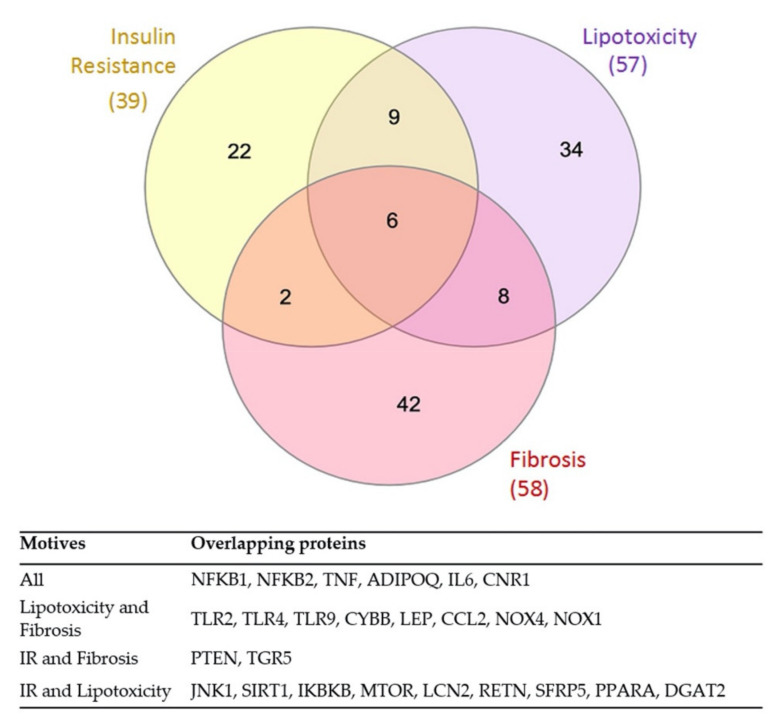
Figure 3
Most represented MoA of RUNX1 promoting lipotoxicity and hepatic injury and fibrosis in NAFLD in the population of TPMS model solutions. Gene names are used in the representations. RUNX1, runt-related protein 1; c-Jun, protein encoded by JUN gene; NFκB, nuclear factor kappa B; PKCε, protein kinase C epsilon; CEBPA, CCAAT/enhancer-binding protein alpha; SPP1, osteopontin; JNK1, c-Jun N-terminal kinase 1; BAX, BCL2 Associated X; CCL2, C-C motif chemokine 2; IL, interleukin; MMP2, matrix metalloproteinase-2; NLRP3, NACHT, LRR and PYD domains-containing protein 3; TLR, toll-like receptor; NOS2, inducible nitric oxide synthase; LCN2, neutrophil gelatinase-associated lipocalin; PLIN1, perlipin; NOX, NADPH oxidase; IR, insulin resistance; LIPO, lipotoxicity; HILF, hepatic injury and liver fibrosis. This picture was generated using Graphviz software.
Figure 4
Figure 4
Overlap of effector proteins between the three NAFLD motives evaluated in the project: VENN diagram showing the number of effector proteins overlapping between the three indicated NAFLD motives. There are 39 proteins involved in IR mechanism, 57 in lipotoxicity, and 58 in fibrosis. Concretely, there are 9 proteins involved in IR and lipotoxicity, 6 in lipotoxicity and fibrosis, and only 2 in IR and fibrosis. In this regard, there are six proteins involved in the three motives of NAFLD pathogenesis: NFκB1, NFκB2, TNF, ADIPOQ, IL-6, CNR1. IR, insulin resistance; NFKB, nuclear factor kappa B; TNF, tumour necrosis factor; ADIPOQ, adiponectin; IL6, interleukin 6; CNR1, cannabinoid receptor 1; TLR, toll-like receptor; CYBB, cytochrome b-245 heavy chain; LEP, leptin; CCL2, C-C motif chemokine 2; NOX, NADPH oxidase; PTEN, phosphatase and tensin homolog; TGR5, G protein-coupled bile acid receptor-1; JNK1, c-Jun N-terminal kinase; SIRT1, sirtuin 1; IKBKB, inhibitor of nuclear factor kappa B kinase subunit beta; MTOR, mammalian target of rapamycin serine/threonine-protein kinase; LCN2, neutrophil gelatinase-associated lipocalin 2; RETN, resistin; SFRP5, secreted frizzled-related protein 5; PPARA, peroxisome proliferator-activated receptor alpha; DGAT2, diacylglycerol O-Acyltransferase 2.

References

    1. Arciello M., Gori M., Maggio R., Barbaro B., Tarocchi M., Galli A., Balsano C. Environmental Pollution: A Tangible Risk for NAFLD Pathogenesis. Int. J. Mol. Sci. 2013;14:22052–22066. doi: 10.3390/ijms141122052. - DOI - PMC - PubMed
    1. Sarwar R., Pierce N., Koppe S. Obesity and Nonalcoholic Fatty Liver Disease: Current Perspectives. DMSO. 2018;11:533–542. doi: 10.2147/DMSO.S146339. - DOI - PMC - PubMed
    1. Larter C.Z., Chitturi S., Heydet D., Farrell G.C. A Fresh Look at NASH Pathogenesis. Part 1: The Metabolic Movers. J. Gastroenterol. Hepatol. 2010;25:672–690. doi: 10.1111/j.1440-1746.2010.06253.x. - DOI - PubMed
    1. Cohen J.C., Horton J.D., Hobbs H.H. Human Fatty Liver Disease: Old Questions and New Insights. Science. 2011;332:1519–1523. doi: 10.1126/science.1204265. - DOI - PMC - PubMed
    1. Cotter T.G., Rinella M. Nonalcoholic Fatty Liver Disease 2020: The State of the Disease. Gastroenterology. 2020;158:1851–1864. doi: 10.1053/j.gastro.2020.01.052. - DOI - PubMed

LinkOut - more resources