Review
. 2022 Jun 17;10(6):1439.
doi: 10.3390/biomedicines10061439.

Clinical Application for Tissue Engineering Focused on Materials

Affiliations
Review

Clinical Application for Tissue Engineering Focused on Materials

Takahiro Kitsuka et al. Biomedicines. .

Abstract

Cardiovascular-related medical conditions remain a significant cause of death worldwide despite the advent of tissue engineering research more than half a century ago. Although autologous tissue is still the preferred treatment, donor tissue is limited, and there remains a need for tissue-engineered vascular grafts (TEVGs). The production of extensive vascular tissue (>1 cm3) in vitro meets the clinical needs of tissue grafts and biological research applications. The use of TEVGs in human patients remains limited due to issues related to thrombogenesis and stenosis. In addition to the advancement of simple manufacturing methods, the shift of attention to the combination of synthetic polymers and bio-derived materials and cell sources has enabled synergistic combinations of vascular tissue development. This review details the selection of biomaterials, cell sources and relevant clinical trials related to large diameter vascular grafts. Finally, we will discuss the remaining challenges in the tissue engineering field resulting from complex requirements by covering both basic and clinical research from the perspective of material design.

Keywords: 3D printing; biodegradable scaffolds; clinical trials; decellularized tissue; electrospinning; silk fibroin; synthetic polymers; tissue engineering; tissue-engineered vascular grafts (TEVGs).


Conflict of interest statement

Toshiharu Shinoka has received grant support from Gunze Ltd. Other authors report no conflicts of interest.

Figures
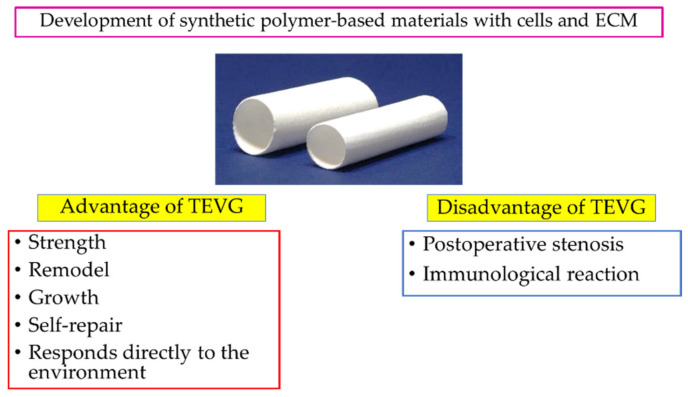
Figure 1
Figure 1
The advantages and disadvantages of TEVGs have emerged over years of development. Recently, the focus has been on the development of next-generation TEVGs with cells and ECM in synthetic polymer-based materials. The image was produced by the authors using the photos provided by Gunze Ltd. (Tokyo, Japan).
Figure 2
Figure 2
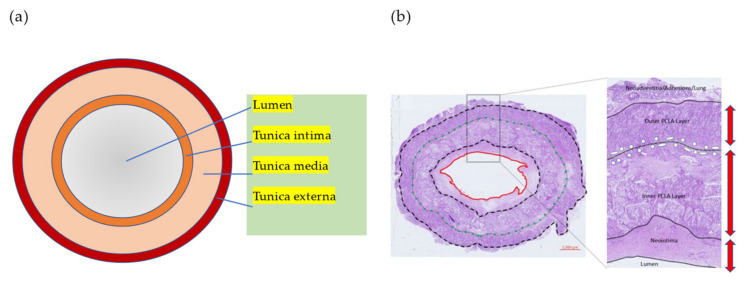
(a) Typical structure diagram of blood vessels. Blood vessels consist of three layers: tunica intima, tunica media, and tunica externa. (b) Tissue staining image of a typical TEVG fabricated with polylactide-co-caprolactone (PCLA) and polyglycolic acid (PGA) in sheep models. After only six weeks, TEVG has remodeled three layers like a native vessel structure. The image was produced by the authors using images from our previous study.
Figure 3
Figure 3
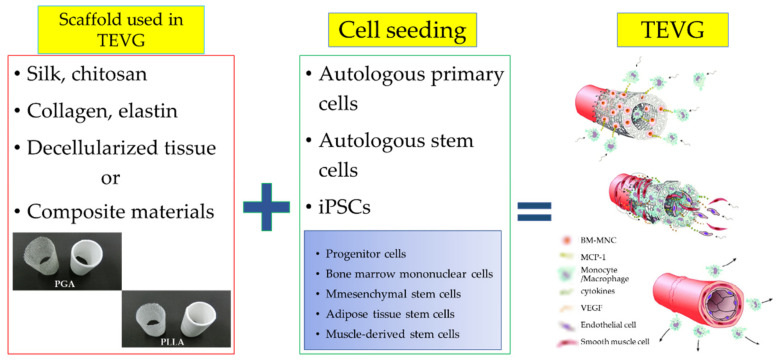
Progressive remodeling in TEVGs in which cells were seeded on scaffold material. It was produced by the authors using the photos provided by Gunze Ltd. (Tokyo, Japan).
Figure 4
Figure 4
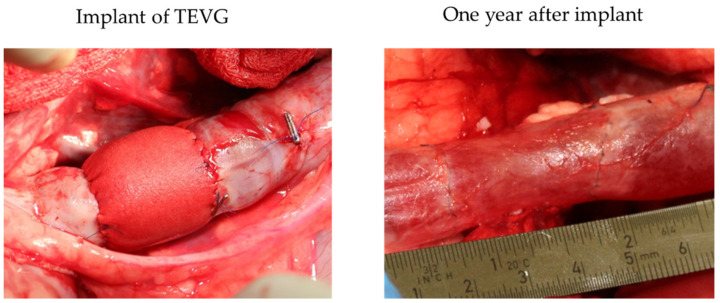
This figure shows immediately after the TEVG implantation (left) and one year after the TEVG implant (right) in sheep models. As shown in the figure, one year after implanting the TEVG, it had adapted to the native blood vessel. The figure was produced by the authors using the images from our previous study.

References

    1. Mathers C.D., Loncar D. Projections of Global Mortality and Burden of Disease from 2002 to 2030. PLoS Med. 2006;3:2011–2030. doi: 10.1371/journal.pmed.0030442. - DOI - PMC - PubMed
    1. Pashneh-Tala S., MacNeil S., Claeyssens F. The Tissue-Engineered Vascular Graft—Past, Present, and Future. Tissue Eng. Part B Rev. 2016;22:68–100. doi: 10.1089/ten.teb.2015.0100. - DOI - PMC - PubMed
    1. Blakemore A.H., Voorhees A.B., Jr. The Use of Tubes Constructed from Vinyon n Cloth in Bridging Arterial Defects—Experimental and Clinical. Ann. Surg. 1954;140:324–334. doi: 10.1097/00000658-195409000-00008. - DOI - PMC - PubMed
    1. Ren X., Feng Y., Guo J., Wang H., Li Q., Yang J., Hao X., Lv J., Ma N., Li W. Surface Modification and Endothelialization of Biomaterials as Potential Scaffolds for Vascular Tissue Engineering Applications. Chem. Soc. Rev. 2015;44:5680–5742. doi: 10.1039/C4CS00483C. - DOI - PubMed
    1. Matsuzaki Y., John K., Shoji T., Shinoka T. The Evolution of Tissue Engineered Vascular Graft Technologies: From Preclinical Trials to Advancing Patient Care. Appl. Sci. 2019;9:1274. doi: 10.3390/app9071274. - DOI - PMC - PubMed

Grants and funding

LinkOut - more resources