


Telemedicine Improves HCV Elimination among Italian People Who Use Drugs: An Innovative Therapeutic Model to Increase the Adherence to Treatment into Addiction Care Centers Evaluated before and during the COVID-19 Pandemic
- PMID: 35741321
- PMCID: PMC9219716
- DOI: 10.3390/biology11060800
Telemedicine Improves HCV Elimination among Italian People Who Use Drugs: An Innovative Therapeutic Model to Increase the Adherence to Treatment into Addiction Care Centers Evaluated before and during the COVID-19 Pandemic
Abstract
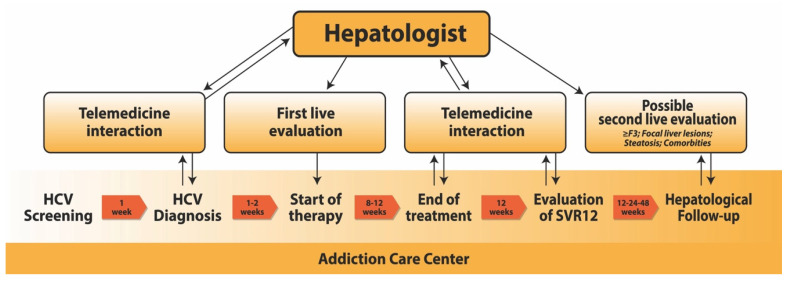
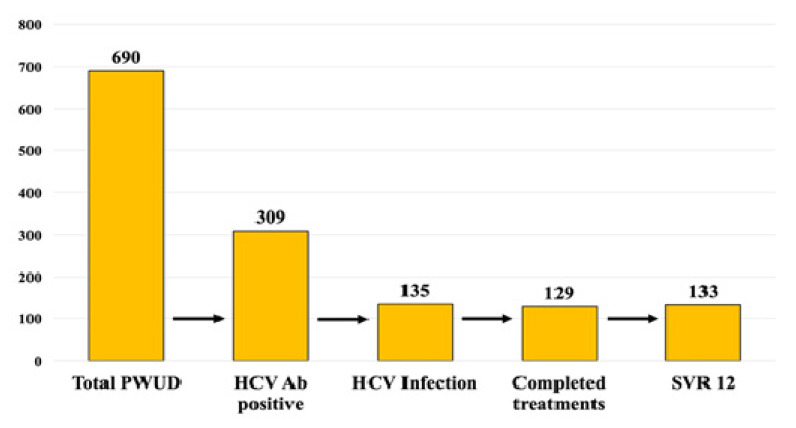
People who use drugs (PWUDs) are generally considered "hard-to-treat" patients, due to adherence to HCV antiviral therapy or re-infection concerns. Linkage-to-care still remains a significant gap for HCV elimination, worsened by the COVID-19 pandemic. To reduce time-to-treat and improve treatment adherence, we have developed a patient-tailored model-of-care, decentralized within the addiction center and supervised remotely by hepatologists. From January 2017 to December 2020, patients were enrolled in one addiction care center in Southern Italy, where a complete hepatologic assessment, including blood chemistry, ultrasound, and transient elastography examination, was provided. DAAs treatment has been adapted on clinical features, also performing a daily administration during an outpatient visit, and monitored remotely by specialists via telemedicine interactions. Adherence was evaluated on the accomplishment of therapy or on the percentage of attended visits. From a total of 690 PWUDs, 135 had an active HCV infection and were enrolled in the study. All patients started the treatment within 3 weeks after HCV diagnosis. Six drop-outs were recorded, obtaining a sustained virological response at week 12 (SVR12) in 98.5% of PWUDs. There were only two cases of treatment failure, one of which is re-infection. No differences were found between the SVR12 rates before and during the COVID-19 pandemic. We obtained a high SVR12 rate, providing a comprehensive assessment within the addiction care center, tailoring the drug administration with a hepatologic remote stewardship. Our therapeutic model should improve the time-to-treat and treatment adherence in PWUDs.
Keywords: COVID-19; differentiated model of care; hepatitis C; person who uses drugs (PWUD).
Conflict of interest statement
The authors declare no conflict of interest.
Figures
References
-
- WHO World Health Organization. Global Health Sector Strategy on Viral Hepatitis 2016–21. [(accessed on 20 April 2022)]; Available online: https://apps.who.int/iris/handle/10665/246177.
-
- Lazarus J.V., Safreed-Harmon K., Thursz M.R., Dillon J.F., El-Sayed M.H., Elsharkawy A.M., Hatzakis A., Jadoul M., Prestileo T., Razavi H., et al. The Micro-Elimination Approach to Eliminating Hepatitis C: Strategic and Operational Considerations. Semin. Liver Dis. 2018;38:181–192. doi: 10.1055/s-0038-1666841. - DOI - PubMed
-
- Grebely J., Larney S., Peacock A., Colledge S., Leung J., Hickman M., Vickerman P., Blach S., Cunningham E.B., Dumchev K., et al. Global, regional, and country-level estimates of hepatitis C infection among people who have recently injected drugs. Addiction. 2019;114:150–166. doi: 10.1111/add.14393. - DOI - PMC - PubMed
Grants and funding
LinkOut - more resources
Full Text Sources
Miscellaneous
