


The Role of the Root in Spoken Word Recognition in Hebrew: An Auditory Gating Paradigm
- PMID: 35741635
- PMCID: PMC9221200
- DOI: 10.3390/brainsci12060750
The Role of the Root in Spoken Word Recognition in Hebrew: An Auditory Gating Paradigm
Abstract
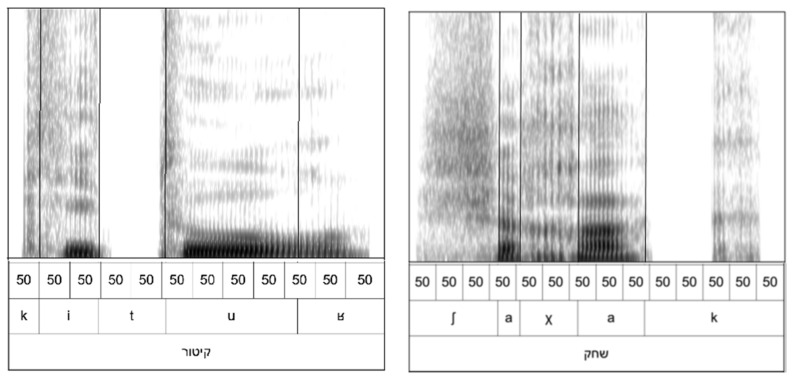
Very few studies have investigated online spoken word recognition in templatic languages. In this study, we investigated both lexical (neighborhood density and frequency) and morphological (role of root morpheme) aspects of spoken word recognition of Hebrew, a templatic language, using the traditional gating paradigm. Additionally, we compared the traditional gating paradigm with a novel, phoneme-based gating paradigm. The phoneme-based approach allows for better control of information available at each gate. We found lexical effects with high-frequency words and low neighborhood density words being recognized at earlier gates. We also found that earlier access to root-morpheme information enabled word recognition at earlier gates. Finally, we showed that both the traditional gating paradigm and gating by phoneme paradigm yielded equivalent results.
Keywords: Hebrew; morphology; spoken word recognition.
Conflict of interest statement
The authors declare no conflict of interest.
Figures
References
-
- Longtin C.M., Meunier F. Morphological decomposition in early visual word processing. J. Mem. Lang. 2005;53:26–41. doi: 10.1016/j.jml.2005.02.008. - DOI
LinkOut - more resources
Full Text Sources
