


Tissutal and Fluidic Aspects in Osteopathic Manual Therapy: A Narrative Review
- PMID: 35742064
- PMCID: PMC9222872
- DOI: 10.3390/healthcare10061014
Tissutal and Fluidic Aspects in Osteopathic Manual Therapy: A Narrative Review
Abstract
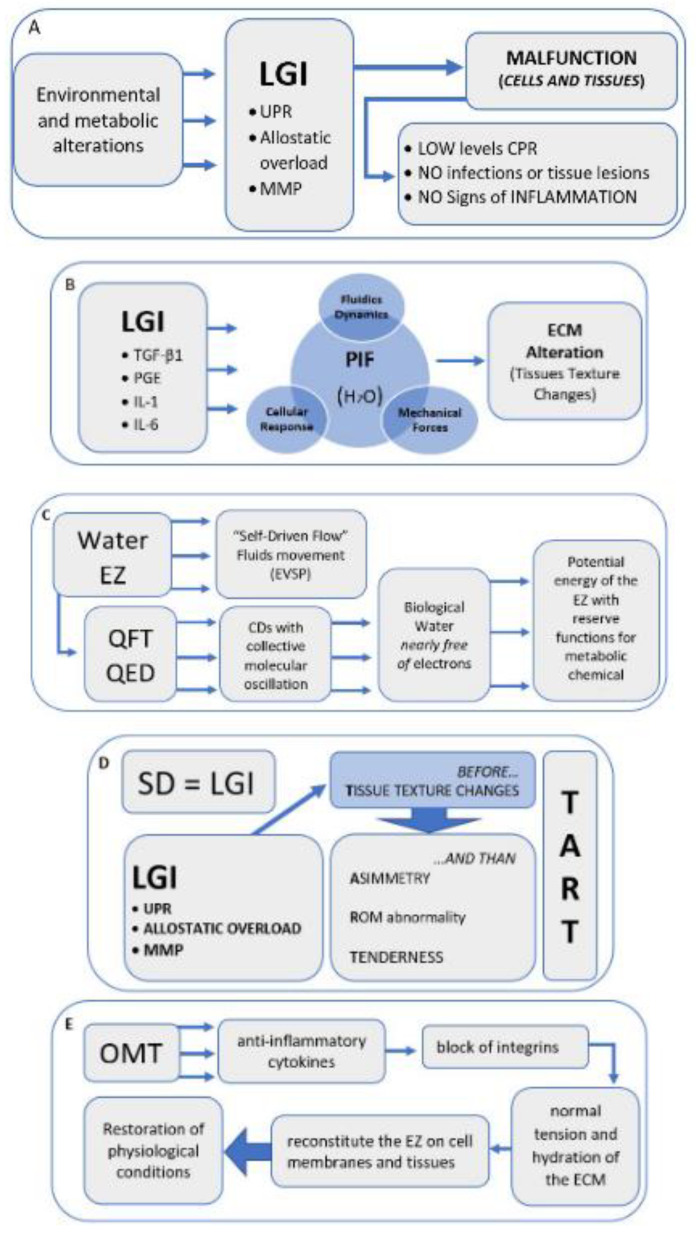
Over the years, several authors have discussed the possibility of considering somatic dysfunction (SD) as a "nosological element" detectable on palpation. There are many aspects to consider regarding the etiology and diagnosis of SD, and the literature on osteopathic issues provides details on physiological signs that characterize it, including tissue texture changes. Recent knowledge suggests that how tissue and, in particular, connective tissue, responds to osteopathic treatment may depend on the modulation of the inflammation degree. Low-grade inflammation (LGI) may act on the extracellular matrix (ECM) and on cellular elements; and these mechanisms may be mediated by biological water. With its molecules organized in structures called exclusion zones (EZ), water could explain the functioning of both healthy and injured tissues, and how they can respond to osteopathic treatment with possible EZ normalization as a result. The relationship between inflammation and DS and the mechanisms involved are described by several authors; however, this review suggests a new model relating to the characteristics of DS and to its clinical implications by linking to LGI. Tissue alterations detectable by osteopathic palpation would be mediated by body fluids and in particular by biological water which has well-defined biophysical characteristics. Research in this area is certainly still to be explored, but our suggestion seems plausible to explain many dynamics related to osteopathic treatment. We believe that this could open up a fascinating scenario of therapeutic possibilities and knowledge in the future.
Keywords: antidromic activity; exclusion zone water; fibroblasts; interstitial fluid pressure; low-grade inflammation; osteopathic manipulative treatment; somatic dysfunction; water.
Conflict of interest statement
The authors declare no conflict of interest.
Figures
References
-
- Fryer G. Somatic dysfunction: An osteopathic conundrum. Int. J. Osteopath. Med. 2016;22:52–63. doi: 10.1016/j.ijosm.2016.02.002. - DOI
-
- Moran R. Somatic dysfunction—Conceptually fascinating, but does it help us address health needs? Int. J. Osteopath. Med. 2016;22:1–2. doi: 10.1016/j.ijosm.2016.11.001. - DOI
-
- World Health Organization (WHO) International Statistical Classification of Diseases and Related Health Problems (ICD 11) WHO; Geneva, Switzerland: 2018.
-
- Ehrenfeuchter W.C., Kappler R.E. Foundations of Osteopathic Medicine. 3rd ed. Lippincott Williams & Wilkins; Philadelphia, PA, USA: 2011. Palpatory Examination; pp. 401–409.
Publication types
LinkOut - more resources
Full Text Sources
