


Nintendo Switch Joy-Cons' Infrared Motion Camera Sensor for Training Manual Dexterity in People with Multiple Sclerosis: A Randomized Controlled Trial
- PMID: 35743333
- PMCID: PMC9224824
- DOI: 10.3390/jcm11123261
Nintendo Switch Joy-Cons' Infrared Motion Camera Sensor for Training Manual Dexterity in People with Multiple Sclerosis: A Randomized Controlled Trial
Abstract
Background: The Nintendo Switch® (NS) is the ninth video game console developed by Nintendo®. Joy-Cons® are the primary game controllers for the NS® video game console, and they have an infrared motion camera sensor that allows capturing the patient's hands without the need to place sensors or devices on the body. The primary aim of the present study was to evaluate the effects of the NS®, combined with a conventional intervention, for improving upper limb (UL) grip muscle strength, coordination, speed of movements, fine and gross dexterity, functionality, quality of life, and executive function in multiple sclerosis (MS) patients. Furthermore, we sought to assess satisfaction and compliance levels.
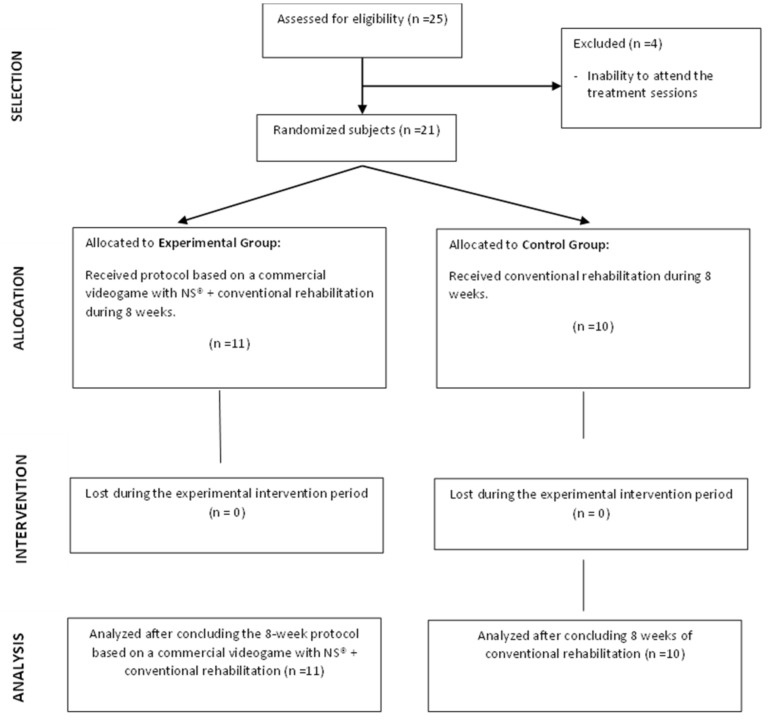
Methods: A single-blinded, randomized clinical trial was conducted. The sample was randomized into two groups: an experimental group who received treatment based on Dr Kawashima's Brain Training® for the NS® (20 min) plus conventional rehabilitation (40 min), and a control group who received the same conventional rehabilitation (60 min) for the ULs. Both groups received two 60 min sessions per week over an eight-week period. Grip strength, the Box and Blocks Test (BBT), the Nine Hole Peg Test (NHPT), the QuickDASH, the Multiple Sclerosis Impact Scale (MSIS-29), the Trail Making Test (TMT), and the Stroop Color and Word Test (SCWT) were used pre- and post-treatment. Side effects and attendance rates were also recorded.
Results: Intragroup analysis showed significant improvements for the experimental group in the post-treatment assessments for grip strength in the more affected side (p = 0.033), the BBT for the more (p = 0.030) and the less affected side (p = 0.022), the TMT (A section) (p = 0.012), and the QuickDASH (p = 0.017). No differences were observed for the control group in intragroup analysis, but they were observed in the NHPT for the more affected side (p = 0.012). The intergroup analysis did not show differences between both groups.
Conclusions: Our results show that an eight-week experimental protocol, after using Dr Kawashima's Brain Training® and the right-side Joy-Con controller for the NS®, combined with a conventional intervention, showed improvements in grip strength, coordination, fine and gross motor function, executive functions, and upper limb functionality in the experimental group. However, no differences were observed when both groups were compared in the intergroup analysis. The addition of Brain Training® for the NS® for the upper limb rehabilitation did not show side effects and was rated with a high satisfaction and excellent compliance in people with MS.
Trial registration: This randomized controlled trial has been registered at ClinicalTrials Identifier: NCT04171908, November 2019.
Keywords: Joy-Cons; Nintendo Switch; infrared; manual dexterity; multiple sclerosis; upper limb; video games; virtual reality.
Conflict of interest statement
The authors declare no conflict of interest.
References
-
- WHO. Multiple Sclerosis International Federation . Atlas: Multiple Sclerosis Resources in the World. World Health Organization; Geneva, Switzerland: 2008.
-
- McDonald W.I., Compston A., Edan G., Goodkin D., Hartung H.P., Lublin F.D., McFarland H.F., Paty D.W., Polman C.H., Reingold S.C., et al. Recommended diagnostic criteria for multiple sclerosis: Guidelines from the international panel on the diagnosis of multiple sclerosis. Ann. Neurol. 2001;50:121–127. doi: 10.1002/ana.1032. - DOI - PubMed
-
- Johansson S., Ytterberg C., Claesson I.M., Lindberg J., Hillert J., Andersson M., Widén L., Lena H., Koch V., Claesson I.M., et al. High concurrent presence of disability in multiple sclerosis associations with perceived health original communication. J. Neurol. 2007;254:767–773. doi: 10.1007/s00415-006-0431-5. - DOI - PubMed
Associated data
LinkOut - more resources
Full Text Sources
Medical
Miscellaneous
