


Primary Orbital Reconstruction with Selective Laser Melting (SLM) of Patient-Specific Implants (PSIs): An Overview of 96 Surgically Treated Patients
- PMID: 35743432
- PMCID: PMC9224837
- DOI: 10.3390/jcm11123361
Primary Orbital Reconstruction with Selective Laser Melting (SLM) of Patient-Specific Implants (PSIs): An Overview of 96 Surgically Treated Patients
Abstract
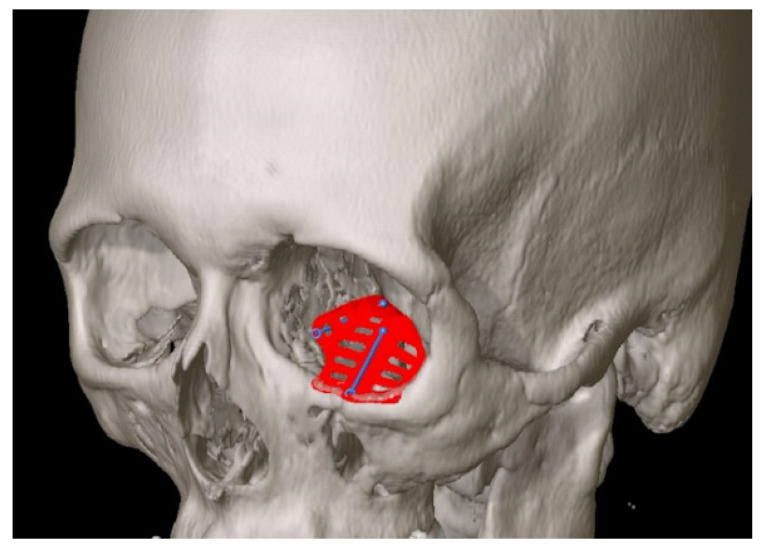
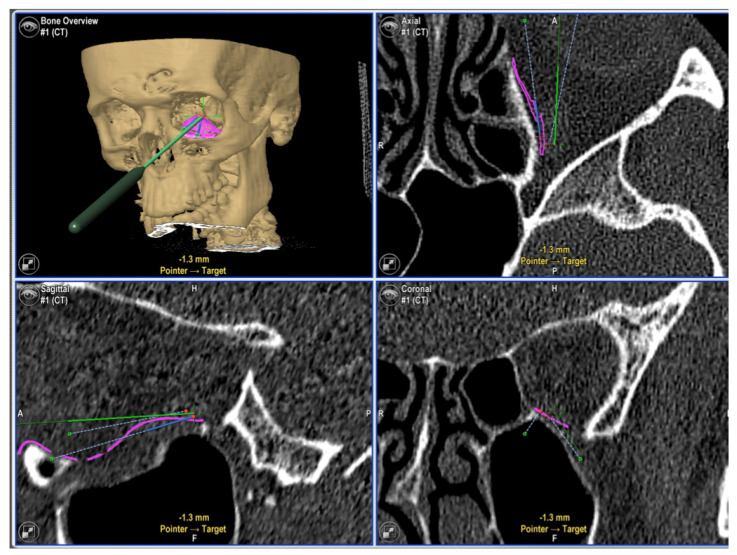
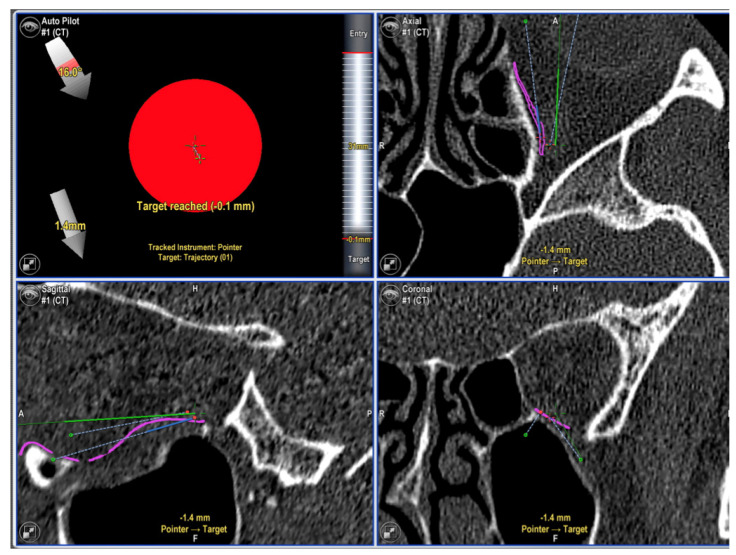
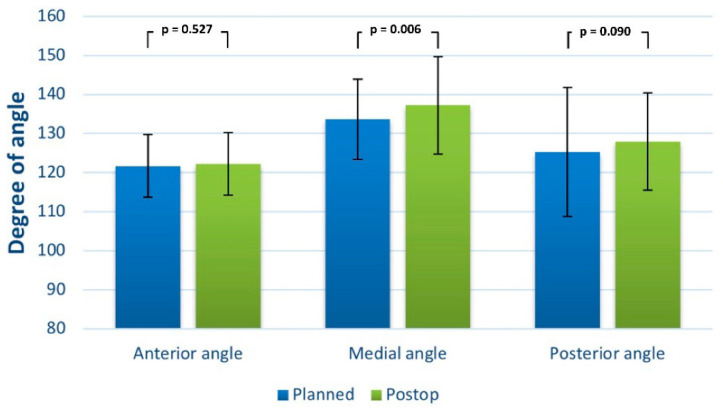
Contemporary advances in technology have allowed the transfer of knowledge from industrial laser melting systems to surgery; such an approach could increase the degree of accuracy in orbital restoration. The aim of this study was to examine the accuracy of selective laser melted PSIs (patient-specific implants) and navigation in primary orbital reconstruction. Ninety-six patients with orbital fractures were included in this study. Planned vs. achieved orbital volumes (a) and angles (b) were compared to the unaffected side (n = 96). The analysis included the overlay of post-treatment on planned images (iPlan 3.0.5, Brainlab®, Feldkirchen, Germany). The mean difference in orbital volume between the digitally planned orbit and the postoperative orbit was 29.16 cm3 (SD 3.54, presurgical) to 28.33 cm3 (SD 3.64, postsurgical, t = 5.00, df = 95.00; p < 0.001), resulting in a mean volume difference (planned vs. postop) of less than 1 cm3. A 3D analysis of the color mapping showed minor deviations compared to the mirrored unaffected side. The results suggested that primary reconstruction in complex orbital wall fractures can be routinely achieved with a high degree of accuracy by using selective laser melted orbital PSIs.
Keywords: 3D mesh; customized implant; intraoperative navigation; orbital reconstruction; orbital wall fracture; selective laser melting.
Conflict of interest statement
The authors declare no conflict of interest.
Figures
References
-
- Shere J.L., Boole J.R., Holtel M.R., Amoroso P.J. An analysis of 3599 midfacial and 1141 orbital blowout fractures among 4426 United States Army Soldiers, 1980–2000. Otolaryngol.—Head Neck Surg. Off. J. Am. Acad. Otolaryngol.-Head Neck Surg. 2004;130:164–170. doi: 10.1016/j.otohns.2003.09.018. - DOI - PubMed
LinkOut - more resources
Full Text Sources
Miscellaneous
