


Is Prehospital Assessment of qSOFA Parameters Associated with Earlier Targeted Sepsis Therapy? A Retrospective Cohort Study
- PMID: 35743570
- PMCID: PMC9224632
- DOI: 10.3390/jcm11123501
Is Prehospital Assessment of qSOFA Parameters Associated with Earlier Targeted Sepsis Therapy? A Retrospective Cohort Study
Abstract
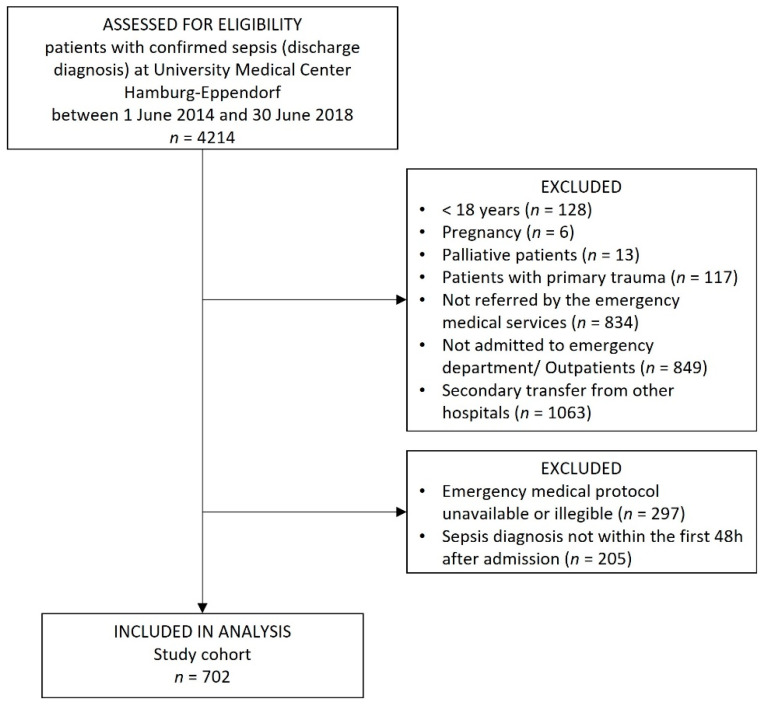
Background: This study aimed to determine whether prehospital qSOFA (quick sequential organ failure assessment) assessment was associated with a shortened 'time to antibiotics' and 'time to intravenous fluid resuscitation' compared with standard assessment.
Methods: This retrospective study included patients who were referred to our Emergency Department between 2014 and 2018 by emergency medical services, in whom sepsis was diagnosed during hospitalization. Two multivariable regression models were fitted, with and without qSOFA parameters, for 'time to antibiotics' (primary endpoint) and 'time to intravenous fluid resuscitation'.
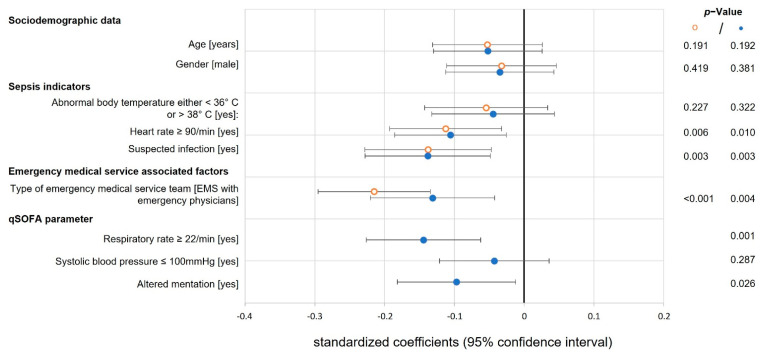
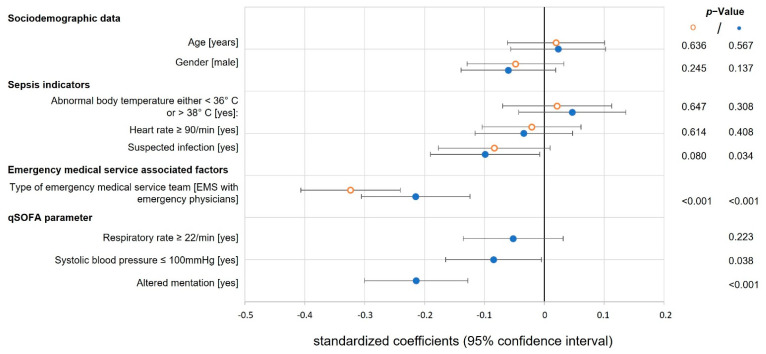
Results: In total, 702 patients were included. Multiple linear regression analysis showed that antibiotics and intravenous fluids were initiated earlier if infections were suspected and emergency medical services involved emergency physicians. A heart rate above 90/min was associated with a shortened time to antibiotics. If qSOFA parameters were added to the models, a respiratory rate ≥ 22/min and altered mentation were independent predictors for earlier antibiotics. A systolic blood pressure ≤ 100 mmHg and altered mentation were independent predictors for earlier fluids. When qSOFA parameters were added, the explained variability of the model increased by 24% and 38%, respectively (adjusted R² 0.106 versus 0.131 for antibiotics and 0.117 versus 0.162 for fluids).
Conclusion: Prehospital assessment of qSOFA parameters was associated with a shortened time to a targeted sepsis therapy.
Keywords: anti-infective agents; emergency medicine; fluid therapy; organ dysfunction scores; sepsis; systemic inflammatory response syndrome.
Conflict of interest statement
The authors declare no conflict of interest.
Figures
References
-
- Seymour C.W., Liu V.X., Iwashyna T.J., Brunkhorst F.M., Rea T.D., Scherag A., Rubenfeld G., Kahn J.M., Shankar-Hari M., Singer M., et al. Assessment of Clinical Criteria for Sepsis: For the Third International Consensus Definitions for Sepsis and Septic Shock (Sepsis-3) JAMA. 2016;315:762–774. doi: 10.1001/jama.2016.0288. - DOI - PMC - PubMed
-
- Song J.U., Sin C.K., Park H.K., Shim S.R., Lee J. Performance of the quick Sequential (sepsis-related) Organ Failure Assessment score as a prognostic tool in infected patients outside the intensive care unit: A systematic review and meta-analysis. Crit. Care. 2018;22:28. doi: 10.1186/s13054-018-1952-x. - DOI - PMC - PubMed
-
- Evans L., Rhodes A., Alhazzani W., Antonelli M., Coopersmith C.M., French C., Machado F.R., McIntyre L., Ostermann M., Prescott H.C., et al. Surviving Sepsis Campaign: International Guidelines for Management of Sepsis and Septic Shock 2021. Crit. Care Med. 2021;49:e1063–e1143. doi: 10.1097/CCM.0000000000005337. - DOI - PubMed
-
- Rhodes A., Evans L.E., Alhazzani W., Levy M.M., Antonelli M., Ferrer R., Kumar A., Sevransky J.E., Sprung C.L., Nunnally M.E., et al. Surviving Sepsis Campaign: International Guidelines for Management of Sepsis and Septic Shock: 2016. Crit. Care Med. 2017;45:486–552. doi: 10.1097/CCM.0000000000002255. - DOI - PubMed
LinkOut - more resources
Full Text Sources
