


Non-STEMI vs. STEMI Cardiogenic Shock: Clinical Profile and Long-Term Outcomes
- PMID: 35743628
- PMCID: PMC9224589
- DOI: 10.3390/jcm11123558
Non-STEMI vs. STEMI Cardiogenic Shock: Clinical Profile and Long-Term Outcomes
Abstract
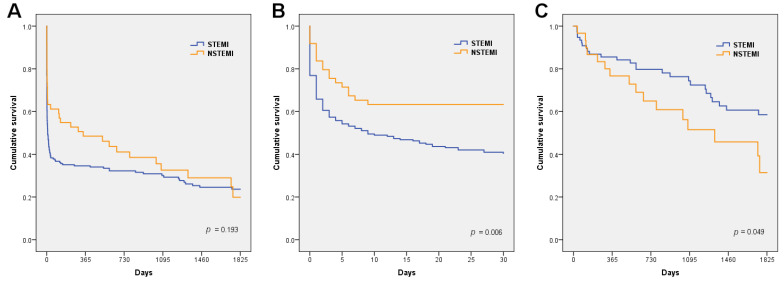
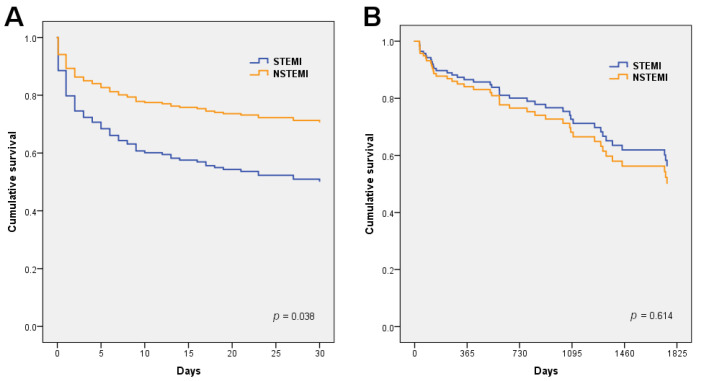
Cardiogenic shock (CS) is a severe complication of acute myocardial infarction (AMI). In AMI-CS, the ST segment deviation on ECG may be elevated (STEMI-CS) or non-elevated (NSTEMI-CS), which may influence prognosis. Our aim was to analyze the clinical profile, acute-phase prognosis, and long-term outcomes of CS relative to the ST pattern on admission. In a prospective registry of 4647 AMI patients admitted to the intensive cardiac care unit of a university hospital between 2010 and 2019, we compared the clinical characteristics, 30-days case fatality, and long-term outcomes of AMI-CS, based on the presence of ST-segment deviation. AMI-CS developed in 239 (5.1%) patients (26.4% women): 190 (79.5%) STEMI-CS and 49 (20.5%) NSTEMI-CS. The mean age was 69.7 years. The STEMI-CS patients had larger infarcts and more mechanical complications than the NSTEMI-CS patients. The NSTEMI-CS patients had a greater prevalence of hypertension, diabetes, peripheral vascular disease, previous cardiovascular comorbidities, three-vessel disease, and left main disease than the STEMI-CS patients. The STEMI-CS patients had higher 30-day mortality than the NSTEMI-CS (59.5% vs. 36.7%; p = 0.004), even after multivariable adjustment (HR 1.91; 95% CI 1.16-3.14), but no differences in mortality were observed at 3 years. In conclusion, the 30-day case-fatality is higher in STEMI-CS, but the long-term outcome is similar in both groups.
Keywords: NSTEMI; STEMI; cardiogenic shock; prognosis.
Conflict of interest statement
The authors declare no conflict of interest.
Figures
References
-
- García-García C., Oliveras T., El Ouaddi N., Rueda F., Serra J., Labata C., Ferrer M., Cediel G., Montero S., Martínez M.J., et al. Short- and Long-Term Mortality Trends in STEMI-Cardiogenic Shock over Three Decades (1989–2018): The Ruti-STEMI-Shock Registry. J. Clin. Med. 2020;9:2398. doi: 10.3390/jcm9082398. - DOI - PMC - PubMed
-
- Anderson M.L., Peterson E.D., Peng S.A., Wang T.Y., Ohman E.M., Bhatt D.L., Saucedo J.F., Roe M.T. Differences in the profile, treatment, and prognosis of patients with cardiogenic shock by myocardial infarction classification: A report from NCDR. Circ. Cardiovasc. Qual. Outcomes. 2013;6:708–715. doi: 10.1161/CIRCOUTCOMES.113.000262. - DOI - PubMed
-
- Abbott J.D., Ahmed H.N., Vlachos H.A., Selzer F., Williams D.O. Comparison of outcome in patients with ST-elevation versus non-ST-elevation acute myocardial infarction treated with percutaneous coronary intervention (from the National Heart, Lung, and Blood Institute Dynamic Registry) Am. J. Cardiol. 2007;100:190–195. doi: 10.1016/j.amjcard.2007.02.083. - DOI - PubMed
-
- García-García C., Subirana I., Sala J., Bruguera J., Sanz G., Valle V., Arós F., Fiol M., Molina L., Serra J., et al. Long-term prognosis of first myocardial infarction according to the electrocardiographic pattern (ST elevation myocardial infarction, non-ST elevation myocardial infarction and non-classified myocardial infarction) and revascularization procedures. Am. J. Cardiol. 2011;108:1061–1067. doi: 10.1016/j.amjcard.2011.06.003. - DOI - PubMed
LinkOut - more resources
Full Text Sources
