. 2022 May 28;12(6):892.
doi: 10.3390/jpm12060892.

Genome-Wide Analyses of Nephrotoxicity in Platinum-Treated Cancer Patients Identify Association with Genetic Variant in RBMS3 and Acute Kidney Injury

Affiliations

Genome-Wide Analyses of Nephrotoxicity in Platinum-Treated Cancer Patients Identify Association with Genetic Variant in RBMS3 and Acute Kidney Injury

Marije J Klumpers et al. J Pers Med. .

Abstract

Nephrotoxicity is a common and dose-limiting side effect of platinum compounds, which often manifests as acute kidney injury or hypomagnesemia. This study aimed to investigate the genetic risk loci for platinum-induced nephrotoxicity. Platinum-treated brain tumor and head-neck tumor patients were genotyped with genome-wide coverage. The data regarding the patient and treatment characteristics and the laboratory results reflecting the nephrotoxicity during and after the platinum treatment were collected from the medical records. Linear and logistic regression analyses were performed to investigate the associations between the genetic variants and the acute kidney injury and hypomagnesemia phenotypes. A cohort of 195 platinum-treated patients was included, and 9,799,032 DNA variants passed the quality control. An association was identified between RBMS3 rs10663797 and acute kidney injury (coefficient -0.10 (95% confidence interval -0.13--0.06), p-value 2.72 × 10⁻⁸). The patients who carried an AC deletion at this locus had statistically significantly lower glomerular filtration rates after platinum treatment. Previously reported associations, such as BACH2 rs4388268, could not be replicated in this study's cohort. No statistically significant associations were identified for platinum-induced hypomagnesemia. The genetic variant in RBMS3 was not previously linked to nephrotoxicity or related traits. The validation of this study's results in independent cohorts is needed to confirm this novel association.

Keywords: GWAS; RBMS3; acute kidney injury; carboplatin; cisplatin; hypomagnesemia; nephrotoxicity.


Conflict of interest statement

The authors declare no conflict of interest.

Figures
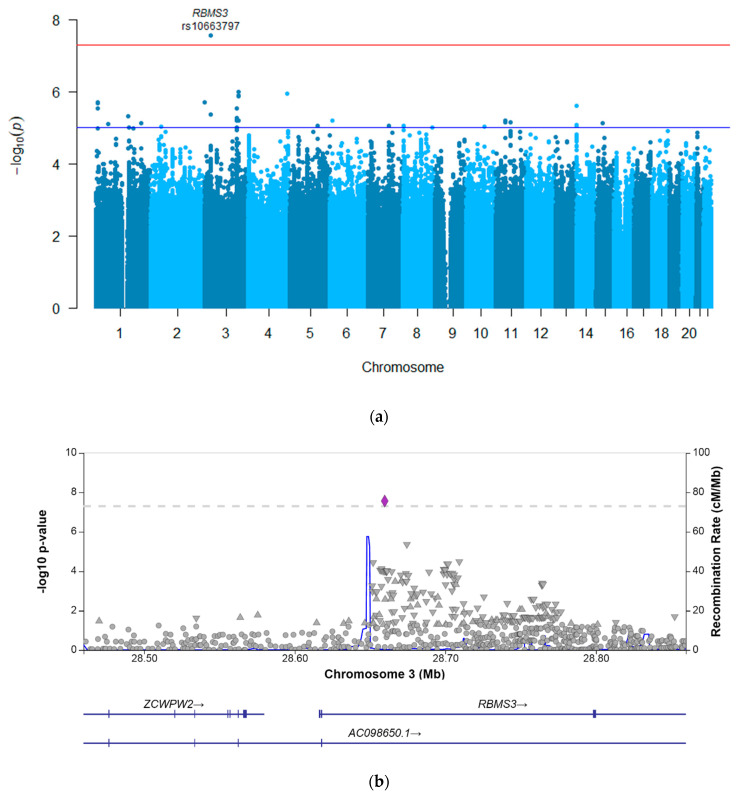
Figure 1
Figure 1
Results of GWAS investigating eGFR decrease after platinum. p-values were generated using logistic regression. (a) Manhattan plot showing the associations between eGFR decrease and genetic variants (blue dots), plotted against chromosomal position (x-axis) and −log10 p-value (y-axis). The red line represents the p-value threshold for genome-wide statistical significance (p < 5 × 10⁻⁸). The blue line represents a suggestive p-value threshold (p < 10−5). (b) LocusZoom plot showing the variant rs10663797 and its surrounding region, which was the variant most strongly associated with eGFR decrease. This variant (purple diamond) is located in the intronic region of the RBMS3. The p-values on the −log10 scale are plotted on the left y-axis. The right y-axis indicates the regional recombination rate (cM/Mb), depicted by the blue line on the plot (where peaks indicate recombination hot spots). The chromosomal position is plotted along the x-axis, along with the genes located in that region.
Figure 2
Figure 2
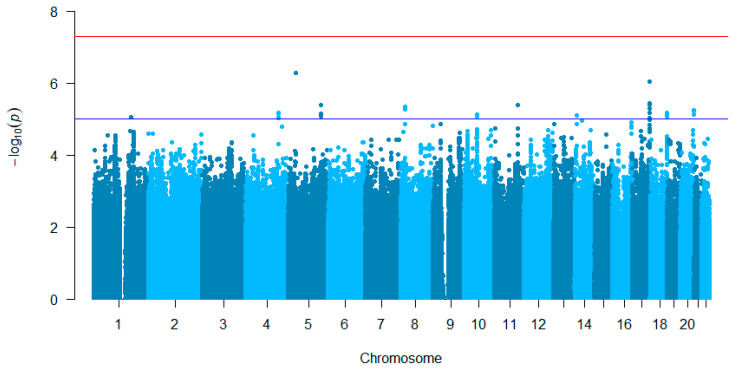
Results of GWAS investigating lowest magnesium plasma level after platinum treatment. The p-values were generated using logistic regression. The Manhattan plot shows the associations between lowest magnesium plasma level and genetic variants (blue dots), plotted against chromosomal position (x-axis) and -log10 p-value (y-axis). The red line represents the p-value threshold for genome-wide statistical significance after Bonferroni correction for multiple testing (p < 5 × 10⁻⁸), with no genetic variants surpassing this threshold. The blue line represents a suggestive p-value threshold (p < 10−5), with 35 hits surpassing this threshold (representing 11 independent loci). The top hit is the genetic variant, RAI4 rs563097889, on chromosome 5 (p = 5.16 × 10⁻⁷).

References

    1. Lebwohl D., Canetta R. Clinical development of platinum complexes in cancer therapy: An historical perspective and an update. Eur. J. Cancer. 1998;34:1522–1534. doi: 10.1016/S0959-8049(98)00224-X. - DOI - PubMed
    1. Arquilla M., Thompson L.M., Pearlman L.F., Simpkins H. Effect of platinum antitumor agents on DNA and RNA investigated by terbium fluorescence. Cancer Res. 1983;43:1211–1216. - PubMed
    1. Wang D., Lippard S.J. Cellular processing of platinum anticancer drugs. Nat. Rev. Drug Discov. 2005;4:307–320. doi: 10.1038/nrd1691. - DOI - PubMed
    1. Go R.S., Adjei A.A. Review of the Comparative Pharmacology and Clinical Activity of Cisplatin and Carboplatin. J. Clin. Oncol. 1999;17:409. doi: 10.1200/JCO.1999.17.1.409. - DOI - PubMed
    1. Dasari S., Tchounwou P.B. Cisplatin in cancer therapy: Molecular mechanisms of action. Eur. J. Pharmacol. 2014;740:364–378. doi: 10.1016/j.ejphar.2014.07.025. - DOI - PMC - PubMed

LinkOut - more resources