Review
. 2022 May 31;10(6):1130.
doi: 10.3390/microorganisms10061130.

Clinical Infections, Antibiotic Resistance, and Pathogenesis of Staphylococcus haemolyticus

Affiliations
Review

Clinical Infections, Antibiotic Resistance, and Pathogenesis of Staphylococcus haemolyticus

Hala O Eltwisy et al. Microorganisms. .

Abstract

Staphylococcus haemolyticus (S. haemolyticus) constitutes the main part of the human skin microbiota. It is widespread in hospitals and among medical staff, resulting in being an emerging microbe causing nosocomial infections. S. haemolyticus, especially strains that cause nosocomial infections, are more resistant to antibiotics than other coagulase-negative Staphylococci. There is clear evidence that the resistance genes can be acquired by other Staphylococcus species through S. haemolyticus. Severe infections are recorded with S. haemolyticus such as meningitis, endocarditis, prosthetic joint infections, bacteremia, septicemia, peritonitis, and otitis, especially in immunocompromised patients. In addition, S. haemolyticus species were detected in dogs, breed kennels, and food animals. The main feature of pathogenic S. haemolyticus isolates is the formation of a biofilm which is involved in catheter-associated infections and other nosocomial infections. Besides the biofilm formation, S. haemolyticus secretes other factors for bacterial adherence and invasion such as enterotoxins, hemolysins, and fibronectin-binding proteins. In this review, we give updates on the clinical infections associated with S. haemolyticus, highlighting the antibiotic resistance patterns of these isolates, and the virulence factors associated with the disease development.

Keywords: S. haemolyticus; antibiotic resistance; biofilm; clinical infections; pathogenesis; virulence factors.


Conflict of interest statement

The authors declare no conflict of interest.

Figures
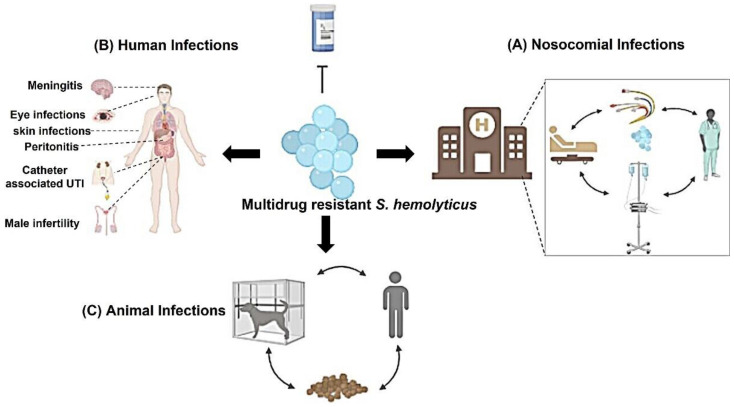
Figure 1
Figure 1
Infections associated with S. haemolyticus: Several infections are associated with S. haemolyticus isolates. S. haemolyticus causes nosocomial infections that can be spread among health care personnel, medical devices, catheters, and patients. In addition, several clinical human infections are recorded with S. haemolyticus such as eye infections, bacteremia, UTIs, male infertility, etc. Human infections are considered nosocomial infections if the infections are acquired in the hospitals. Moreover, S. haemolyticus infect animals such as dogs and infection can spread throughout the animal, owner, kennel breed, and animal food.
Figure 2
Figure 2
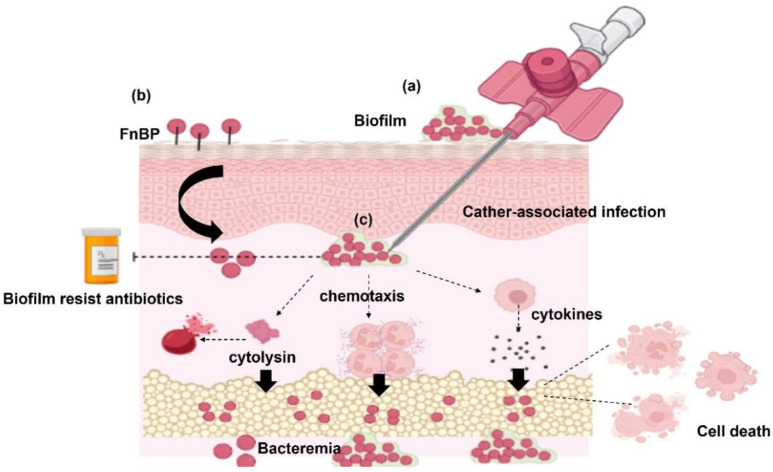
Pathogenesis of S. haemolyticus. (a) S. haemolyticus isolates that form a biofilm adhere to the catheter and internalize with it inside the host. Biofilm-associated S. haemolyticus isolates are resistant to antibiotics. (b) Fibronectin-binding proteins (FnBP) of S. haemolyticus help in bacterial adherence, internalization, and invasion to host cells. (c) S. haemolyticus invades the host cells causing bacteremia through the release of cytolysins, proinflammatory cytokines from the host immune cells, and activation of chemotaxis.

References

    1. Eng R.H., Wang C., Person A., Kiehn T.E., Armstrong D. Species identification of coagulase-negative staphylococcal isolates from blood cultures. J. Clin. Microbiol. 1982;15:439–442. doi: 10.1128/jcm.15.3.439-442.1982. - DOI - PMC - PubMed
    1. John J.F., Jr., Gramling P.K., O’Dell N.M. Species identification of coagulase-negative staphylococci from urinary tract isolates. J. Clin. Microbiol. 1978;8:435–437. doi: 10.1128/jcm.8.4.435-437.1978. - DOI - PMC - PubMed
    1. Liekweg W.G., Jr., Greenfield L.J. Vascular prosthetic infections: Collected experience and results of treatment. Surgery. 1977;81:335–342. - PubMed
    1. Rupp M.E., Archer G.L. Coagulase-negative staphylococci: Pathogens associated with medical progress. Clin. Infect. Dis. Off. Publ. Infect. Dis. Soc. Am. 1994;19:231–243. doi: 10.1093/clinids/19.2.231. quiz 244–235. - DOI - PubMed
    1. Kloos W.E., Schleifer K.H. Simplified scheme for routine identification of human Staphylococcus species. J. Clin. Microbiol. 1975;1:82–88. doi: 10.1128/jcm.1.1.82-88.1975. - DOI - PMC - PubMed

LinkOut - more resources