Review
. 2022 Jun 2;10(6):1151.
doi: 10.3390/microorganisms10061151.

Traditional Fermented Foods and Beverages from around the World and Their Health Benefits

Affiliations
Review

Traditional Fermented Foods and Beverages from around the World and Their Health Benefits

Leonel Cuamatzin-García et al. Microorganisms. .

Abstract

Traditional fermented foods and beverages play an important role in a range of human diets, and several experimental studies have shown their potential positive effects on human health. Studies from different continents have revealed strong associations between the microorganisms present in certain fermented foods (e.g., agave fructans, kefir, yeats, kombucha, chungkookjang, cheeses and vegetables, among others) and weight maintenance, reductions in the risk of cardiovascular disease, antidiabetic and constipation benefits, improvement of glucose and lipids levels, stimulation of the immunological system, anticarcinogenic effects and, most importantly, reduced mortality. Accordingly, the aim of this review is to corroborate information reported in experimental studies that comprised interventions involving the consumption of traditional fermented foods or beverages and their association with human health. This work focuses on studies that used fermented food from 2014 to the present. In conclusion, traditional fermented foods or beverages could be important in the promotion of human health. Further studies are needed to understand the mechanisms involved in inflammatory, immune, chronic and gastrointestinal diseases and the roles of fermented traditional foods and beverages in terms of preventing or managing those diseases.

Keywords: functional food; gut microbiota; prebiotics; probiotics; traditional fermented foods and beverages.


Conflict of interest statement

The authors declare no conflict of interest.

Figures
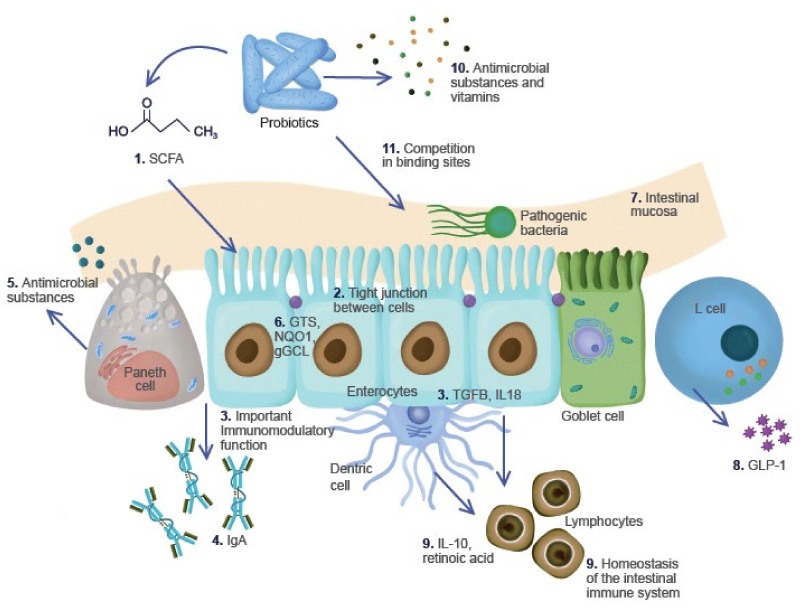
Figure 1
Figure 1
Probiotic functions. (1) Short-chain fatty acids (SCFA: butyrate, propionate, acetate) are the main sources of energy of intestinal cells. (2) The adequate function of enterocytes increases the barrier function and prevents the passage of pathogens. (3) Enterocytes inhibit the production of pro-inflammatory cytokines IL-6*, TNF-α* and IFN-γ*, and stimulate the production of TGFB and IL-8* for lymphocyte recruitment, which maintains the immune balance. (4) With the help of Paneth cells, they also produce immunoglobulin A (IgA). (5) Paneth cells produce antimicrobial substances (alpha defensin and lysozymes). (6) They possess antioxidant properties, promoting the synthesis of protection mechanisms against reactive oxygen species (ROS), glutathione S-tranferase (GSTs), NAD (P) H: quinone reductase (NQO1) and glutamicylcysteine ligase gamma (gGCL), among others. (7) Goblet cells produce intestinal mucus. (8) L cells stimulate the synthesis of GLP-1. (9) Macrophages and dendritic cells use butyrate, stimulating the production of IL-10 and retinoic acid that also recruit lymphocytes and participate in the homeostasis of the immune system. (10) Probiotics synthesize vitamins (K, B5, B8, B9 and B12) and other substances such as lactic acid and hydrogen peroxide that act as antimicrobials. (11) They can compete and fight against pathogens. *IL-6: Interleukin-6; TNF-α: Tumor Necrosis Factor alpha, IFN-γ: Interferon gamma; TGFB: Transforming growth factor beta; IL18: Interleukin-18.
Figure 2
Figure 2
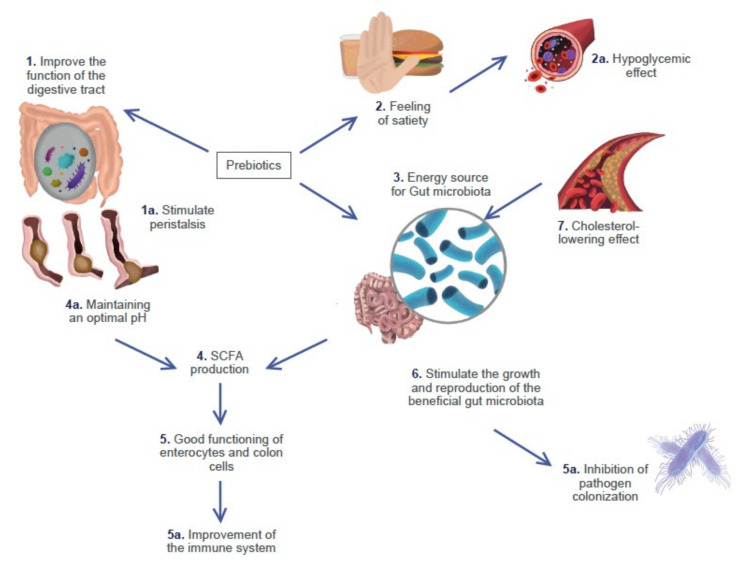
Functions of prebiotics. (1) The regulation of intestinal transit by water retention, which improves stool consistency and makes movements more fluid (1a), thereby stimulating peristalsis. (2) In adequate amounts, a feeling of satiety is given. They inhibit the absorption of simple carbohydrates and reduce blood glucose. (3) With a good source of energy, the gut microbiota achieves a proper function. (4) The production of SCFA (4a) has an impact on the intestinal pH (which, under optimal conditions, is slightly acidic), leading to the inhibition of the proliferation of pathogens. (5) SCFAs are a source of energy for enterocytes and colonocytes, (5a) improving the immune system. (6) They stimulate the growth and reproduction of beneficial gut microbiota, (6a) inhibiting the colonization of pathogenic bacteria. (7) The proper function of the gut microbiota induces hypocholesterolemia.

References

    1. McGovern P.E., Zhang J., Tang J., Zhang Z., Hall G.R., Moreau R.A., Nunez A., Butrym E.D., Richards M.P., Wang C.-S., et al. Fermented Beverages of Pre- and Proto-Historic China. Proc. Natl. Acad. Sci. USA. 2004;101:17593–17598. doi: 10.1073/pnas.0407921102. - DOI - PMC - PubMed
    1. Dimidi E., Cox S.R., Rossi M., Whelan K. Fermented Foods: Definitions and Characteristics, Impact on the Gut Microbiota and Effects on Gastrointestinal Health and Disease. Nutrients. 2019;11:1806. doi: 10.3390/nu11081806. - DOI - PMC - PubMed
    1. Tamang J.P., Watanabe K., Holzapfel W.H. Review: Diversity of Microorganisms in Global Fermented Foods and Beverages. Front. Microbiol. 2016;7:377. doi: 10.3389/fmicb.2016.00377. - DOI - PMC - PubMed
    1. Tamang J.P., Shin D.-H., Jung S.-J., Chae S.-W. Functional Properties of Microorganisms in Fermented Foods. Front. Microbiol. 2016;7:578. doi: 10.3389/fmicb.2016.00578. - DOI - PMC - PubMed
    1. Stanton C., Fitzgerald G.F., Ross R.P. Abstract: Overview of Technology Developments in Probiotic Field. Microb. Ecol. Health Dis. 2012;23:18561.