


Uncovering the Molecular Basis for the Better Gefitinib Sensitivity of EGFR with Complex Mutations over Single Rare Mutation: Insights from Molecular Simulations
- PMID: 35744964
- PMCID: PMC9230809
- DOI: 10.3390/molecules27123844
Uncovering the Molecular Basis for the Better Gefitinib Sensitivity of EGFR with Complex Mutations over Single Rare Mutation: Insights from Molecular Simulations
Abstract
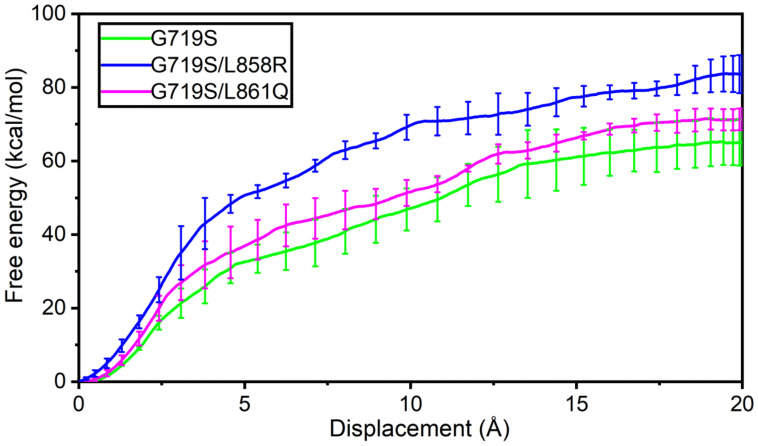
Epidermal growth factor receptor (EGFR) is an intensively focused target for anti-tumor compounds used in non-small cell lung cancer (NSCLC) therapy. Compared to the classical activating mutations, there are still many uncommon EGFR mutations associated with poorer responses to EGFR inhibitors. A detailed understanding of the molecular basis for multiple EGFR mutants exhibiting diverse responses to inhibitors is of critical importance for related drug development. Herein, we explored the molecular determinants contributing to the distinct responses of EGFR with a single rare mutation (G719S) or combined mutations (G719S/L858R and G719S/l861Q) to Gefitinib (IRE). Our results indicated that interactions, formed within the tetrad of residues S768 (in the αC-helix), D770 (in the αC-β4 loop), Y827 (in the αE-helix), and R831 (in the catalytic loop), play an important role in the stability of αC-helix and the maintenance of K745-E762 salt bridge in the absence of IRE, which are weakened in the EGFRG719S system and enhanced in the EGFRG719S/L858R system upon IRE binding. Besides, the introduced hydrogen bonds by the co-occurring mutation partner also contribute to the stability of αC-helix. The work done for inhibitor dissociation suggests that IRE exhibits a stronger binding affinity to EGFRG719S/L858R mutant. Together, these findings provide a deeper understanding of minor mutations, which is essential for drug development targeting EGFR with less common mutations.
Keywords: EGFR complex mutations; EGFR rare mutants; Gefitinib (IRE); molecular dynamics simulation; steered molecular dynamics simulation.
Conflict of interest statement
The authors declare no conflict of interest.
Figures
References
-
- Day K.C., Lorenzatti Hiles G., Kozminsky M., Dawsey S.J., Paul A., Broses L.J., Shah R., Kunja L.P., Hall C., Palanisamy N., et al. HER2 and EGFR Overexpression Support Metastatic Progression of Prostate Cancer to Bone. Cancer Res. 2017;77:74–85. doi: 10.1158/0008-5472.CAN-16-1656. - DOI - PMC - PubMed
-
- Arcila M.E., Nafa K., Chaft J.E., Rekhtman N., Lau C., Reva B.A., Zakowski M.F., Kris M.G., Ladanyi M. EGFR exon 20 insertion mutations in lung adenocarcinomas: Prevalence, molecular heterogeneity, and clinicopathologic characteristics. Mol. Cancer Ther. 2013;12:220–229. doi: 10.1158/1535-7163.MCT-12-0620. - DOI - PMC - PubMed
-
- Jackman D.M., Yeap B.Y., Sequist L.V., Lindeman N., Holmes A.J., Joshi V.A., Bell D.W., Huberman M.S., Halmos B., Rabin M.S., et al. Exon 19 deletion mutations of epidermal growth factor receptor are associated with prolonged survival in non-small cell lung cancer patients treated with gefitinib or erlotinib. Clin. Cancer Res. 2006;12:3908–3914. doi: 10.1158/1078-0432.CCR-06-0462. - DOI - PubMed
MeSH terms
Substances
Grants and funding
LinkOut - more resources
Full Text Sources
Medical
Research Materials
Miscellaneous
