Review
. 2022 Jun 17;14(12):2526.
doi: 10.3390/nu14122526.

Impact of Zinc Transport Mechanisms on Embryonic and Brain Development

Affiliations
Review

Impact of Zinc Transport Mechanisms on Embryonic and Brain Development

Jeremy Willekens et al. Nutrients. .

Abstract

The trace element zinc (Zn) binds to over ten percent of proteins in eukaryotic cells. Zn flexible chemistry allows it to regulate the activity of hundreds of enzymes and influence scores of metabolic processes in cells throughout the body. Deficiency of Zn in humans has a profound effect on development and in adults later in life, particularly in the brain, where Zn deficiency is linked to several neurological disorders. In this review, we will summarize the importance of Zn during development through a description of the outcomes of both genetic and early dietary Zn deficiency, focusing on the pathological consequences on the whole body and brain. The epidemiology and the symptomology of Zn deficiency in humans will be described, including the most studied inherited Zn deficiency disease, Acrodermatitis enteropathica. In addition, we will give an overview of the different forms and animal models of Zn deficiency, as well as the 24 Zn transporters, distributed into two families: the ZIPs and the ZnTs, which control the balance of Zn throughout the body. Lastly, we will describe the TRPM7 ion channel, which was recently shown to contribute to intestinal Zn absorption and has its own significant impact on early embryonic development.

Keywords: TRPM7; brain; development; fetal programming; zinc; zinc deficiency.


Conflict of interest statement

The authors declare no conflict of interest.

Figures

Figure 1
Figure 1
Schematic of Zinc Distribution in the Body. Dietary zinc is absorbed (uptake) in the small intestine (duodenum and jejunum) and about 60% and 30% will be stored in the bone and skeletal muscles, respectively. Liver and skin both represent about 5% of zinc storage in the body. The remaining is transported to other organs, such as the brain, the pancreas, the kidney, or the mammary gland through blood circulation, constituting only about 0.1% of the total zinc of the body. In the blood, zinc is found under two forms: bound to albumin (about 75 to 85% of the serum zinc), constituting the exchangeable pool of zinc; or bound to 2-macroglobulin (15 to 25% of serum zinc), which is the non-exchangeable reserve of zinc. Excess of zinc is mainly excreted through gastrointestinal excretion, depending on the zinc status; or by renal excretion, that represents a minor and less regulated Zn egestion through urinary loss. These complex mechanisms of absorption, transport, excretion, and reabsorption are tightly controlled by two families of Zn transporters: the ZnTs and the ZIPs proteins.
Figure 2
Figure 2
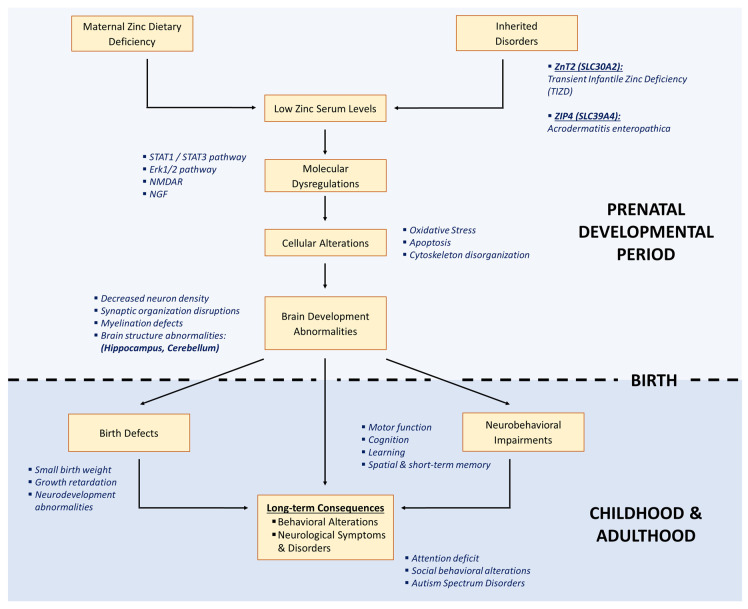
Long-term consequences of zinc deprivation during brain development. Dietary zinc is absorbed (uptake) in the small intestine (duodenum and jejunum) and about 60% and 30% will be stored in the bone and skeletal muscles, respectively. Liver and skin both represent about 5% of zinc storage in the body. The remaining is transported to other organs, such as the brain, the pancreas, the kidney, or the mammary gland through blood circulation, constituting only about 0.1% of the total zinc of the body. In the blood, zinc is found under two forms: bound to albumin (about 75 to 85% of the serum zinc), constituting the exchangeable pool of zinc; or bound to 2-macroglobulin (15 to 25% of serum zinc), which is the non-exchangeable reserve of zinc. Excess of zinc is mainly excreted through gastrointestinal excretion, depending on the zinc status, or by renal excretion, which represents a minor and less regulated zinc egestion through urinary loss. These complex mechanisms of absorption, transport, excretion, and reabsorption are tightly controlled by two families of zinc transporters: the ZnTs and the ZIPs proteins. Early zinc deficiency caused by dietary deprivation or inherited mutation of ZnT2 (Transient Infantile Zinc Deficiency, TIZD) or ZIP4 (Acrodermatitis enteropathica) during prenatal brain development is the source of molecular dysregulations that can then cause cellular alteration and consequential structural and functional brain development abnormalities. Altogether, these deleterious events can be the source of birth defects and/or neurobehavioral impairments that will have mild to severe adverse long-term consequences during childhood and adulthood. Abbreviations: ZnT: Zinc Transporter; SLC30A2: Solute Carrier family 30 member 2; ZIP4: Zinc-regulated, Iron-regulated transporter-like Protein; SLC39A4: Solute Carrier family 39 member 4; STAT1/3: Signal Transducer and Activator of Transcription 1/3; Erk1/2: Extracellular signal-Regulated Kinases 1/2; NMDAR: N-Methyl-D-Aspartate Receptor; NGF: Nerve Growth Factor.

References

    1. Bafaro E., Liu Y., Xu Y., Dempski R.E. The Emerging Role of Zinc Transporters in Cellular Homeostasis and Cancer. Signal Transduct. Target. Ther. 2017;2:17029. doi: 10.1038/sigtrans.2017.29. - DOI - PMC - PubMed
    1. Kambe T., Tsuji T., Hashimoto A., Itsumura N. The Physiological, Biochemical, and Molecular Roles of Zinc Transporters in Zinc Homeostasis and Metabolism. Physiol. Rev. 2015;95:749–784. doi: 10.1152/physrev.00035.2014. - DOI - PubMed
    1. Lee S.R., Noh S.J., Pronto J.R., Jeong Y.J., Kim H.K., Song I.S., Xu Z., Kwon H.Y., Kang S.C., Sohn E.-H., et al. The Critical Roles of Zinc: Beyond Impact on Myocardial Signaling. Korean J. Physiol. Pharmacol. 2015;19:389–399. doi: 10.4196/kjpp.2015.19.5.389. - DOI - PMC - PubMed
    1. Murakami M., Hirano T. Intracellular Zinc Homeostasis and Zinc Signaling. Cancer Sci. 2008;99:1515–1522. doi: 10.1111/j.1349-7006.2008.00854.x. - DOI - PMC - PubMed
    1. Andreini C., Banci L., Bertini I., Rosato A. Counting the Zinc-Proteins Encoded in the Human Genome. J. Proteome Res. 2006;5:196–201. doi: 10.1021/pr050361j. - DOI - PubMed

Supplementary concepts

LinkOut - more resources