


Factors Associated with Decisions of Arab Minority Parents in Israel to Vaccinate Their Children against COVID-19
- PMID: 35746479
- PMCID: PMC9227855
- DOI: 10.3390/vaccines10060870
Factors Associated with Decisions of Arab Minority Parents in Israel to Vaccinate Their Children against COVID-19
Abstract
The Arab ethnic community in Israel is characterized by low social economic status and is at risk due to the typically crowded households. Understanding parents' level of awareness is important to avoid new outbreaks.
Objectives: This study seeks to identify predicting factors associated with perceived susceptibility to COVID-19, and barriers to COVID-19 vaccination.
Materials and methods: A survey was conducted through social media, using snowball sampling via social networks. Additionally, t-tests, Chi-square tests, and Z tests were used to evaluate differences between independent proportions. Pearson correlations were calculated for the study variables. Multiple logistic regression examined the extent to which the background variables were related to the intention to vaccinate the child.
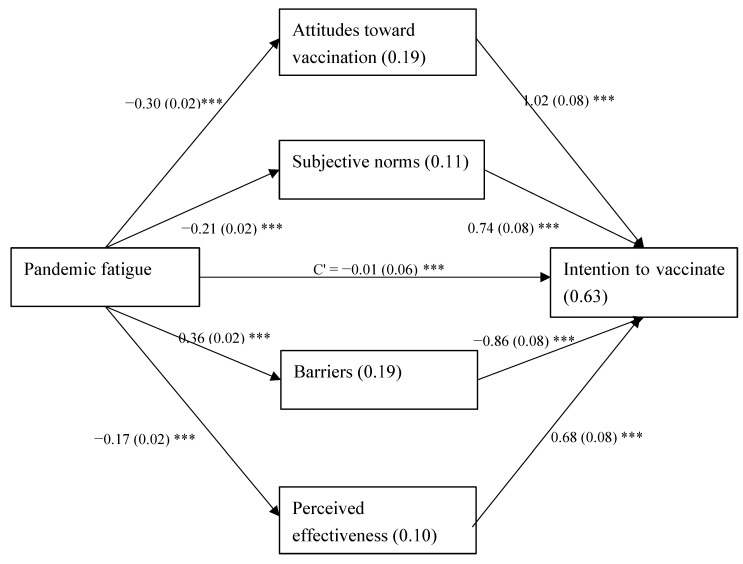
Results: A total of 2843 Arab parents participated in the study. Older parents, higher socioeconomic status, higher trust in the authorities, vaccinated parents, and low psychological and physical barriers were positively correlated with willingness to vaccinate children. Pandemic fatigue was associated with less positive attitudes and reduced perceived effectiveness toward vaccination.
Conclusion: Addressing minorities' poor standards of living and physical and psychological barriers posed by the authorities to minorities' access to vaccination may increase compliance with COVID-19 vaccination and protect the health of the entire population.
Keywords: Arab children; COVID-19 vaccine; Israel; minority; parents’ intention.
Conflict of interest statement
The authors declare no conflict of interest.
Figures
References
-
- Israeli Ministry of Health: Corona Virus in Israel—General Situation. [(accessed on 21 January 2022)]; Available online: https://datadashboard.health.gov.il/COVID-19/general.
-
- Bourion-Bédès S., Tarquinio C., Batt M., Tarquinio P., Lebreuilly R., Sorsana C., Baumann C. Psychological impact of the COVID-19 outbreak on students in a French region severely affected by the disease: Results of the PIMS-CoV 19 study. Psychiatry Res. 2021;295:113559. doi: 10.1016/j.psychres.2020.113559. - DOI - PMC - PubMed
-
- Laron M., Goldweg R. Healthy Behaviors during Corona Virus Outbreak: Preliminary Findings. Myers-JDC-Brookdale Institute. Jerusalem. [(accessed on 24 April 2022)]. Available online: https://brookdale.jdc.org.il/publication/israeli-household-health-behavi...
-
- Kowalski R.M., Limber S.P., Mc Cord A. A developmental approach to cyberbullying: Prevalence and protective factors. Aggress. Violent Behav. 2019;45:20–32. doi: 10.1016/j.avb.2018.02.009. - DOI
LinkOut - more resources
Full Text Sources
