


Sputnik V Effectiveness against Hospitalization with COVID-19 during Omicron Dominance
- PMID: 35746546
- PMCID: PMC9227631
- DOI: 10.3390/vaccines10060938
Sputnik V Effectiveness against Hospitalization with COVID-19 during Omicron Dominance
Abstract
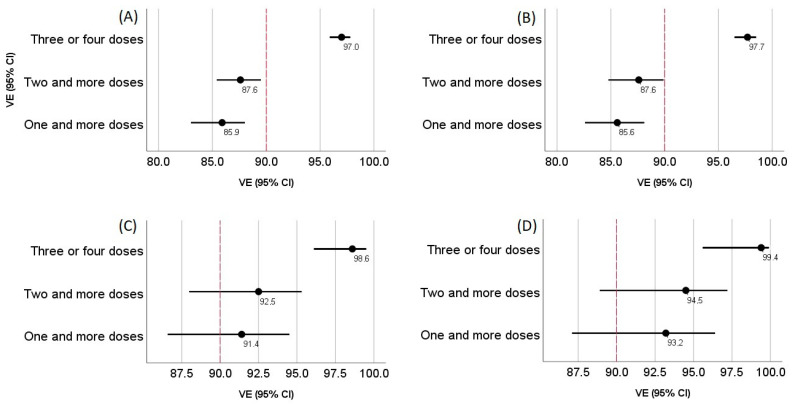
Mass vaccination campaigns against COVID-19 affected more than 90% of the population in most developed countries. The new epidemiologic wave of COVID-19 has been ongoing since the end of 2021. It is caused by a virus variant B.1.1.529, also known as "Omicron" and its descendants. The effectiveness of major vaccines against Omicron is not known. The purpose of this study is to evaluate the efficacy of the Sputnik V vaccine. The main goal is to assess its protection against hospitalization in the period of Omicron dominance. We conducted our study based on a large clinical center in Moscow (Russia) where 1112 patients were included. We used the case-population method to perform the calculations. The data we obtained indicate that the Omicron variant causes at least 90% of infections in the studied cohort. The effectiveness of protection against hospitalization with COVID-19 in our study was 85.9% (95% CI 83.0-88.0%) for those who received more than one dose. It was 87.6% (95% CI 85.4-89.5%) and 97.0% (95% CI 95.9-97.8%) for those who received more than two or three doses. The effectiveness in cases of more severe forms was higher than for less severe ones. Thus, present study indicates the high protective efficacy of vaccination against hospitalization with COVID-19 in case of Omicron lineage.
Keywords: COVID-19; Omicron; SARS-CoV-2; Sputnik Light; Sputnik V; VOC; vaccine; vaccine effectiveness.
Conflict of interest statement
D.Y.L. and A.L.G. (Alexander L. Gintsburg) report patents for a Sputnik V immunobiological expression vector, for a pharmaceutical agent, and for its method of use to prevent COVID-19. The funders had no role in the design and conduct of the study; in the collection, management, analysis, and interpretation of the data; in the preparation, review, or approval of the manuscript; or in the decision to submit the manuscript for publication. All other authors declare no competing interests.
Figures
References
-
- Logunov D.Y., Dolzhikova I.V., Shcheblyakov D.V., Tukhvatulin A.I., Zubkova O.V., Dzharullaeva A.S., Kovyrshina A.V., Lubenets N.L., Grousova D.M., Erokhova A.S., et al. Safety and Efficacy of an rAd26 and rAd5 Vector-Based Heterologous Prime-Boost COVID-19 Vaccine: An Interim Analysis of a Randomised Controlled Phase 3 Trial in Russia. Lancet. 2021;397:671–681. doi: 10.1016/S0140-6736(21)00234-8. - DOI - PMC - PubMed
-
- Voysey M., Clemens S.A.C., Madhi S.A., Weckx L.Y., Folegatti P.M., Aley P.K., Angus B., Baillie V.L., Barnabas S.L., Bhorat Q.E., et al. Safety and Efficacy of the ChAdOx1 nCoV-19 Vaccine (AZD1222) against SARS-CoV-2: An Interim Analysis of Four Randomised Controlled Trials in Brazil, South Africa, and the UK. Lancet. 2021;397:99–111. doi: 10.1016/S0140-6736(20)32661-1. - DOI - PMC - PubMed
LinkOut - more resources
Full Text Sources
Miscellaneous
