


Omicron Sub-Lineages (BA.1.1.529 + BA.*) Current Status in Ecuador
- PMID: 35746651
- PMCID: PMC9230377
- DOI: 10.3390/v14061177
Omicron Sub-Lineages (BA.1.1.529 + BA.*) Current Status in Ecuador
Abstract
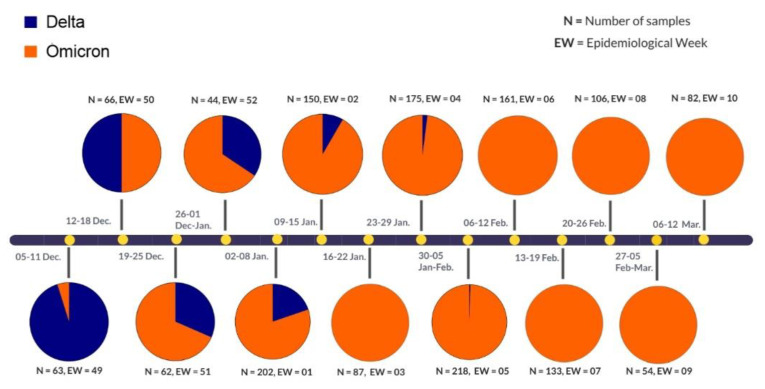
The Omicron variant of SARS-CoV-2 is the latest pandemic lineage causing COVID-19. Despite having a vaccination rate ≥85%, Ecuador recorded a high incidence of Omicron from December 2021 to March 2022. Since Omicron emerged, it has evolved into multiple sub-lineages with distinct prevalence in different regions. In this work, we use all Omicron sequences from Ecuador available at GISAID until March 2022 and the software Nextclade and Pangolin to identify which lineages circulate in this country. We detected 12 different sub-lineages (BA.1, BA.1.1, BA.1.1.1, BA.1.1.14, BA.1.1.2, BA.1.14, BA.1.15, BA.1.16, BA.1.17, BA.1.6, BA.2, BA.2.3), which have been reported in Africa, America, Europe, and Asia, suggesting multiple introduction events. Sub-lineages BA.1 and BA.1.1 were the most prevalent. Genomic surveillance must continue to evaluate the dynamics of current sub-lineages, the early introduction of new ones and vaccine efficacy against evolving SARS-CoV-2.
Keywords: COVID-19; Ecuador; Omicron; sub-lineages.
Conflict of interest statement
The authors declare no conflict of interest.
Figures

References
-
- World Health Organization WHO Coronavirus (COVID-19) Dashboard. [(accessed on 7 April 2022)]. Available online: https://covid19.who.int/
-
- Khandia R., Singhal S., Alqahtani T., Kamal M.A., El-Shall N., Nainu F., Desingu P., Dhama K. Emergence of SARS-CoV-2 Omicron (B.1.1.529) variant, salient features, high global health concerns and strategies to counter it amid ongoing COVID-19 pandemic. Environ. Res. 2022;209:112816. doi: 10.1016/j.envres.2022.112816. - DOI - PMC - PubMed
MeSH terms
Supplementary concepts
LinkOut - more resources
Full Text Sources
Medical
Miscellaneous
