. 2022 Jun 5;14(6):1228.
doi: 10.3390/v14061228.

Azelnidipine Exhibits In Vitro and In Vivo Antiviral Effects against Flavivirus Infections by Targeting the Viral RdRp

Affiliations

Azelnidipine Exhibits In Vitro and In Vivo Antiviral Effects against Flavivirus Infections by Targeting the Viral RdRp

Zhuang Wang et al. Viruses. .

Abstract

Flaviviruses, represented by Zika and dengue virus (ZIKV and DENV), are widely present around the world and cause various diseases with serious consequences. However, no antiviral drugs have been clinically approved for use against them. Azelnidipine (ALP) is a dihydropyridine calcium channel blocker and has been approved for use as an antihypertensive drug. In the present study, ALP was found to show potent anti-flavivirus activities in vitro and in vivo. ALP effectively prevented the cytopathic effect induced by ZIKV and DENV and inhibited the production of viral RNA and viral protein in a dose-dependent manner. Moreover, treatment with 0.3 mg/kg of ALP protected 88.89% of mice from lethal challenge. Furthermore, using the time-of-drug-addition assay, the enzymatic inhibition assay, the molecular docking, and the surface plasmon resonance assay, we revealed that ALP acted at the replication stage of the viral infection cycle by targeting the viral RNA-dependent RNA polymerase. These findings highlight the potential for the use of ALP as an antiviral agent to combat flavivirus infections.

Keywords: RdRp; Zika virus; antiviral; azelnidipine; flavivirus.


Conflict of interest statement

The authors declare no conflict of interest.

Figures
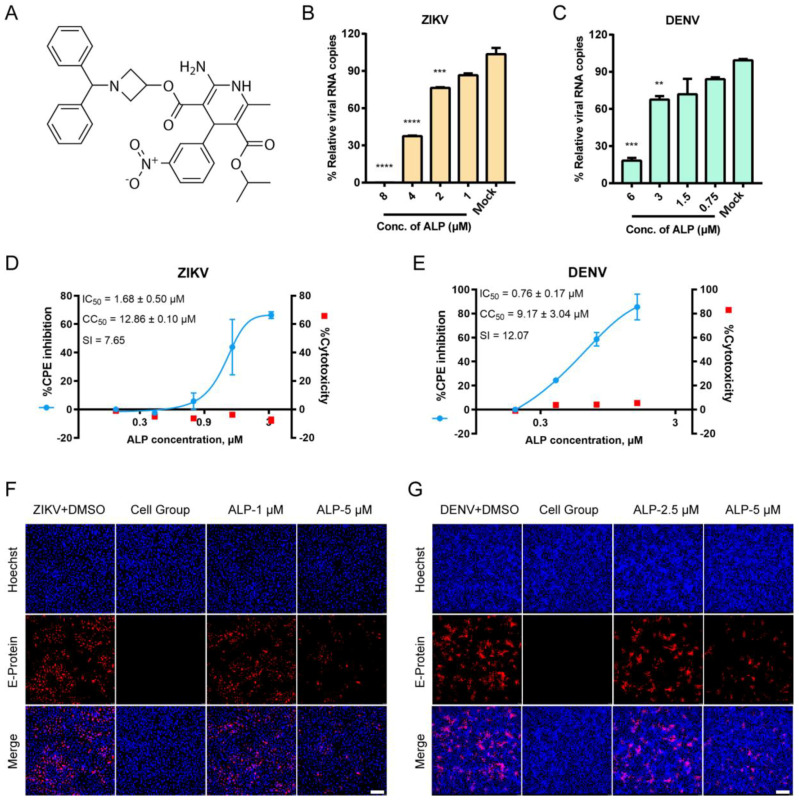
Figure 1
Figure 1
In vitro antiviral activities of Azelnidipine (ALP) against Zika and dengue virus (ZIKV and DENV). (A) Molecular structure of ALP. (B,C) Cells were cultured with ZIKV or DENV in the presence of different concentrations of ALP. Cellular RNA was extracted at 72 h post-infection (h.p.i.) and quantified using qRT-PCR to determine the viral RNA level. Data were collected from three independent experiments and analyzed using one-way analysis of variance. ** p < 0.01, *** p < 0.001, and **** p < 0.0001. (D,E) The cytopathic effect (CPE) protection efficacy of ALP against ZIKV or DENV was evaluated in Vero or BHK cell lines, respectively. The left and right y-axes represent the mean % CPE inhibition and cytotoxicity of the drug, respectively. SI (selectivity index) = CC50/IC50. (F,G) Fluorescence imaging of ALP against ZIKV and DENV. Cells were stained with Hoechst (blue) and the anti-flavivirus envelope protein (red). Scale bar: 200 µm.
Figure 2
Figure 2
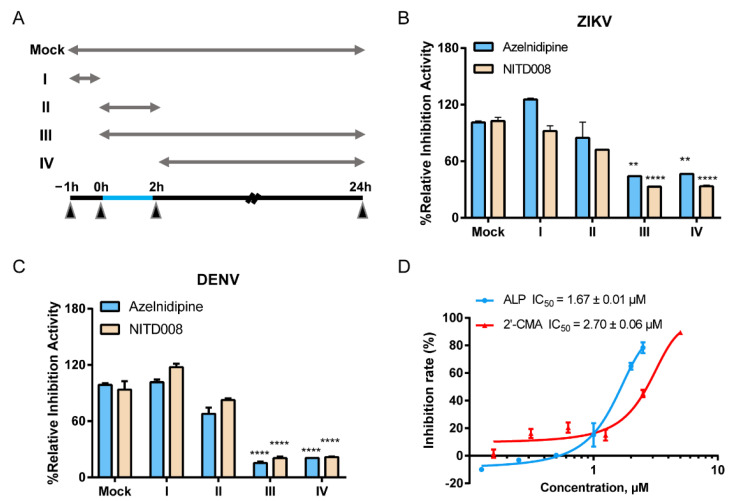
Time-of-drug-addition assay and the replicon assay for ALP. (A) Experimental design of the time-of-drug-addition assay. Virus diluent (blue line) was incubated with the cells at 0–2 h. ALP and the positive control drug NITD008 were added to the cells before, during, after, or throughout the whole infection, respectively, as indicated in the horizontal upper lines. The cellular RNA was extracted at 24 h.p.i. and quantitated by qRT-PCR. One-way analysis of variance (B,C) was performed for statistical analysis. Data are expressed as means ± standard error of mean. ** p < 0.01 and **** p < 0.0001. (D) The inhibitory effect of ALP against ZIKV replicon. Cells were treated with ALP at the indicated concentrations, and luciferase activities were measured at 48 h.p.i. The inhibitor 2′-CMA was set as the positive control. The inhibition curve was fitted using GraphPad Prism 7 software.
Figure 3
Figure 3
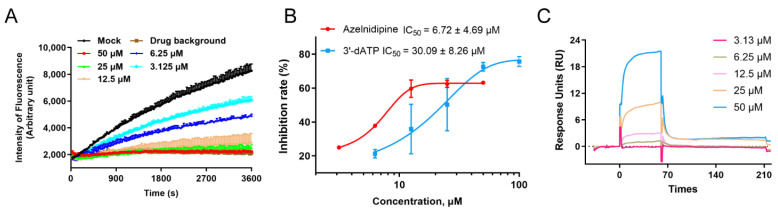
Enzymatic inhibition evaluation of ALP against flavivirus RdRp protein. (A) Real-time fluorescence changes in DENV RdRp enzymatic system inhibited by different concentrations of ALP (50–3.125 μΜ). (B) Dose–response inhibitory curve for ALP’s activity against the DENV RdRp protein. The nucleotide 3′-dATP was used as the positive control. (C) Surface plasmon resonance assay was conducted to determine the direct interactions between ALP and DENV RdRp protein. Immobilized DENV RdRp protein was coated onto a CM5 chip and incubated with gradient-diluted ALP for response unit monitoring. Representative results are as shown.
Figure 4
Figure 4
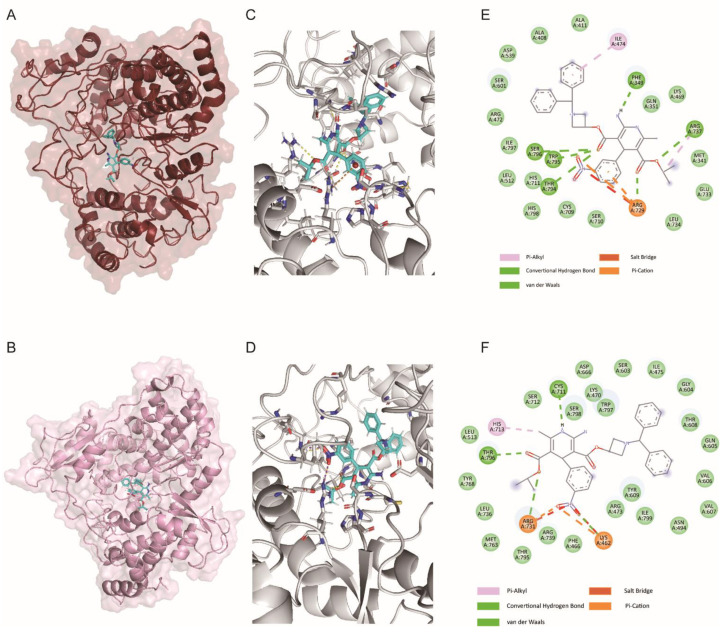
Predicted binding sites for ALP bound to DENV RdRp protein (A,C,E) or ZIKV RdRp protein (B,D,F). RdRp proteins of DENV (5K5M) and ZIKV (6LD5) were used for the ligand-docking assay. The overview and specific diagrams of the binding pose between ALP and RdRp protein are shown in the left panel (A,B) and middle panel (C,D), respectively. The predicted results for interacting residues and bonds are shown in right panel (E,F).
Figure 5
Figure 5
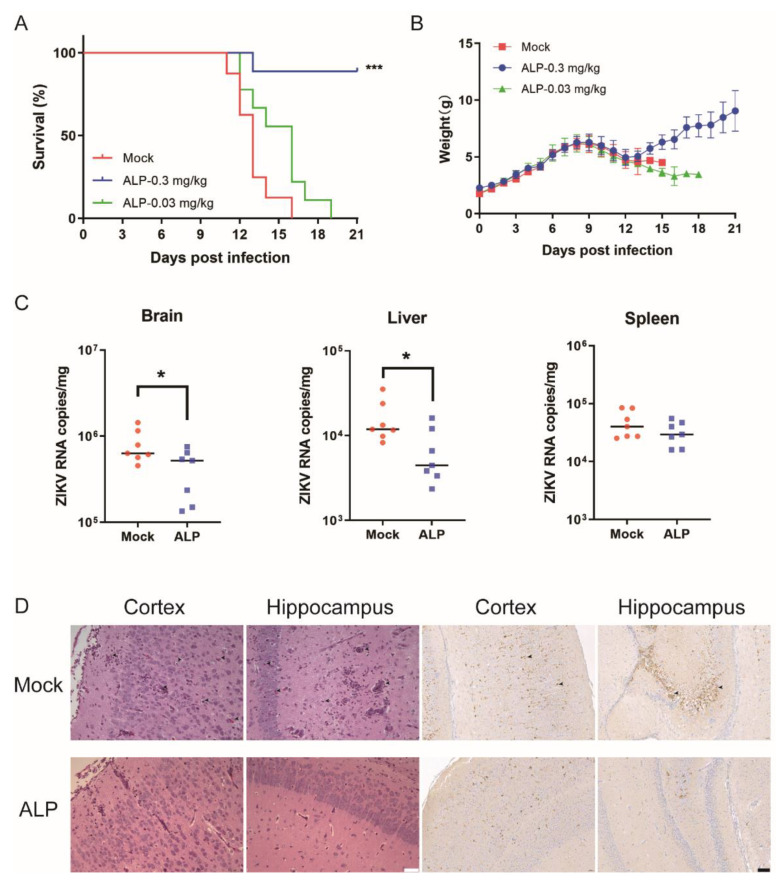
In vivo anti-ZIKV efficacy of ALP in the ZIKV lethal challenge mouse model. One-day-old ICR suckling mice were treated with 0.3 mg/kg or 0.03 mg/kg of ALP intraperitoneally (i.p.) 4 h after ZIKV-SMGC-1 challenge (1.2 × 10⁴ PFU/mouse, i.p.), and this was administered for 9 consecutive days. The changes in survival (A) and bodyweight (B) of the ZIKV-infected mice in each group were recorded until 21 d.p.i.. Survival data were analyzed using a log-rank test, *** p < 0.001. (C) The viral loads in mouse brains, livers, and spleens were measured by qRT-PCR. * p < 0.1. (D) H&E staining (scale bar = 50 µm) and immunohistochemistry assay (scale bar = 200 µm) of sectioned brains. At 3 days post-infection, azelnidipine treatment alleviated the histopathological changes in mice caused by ZIKV infection. The viral antigens were visualized using NS2B antibodies via an immunohistochemistry assay. Yellow staining is considered to show viral antigens.

References

    1. Pierson T.C., Diamond M.S. The continued threat of emerging flaviviruses. Nat. Microbiol. 2020;5:796–812. doi: 10.1038/s41564-020-0714-0. - DOI - PMC - PubMed
    1. Roy S.K., Bhattacharjee S. Dengue virus: Epidemiology, biology, and disease aetiology. Can. J. Microbiol. 2021;67:687–702. doi: 10.1139/cjm-2020-0572. - DOI - PubMed
    1. Thomas S.J., Yoon I.K. A review of Dengvaxia®: Development to deployment. Hum. Vaccines Immunother. 2019;15:2295–2314. doi: 10.1080/21645515.2019.1658503. - DOI - PMC - PubMed
    1. Shukla R., Ramasamy V., Shanmugam R.K., Ahuja R., Khanna N. Antibody-Dependent Enhancement: A Challenge for Developing a Safe Dengue Vaccine. Front. Cell. Infect. Microbiol. 2020;10:572681. doi: 10.3389/fcimb.2020.572681. - DOI - PMC - PubMed
    1. Pierson T.C., Diamond M.S. The emergence of Zika virus and its new clinical syndromes. Nature. 2018;560:573–581. doi: 10.1038/s41586-018-0446-y. - DOI - PubMed

Publication types

MeSH terms