


Global Burden of Cyclospora cayetanensis Infection and Associated Risk Factors in People Living with HIV and/or AIDS
- PMID: 35746750
- PMCID: PMC9228463
- DOI: 10.3390/v14061279
Global Burden of Cyclospora cayetanensis Infection and Associated Risk Factors in People Living with HIV and/or AIDS
Abstract
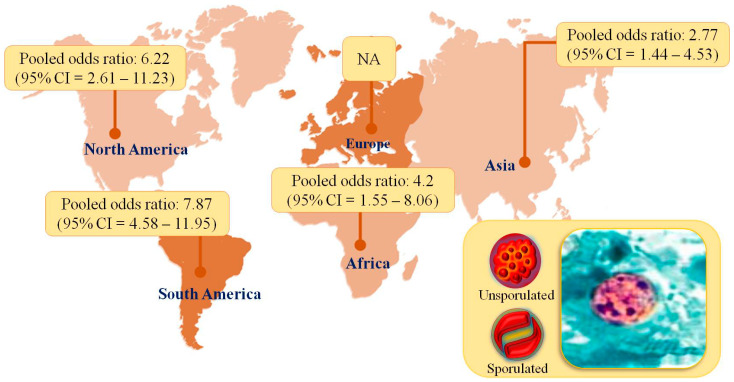
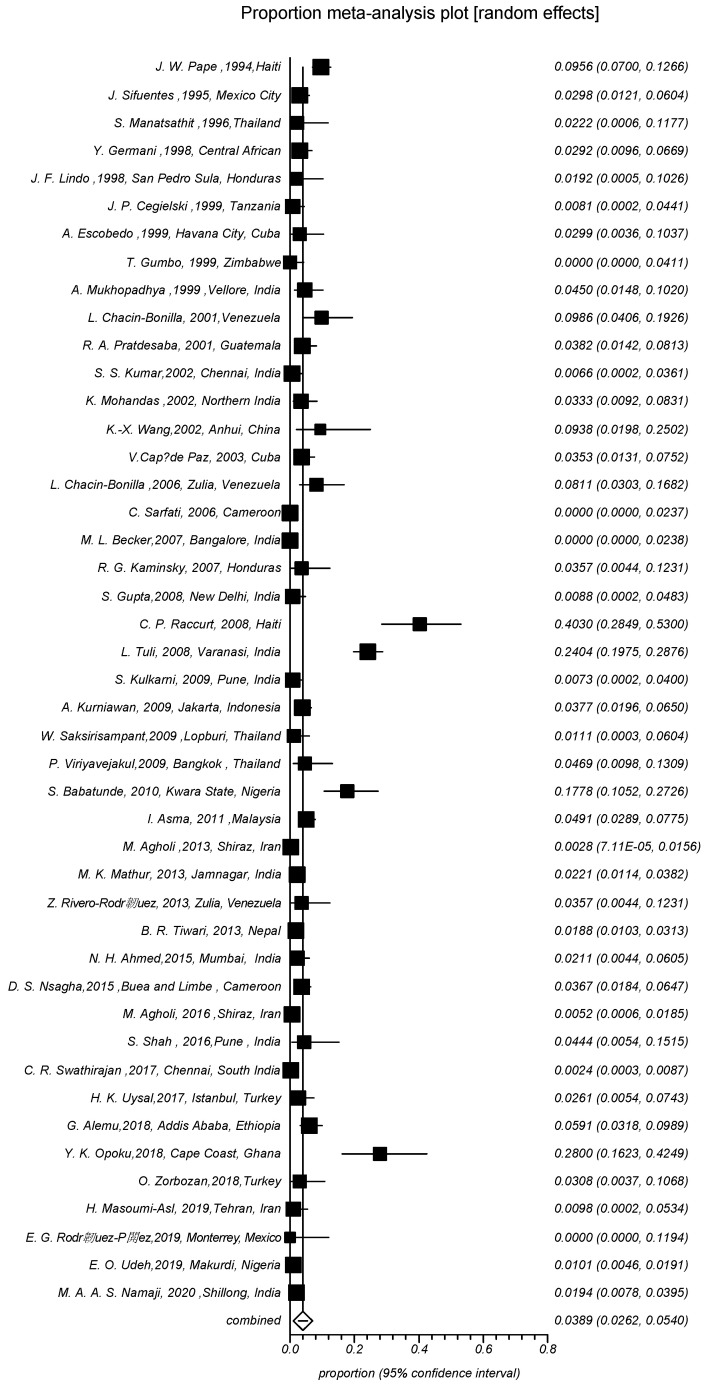
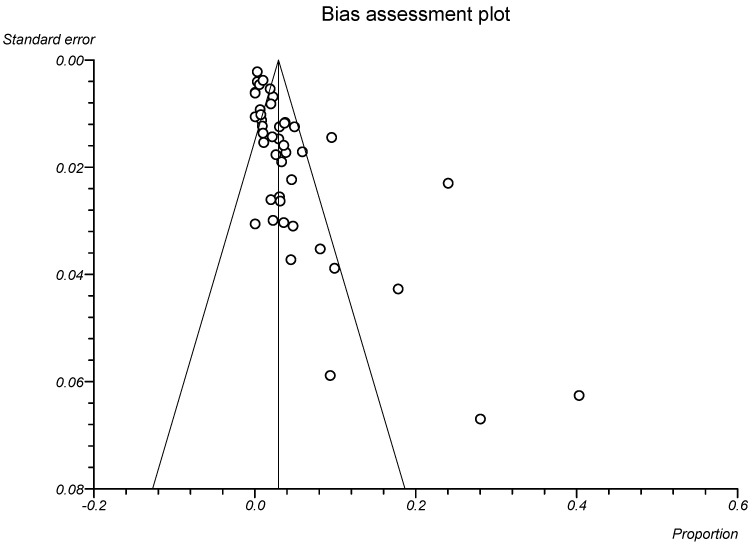
Cyclospora cayetanensis infections remain one of the most common protozoan opportunistic causes of gastrointestinal diseases and diarrhea among people living with HIV and/or AIDS (PLWHA). This study was conducted to provide a summary of the evidence on the global burden of C. cayetanensis infection and associated risk factors among PLWHA. Scopus, PubMed, Science Direct, and EMBASE were searched up to February 2022. All original peer-reviewed original research articles were considered, including descriptive and cross-sectional studies describing C. cayetanensis in PLWHA. Incoherence and heterogeneity between studies were quantified by I index and Cochran's Q test. Publication and population bias were assessed with funnel plots and Egger's asymmetry regression test. All statistical analyses were performed using StatsDirect. The pooled prevalence of C. cayetanensis infection among PLWHA was 3.89% (95% CI, 2.62-5.40). The highest prevalence found in South America was 7.87% and the lowest in Asia 2.77%. In addition, the prevalence of C. cayetanensis was higher in PLWHA compared to healthy individuals. There was a relationship between a higher C. cayetanensis prevalence in PLWHA with a CD4 cell count below 200 cells/mL and people with diarrhea. The results show that PLWHA are more vulnerable to C. cayetanensis infection and emphasizes the need to implement the screening and prophylaxis tailored to the local context. Owing to the serious and significant clinical manifestations of the parasite, an early identification of seropositivity is recommended to initiate prophylaxis between PLWHA with a CD4 count ≤200 cells/mL and PLWHA who do not receive antiviral therapy.
Keywords: AIDS; Cyclospora cayetanensis; HIV; meta-analysis; prevalence; protozoan parasite.
Conflict of interest statement
The authors declare no conflict of interest.
Figures
References
-
- Uzairue L.I., Oghena M., Ikede R.E., Aguda O.N., Adebisi Y.A., Lucero-Prisno D.E., III Prevalence, risk factors and impact of cellular immunity on intestinal parasitosis among people living with HIV at Auchi, Edo State, Nigeria. Int. J. STD AIDS. 2021;32:1106–1113. doi: 10.1177/09564624211020984. - DOI - PubMed
-
- UNAIDS DATA 2021. [(accessed on 12 December 2021)]. Available online: https://www.unaids.org/sites/default/files/media_asset/JC3032_AIDS_Data_....
-
- Batista F.S., Miranda L.d.S., Silva M.B.d.O., Taborda R.L.M., Soares M.C.F., Matos N.B. Chronic Cystoisospora belli infection in an HIV/AIDS patient treated at the specialized assistance service in Porto Velho County-Rondônia. Rev. Da Soc. Bras. De Med. Trop. 2019;52:e20180204. doi: 10.1590/0037-8682-0204-2018. - DOI - PubMed
-
- Siddiqui U., Bini E.J., Chandarana K., Leong J., Ramsetty S., Schiliro D., Poles M. Prevalence and impact of diarrhea on health-related quality of life in HIV-infected patients in the era of highly active antiretroviral therapy. J. Clin. Gastroenterol. 2007;41:484–490. doi: 10.1097/01.mcg.0000225694.46874.fc. - DOI - PubMed
Publication types
MeSH terms
LinkOut - more resources
Full Text Sources
Medical
Research Materials
