


Expanding Mouse-Adapted Yamagata-like Influenza B Viruses in Eggs Enhances In Vivo Lethality in BALB/c Mice
- PMID: 35746770
- PMCID: PMC9229684
- DOI: 10.3390/v14061299
Expanding Mouse-Adapted Yamagata-like Influenza B Viruses in Eggs Enhances In Vivo Lethality in BALB/c Mice
Abstract
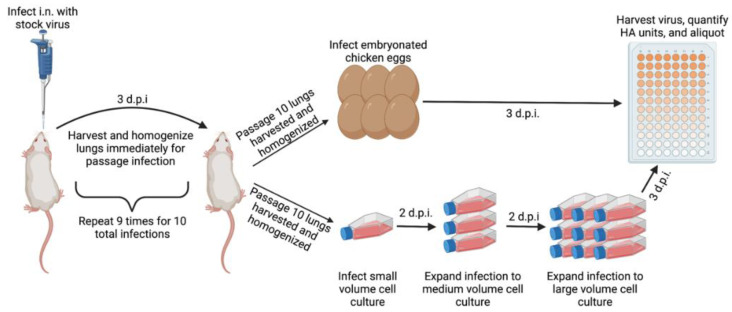
Despite the yearly global impact of influenza B viruses (IBVs), limited host range has been a hurdle to developing a readily accessible small animal disease model for vaccine studies. Mouse-adapting IBV can produce highly pathogenic viruses through serial lung passaging in mice. Previous studies have highlighted amino acid changes throughout the viral genome correlating with increased pathogenicity, but no consensus mutations have been determined. We aimed to show that growth system can play a role in mouse-adapted IBV lethality. Two Yamagata-lineage IBVs were serially passaged 10 times in mouse lungs before expansion in embryonated eggs or Madin-Darby canine kidney cells (London line) for use in challenge studies. We observed that virus grown in embryonated eggs was significantly more lethal in mice than the same virus grown in cell culture. Ten additional serial lung passages of one strain again showed virus grown in eggs was more lethal than virus grown in cells. Additionally, no mutations in the surface glycoprotein amino acid sequences correlated to differences in lethality. Our results suggest growth system can influence lethality of mouse-adapted IBVs after serial lung passaging. Further research can highlight improved mechanisms for developing animal disease models for IBV vaccine research.
Keywords: embryonated eggs; growth system; hemagglutinin; influenza B virus; mouse-adapting; neuraminidase.
Conflict of interest statement
The authors declare no conflict of interest.
Figures

References
-
- World Health Organization Influenza (Seasonal) [(accessed on 1 September 2021)]. Available online: https://www.who.int/en/news-room/fact-sheets/detail/influenza-(seasonal)
-
- Laporte M., Stevaert A., Raeymaekers V., Boogaerts T., Nehlmeier I., Chiu W., Benkheil M., Vanaudenaerde B., Pöhlmann S., Naesens L. Hemagglutinin Cleavability, Acid Stability, and Temperature Dependence Optimize Influenza B Virus for Replication in Human Airways. J. Virol. 2019;94:e01430-19. doi: 10.1128/JVI.01430-19. - DOI - PMC - PubMed
-
- Caini S., Kusznierz G., Garate V.V., Wangchuk S., Thapa B., Júnior F.J.D.P., De Almeida W.A.F., Njouom R., Fasce R.A., Bustos P., et al. The epidemiological signature of influenza B virus and its B/Victoria and B/Yamagata lineages in the 21st century. PLoS ONE. 2019;14:e0222381. doi: 10.1371/journal.pone.0222381. - DOI - PMC - PubMed
-
- Chan P.K.S., Chan M.C.W., Cheung J.L.K., Lee N., Leung T.F., Yeung A.C.M., Wong M.C.S., Ngai K.L.K., Nelson E.A.S., Hui D.S.C. Influenza B Lineage Circulation and Hospitalization Rates in a Subtropical City, Hong Kong, 2000–2010. Clin. Infect. Dis. 2012;56:677–684. doi: 10.1093/cid/cis885. - DOI - PubMed
Publication types
MeSH terms
Substances
Grants and funding
LinkOut - more resources
Full Text Sources
Medical
