


Familial Brain Calcifications With Leukoencephalopathy: A Novel PDGFB Variant
- PMID: 35747618
- PMCID: PMC9210546
- DOI: 10.1212/NXG.0000000000200001
Familial Brain Calcifications With Leukoencephalopathy: A Novel PDGFB Variant
Abstract
Objective: To describe a family with primary familial brain calcifications (PFBCs) and leukoencephalopathy associated with a novel variant in PDGFB.
Methods: We present 3 generations of a family with PFBC associated with a previously unreported variant in PDGFB.
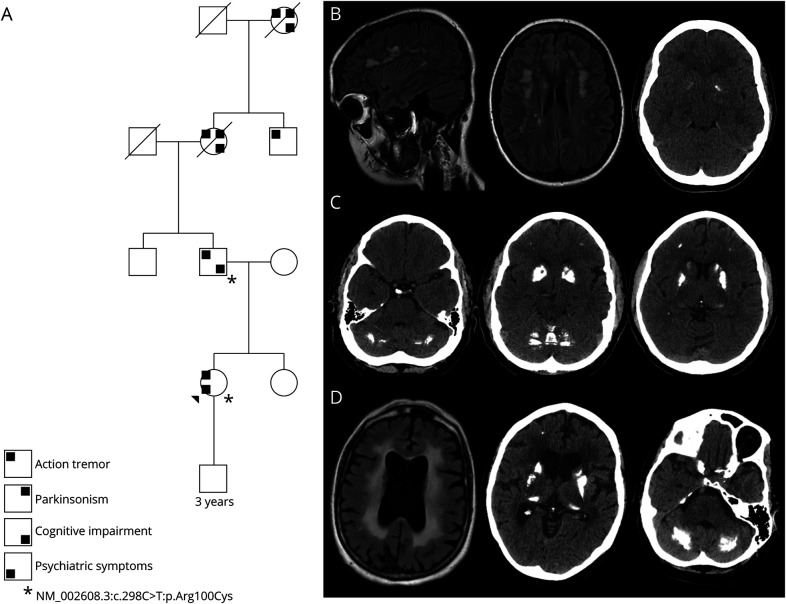
Results: A 24-year-old woman with migraine, bipolar disorder, and functional neurologic disorder was found to have bilateral calcifications of the basal ganglia and frontally predominant periventricular white matter disease. Her father had mild cognitive impairment and action tremor of the hands with basal ganglia and cerebellar calcifications found incidentally on head CT. Her paternal grandmother had severe parkinsonism and dementia with calcifications of the basal ganglia and cerebellum and diffuse, confluent periventricular white matter disease. Genetic testing in both the proband and her father revealed a PDGFB variant (NM_002608.3:c.298C>T:p.Arg100Cys) not reported in publicly available databases. Multiple in silico analysis tools support pathogenicity.
Discussion: Our report identifies a novel PDGFB variant associated with PFBC and highlights the rare association of leukoencephalopathy with PDGFB-associated PFBC.
Copyright © 2022 The Author(s). Published by Wolters Kluwer Health, Inc. on behalf of the American Academy of Neurology.
Figures
References
LinkOut - more resources
Full Text Sources