


Clinical implications of left atrial changes after optimization of medical therapy in patients with heart failure
- PMID: 35748048
- PMCID: PMC10084101
- DOI: 10.1002/ejhf.2593
Clinical implications of left atrial changes after optimization of medical therapy in patients with heart failure
Abstract
Aims: Limited data exist regarding the prognostic relevance of changes in left atrial (LA) dimensions in patients with heart failure (HF). We assessed changes in LA dimension and their relation with outcomes after optimization of guideline-directed medical therapy (GDMT) in patients with new-onset or worsening HF.
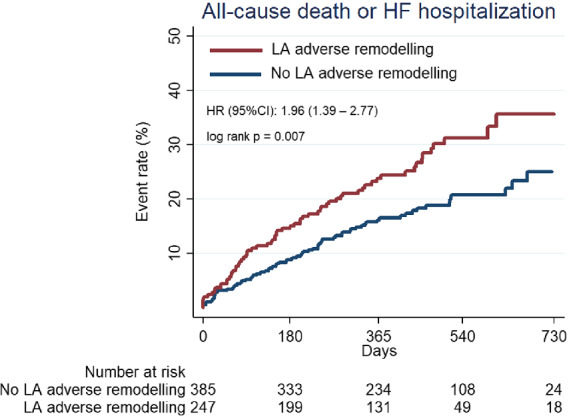
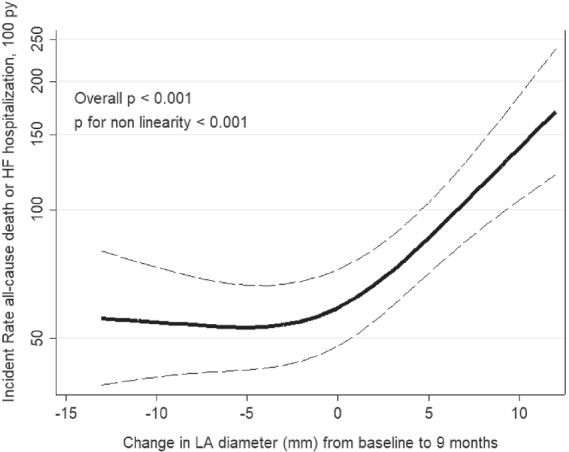
Methods and results: Left atrial diameter was assessed at baseline and 9 months after GDMT optimization in 632 patients (mean age 65.8 ± 12.1 years, 22.3% female) enrolled in BIOSTAT-CHF. LA adverse remodelling (LAAR) was defined as an increase in LA diameter on transthoracic echocardiography between baseline and 9 months. After the 9-month visit, patients were followed for a median of 13 further months. LAAR was observed in 247 patients (39%). Larger baseline LA diameter (odds ratio [OR] 0.90; 95% confidence interval [CI] 0.87-0.93; p < 0.001) and up-titration to higher doses of angiotensin-converting enzyme inhibitors or angiotensin receptor blockers (ACEi/ARBs) (OR 0.56; 95% CI 0.34-0.92; p = 0.022) were independently associated with lower likelihood of LAAR. LAAR was associated with an increased risk of the composite of all-cause mortality or HF hospitalization (log-rank p = 0.007 and adjusted hazard ratio 1.73, 95% CI 1.22-2.45, p = 0.002). The association was more pronounced in patients without a history of atrial fibrillation (p for interaction = 0.009).
Conclusion: Among patients enrolled in BIOSTAT-CHF, LAAR was associated with an unfavourable outcome and was prevented by ACEi/ARB up-titration. Changes in LA dimension may be a useful marker of response to treatment and improve risk stratification in patients with HF.
Keywords: Guideline-directed medical therapy; Heart failure; Left atrium.
© 2022 The Authors. European Journal of Heart Failure published by John Wiley & Sons Ltd on behalf of European Society of Cardiology.
Figures
Comment in
-
Letter regarding the article 'Clinical implications of left atrial changes after optimization of medical therapy in patients with heart failure'.Eur J Heart Fail. 2023 Jan;25(1):133. doi: 10.1002/ejhf.2680. Epub 2022 Sep 20. Eur J Heart Fail. 2023. PMID: 36066468 No abstract available.
-
Reply to the letter regarding the article 'Clinical implications of left atrial changes after optimization of medical therapy in patients with heart failure'.Eur J Heart Fail. 2023 Jan;25(1):133-134. doi: 10.1002/ejhf.2713. Epub 2022 Nov 7. Eur J Heart Fail. 2023. PMID: 36221805 No abstract available.
References
-
- Redfield MM, Jacobsen SJ, Burnett JC Jr, Mahoney DW, Bailey KR, Rodeheffer RJ. Burden of systolic and diastolic ventricular dysfunction in the community: appreciating the scope of the heart failure epidemic. JAMA. 2003;289:194–202. - PubMed
-
- Bursi F, Weston SA, Redfield MM, Jacobsen SJ, Pakhomov S, Nkomo VT, et al. Systolic and diastolic heart failure in the community. JAMA. 2006;296:2209–16. - PubMed
-
- Khan MS, Memon MM, Murad MH, Vaduganathan M, Greene SJ, Hall M, et al. Left atrial function in heart failure with preserved ejection fraction: a systematic review and meta‐analysis. Eur J Heart Fail. 2020;22:472–85. - PubMed
-
- Inciardi RM, Rossi A. Left atrium: a forgotten biomarker and a potential target in cardiovascular medicine. J Cardiovasc Med (Hagerstown). 2019;20:797–808. - PubMed
Publication types
MeSH terms
Substances
Grants and funding
LinkOut - more resources
Full Text Sources
Medical
Research Materials
Miscellaneous
