Application of Machine Learning Approaches to Predict Postnatal Growth Failure in Very Low Birth Weight Infants
- PMID: 35748075
- PMCID: PMC9226835
- DOI: 10.3349/ymj.2022.63.7.640
Application of Machine Learning Approaches to Predict Postnatal Growth Failure in Very Low Birth Weight Infants
Erratum in
-
Erratum to "Application of Machine Learning Approaches to Predict Postnatal Growth Failure in Very Low Birth Weight Infants" by Han JH, et al. (Yonsei Med J 2022;63(7):640-647).Yonsei Med J. 2022 Oct;63(10):975. doi: 10.3349/ymj.2021.0791.er. Yonsei Med J. 2022. PMID: 36168253 Free PMC article.
Abstract
Purpose: The aims of the study were to develop and evaluate a machine learning model with which to predict postnatal growth failure (PGF) among very low birth weight (VLBW) infants.
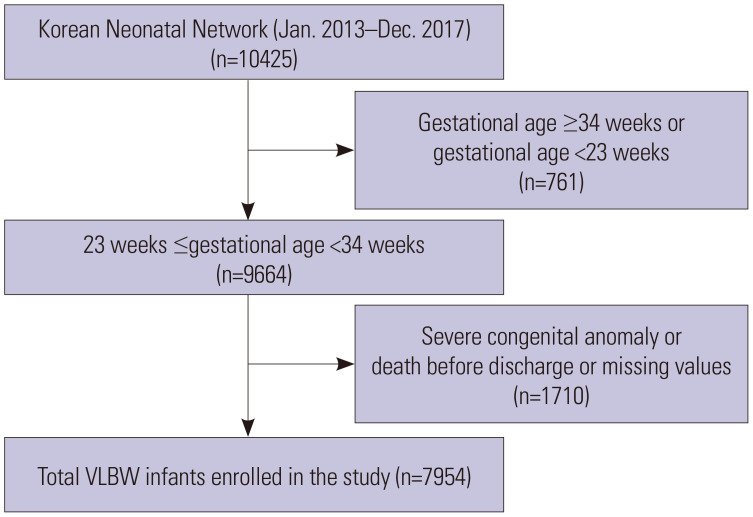
Materials and methods: Of 10425 VLBW infants registered in the Korean Neonatal Network between 2013 and 2017, 7954 infants were included. PGF was defined as a decrease in Z score >1.28 at discharge, compared to that at birth. Six metrics [area under the receiver operating characteristic curve (AUROC), accuracy, precision, sensitivity, specificity, and F1 score] were obtained at five time points (at birth, 7 days, 14 days, 28 days after birth, and at discharge). Machine learning models were built using four different techniques [extreme gradient boosting (XGB), random forest, support vector machine, and convolutional neural network] to compare against the conventional multiple logistic regression (MLR) model.
Results: The XGB algorithm showed the best performance with all six metrics across the board. When compared with MLR, XGB showed a significantly higher AUROC (p=0.03) for Day 7, which was the primary performance metric. Using optimal cut-off points, for Day 7, XGB still showed better performances in terms of AUROC (0.74), accuracy (0.68), and F1 score (0.67). AUROC values seemed to increase slightly from birth to 7 days after birth with significance, almost reaching a plateau after 7 days after birth.
Conclusion: We have shown the possibility of predicting PGF through machine learning algorithms, especially XGB. Such models may help neonatologists in the early diagnosis of high-risk infants for PGF for early intervention.
Keywords: Growth failure; machine learning; neonatal intensive care unit; prediction; very low birth weight infants.
© Copyright: Yonsei University College of Medicine 2022.
Conflict of interest statement
The authors have no potential conflicts of interest to disclose.
Figures
References
-
- Horbar JD, Ehrenkranz RA, Badger GJ, Edwards EM, Morrow KA, Soll RF, et al. Weight growth velocity and postnatal growth failure in infants 501 to 1500 grams: 2000-2013. Pediatrics. 2015;136:e84–e92. - PubMed
-
- Griffin IJ, Tancredi DJ, Bertino E, Lee HC, Profit J. Postnatal growth failure in very low birthweight infants born between 2005 and 2012. Arch Dis Child Fetal Neonatal Ed. 2016;101:F50–F55. - PubMed
-
- Ziegler EE, Thureen PJ, Carlson SJ. Aggressive nutrition of the very low birthweight infant. Clin Perinatol. 2002;29:225–244. - PubMed
-
- Lima PA, Carvalho Md, Costa AC, Moreira ME. Variables associated with extra uterine growth restriction in very low birth weight infants. J Pediatr (Rio J) 2014;90:22–27. - PubMed
MeSH terms
Grants and funding
LinkOut - more resources
Full Text Sources